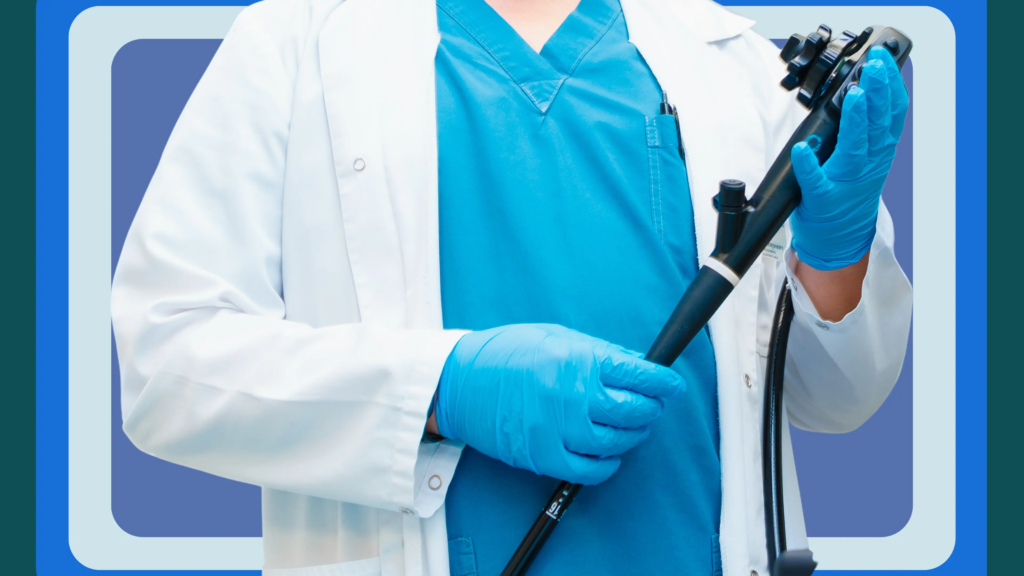
While no medical procedure is fun, exactly, some can feel more intimidating than others. Root canals and mammograms may make the shortlist, but at the very top is the colonoscopy, a routine procedure in which a doctor uses a long tube with a tiny camera to examine your colon and rectum.
Although you might get a colonoscopy at any age to diagnose or rule out various gastrointestinal conditions, the American Cancer Society recommends people with an average risk of colorectal cancer start screening at age 45.
If you have no idea what to expect, you’re not alone. “No one wants to talk about their colon health,“ says Dr. Fola May, director of UCLA’s Melvin and Bren Simon Gastroenterology Quality Improvement Program and an assistant professor at UCLA’s David Geffen School of Medicine.
But a colonoscopy doesn’t have to be shrouded in mystery. Here are eight things doctors want you to know about getting one.
Colonoscopies can prevent cancer—not just detect it Colorectal cancer is the third most common cancer in the U.S., with more than 150,000 people expected to be diagnosed in 2026. In people under 50, colorectal cancer is now the leading cause of cancer-related death, with cases rising by about 3% per year since 2011.
Read More: 10 Tricks That Will Make You the Best Listener in the Room
A colonoscopy not only screens for cancer but, in many cases, “can prevent cancer altogether,” May says. During the procedure, doctors are looking to remove polyps—small clumps of cells that form on the lining of the colon or rectum. Polyps are common, particularly as you get older; around 40% of people over 50 will have them. While most are harmless, some have the potential to become malignant over time.
“If we can find polyps and take them out before they even transform into a cancer, we’re preventing people from ever having to hear those words, ‘You have cancer,’” May says.
If a colonoscopy has no concerning findings, adults at average risk typically wait 10 years until the next one. If polyps are removed, the follow-up interval varies depending on the number, size, and type of polyps. You should follow the prep instructions meticulously Your colon and rectum need to be completely empty for the doctor to get the most accurate look. This means you’ll follow a liquid diet the day before your procedure, and then take a colonoscopy prep solution, which will have a strong laxative effect. Read More: 10 Weird Signs You’re Sleep-Deprived
While it’s not exactly pleasant, “you want to do the prep once and do it right,” says Dr. Sreeni Jonnalagadda, a gastroenterologist at Saint Luke’s Hospital Abdominal Transplant and Multispecialty Clinic in Kansas City, Mo. Adhere carefully to the instructions you’ve been given, and call the clinic if you have questions or doubts.
Start preparing days in advance
A few days before your procedure, switch to what’s called a low-residue diet—one free of high-fiber foods like whole grains, fruits, and raw vegetables—which will help minimize the amount of undigested food that lingers in your colon. Stay away from nuts and seeds, which can clog the scope. Eating more lightly than usual can also make the impending “evacuation” a little easier: “What goes in has to come out,” May says.
It’s also important to guard against potential dehydration. May tells her patients to drink an additional liter of water every day starting three days before their procedure. You have options on the liquid diet
A day without solid food might sound awful, but “different people swear by what works for them,” Jonnalagadda says. Clear fruit juices, clear soda, and black tea or coffee are allowed the day before the procedure, along with broth or bouillon for protein.
If you’re desperate to feel like you’re eating something, “many patients find chewing gummy bears provides significant psychological relief from the other aspects of colon cleansing prep,” Jonnalagadda says. Just avoid red, blue, and purple gummies, which can leave a residue that resembles blood. (The same goes for ice pops, Jell-O, and Italian ice.)
Everyone tolerates the prep solution differently
The process of preparing for a colonoscopy is “highly variable,” May says. “I have people who say, ‘It was great, I felt light, I felt clean.’ And then I have people who come in and say, ‘That was the worst night of my life.’”
Read More: The Race to Explain Why More Young Adults Are Getting Cancer
Jonnalagadda advises putting the prep solution in the fridge—the colder it is, the more tolerable it will be —and drinking it through a straw to reduce exposure to the taste buds on your tongue. People often don’t anticipate just how much liquid they’ll have to drink, whether it’s the solution or water afterwards; getting through the volume can be a struggle all its own.
People who suffer from constipation “may want to ask their doctors and say, ‘I tend to run really constipated, do I need a little extra?’” suggests Dr. Uri Ladabaum, who heads the clinical service of the division of gastroenterology and hepatology at Stanford University School of Medicine and is the director of the Gastrointestinal Cancer Prevention Program.
Once the solution takes effect, prepare to get intimately acquainted with your toilet. Jonnalagadda advises stocking up on medicated moisturized wipes to avoid soreness.
You probably won’t remember the procedure While prep is intensive, and there can be some waiting both before and after the colonoscopy, “your procedure itself is probably only about 30 minutes,” May says.
Though you can choose to be completely awake or under a mild sedative, the vast majority of patients in the U.S. are given deep sedation that effectively puts them to sleep.
Read More: 8 Signs You’re the Problem in Your Arguments
“Most of the time, you’ll go through the procedure like, ‘Oh my God, was that it?’” Ladabaum says. “The sedation is so good and the recovery is not a big deal. And people are like, ‘Wow, I worried more than I needed to.’”
It’s just another day at the office for your doctor
Patients are often embarrassed by the nature of the exam, Jonnalagadda says. But it helps to remember that your doctor is a medical professional who has done hundreds or thousands of colonoscopies. “I say, ‘We do this all morning and all afternoon in here,’” May says. Everyone, at some point, should be screened for colorectal cancer, she adds, and the procedure, while it might feel awkward, is a small price to pay for peace of mind.
Don’t feel bad if you’ve put it off—just do it If you’ve delayed your colonoscopy, try to get back on track as soon as possible, Ladabaum says. “Number one: don’t feel guilty about it. Number two: don’t freak out. Number three: don’t get the wrong message, which is, ‘Oh, I don’t need it,’” he says. “The whole point of screening is we are looking for disease when it’s not symptomatic to try to prevent bad things from happening.”
The post 8 Things Doctors Want You to Know Before Your Colonoscopy appeared first on TIME.