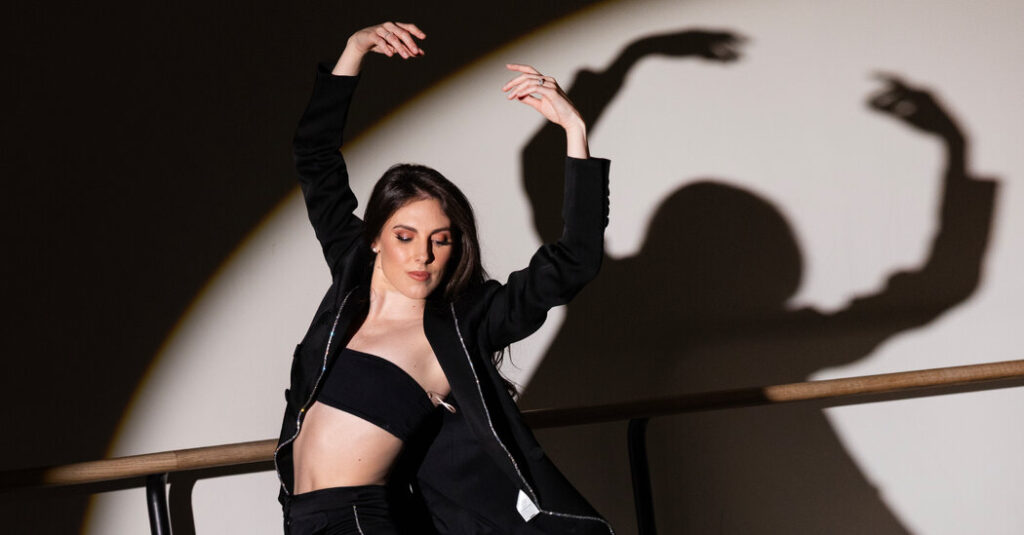
Tiler Peck has been thinking about George Balanchine a lot lately. It’s not a stretch. He was the founding choreographer of New York City Ballet, where Peck has danced for 22 years. She never met Balanchine, but she knows him through his ballets. And no one made ballets like Balanchine, especially the mammoth ones, with rows and rows of dancers stretched across the stage, kicking and spinning toward a synchronized, rapturous finale.
His way of turning chaos into clockwork, of shifting the act of watching ballet to an out-of-body experience, might do a number on a choreographer trying to make a full-scale classical dance at City Ballet. (While grand, last year’s “Paquita,” by Alexei Ratmansky, featured just 16 dancers.) Still, why hasn’t anyone tried? Why don’t choreographers make huge classical ballets anymore?
These are the kinds of questions that obsess Peck, a perpetually sunny ballerina with strong opinions about the state of ballet. A flurry of them came to her mind when she was offered her second commission at City Ballet.
“I started thinking, ‘What do I love about George Balanchine ballets, the big ones that I love to dance in and watch?’” she said. “So much of it is about, to me, the structure. So I started thinking, what is it about ‘Symphony in C’? It’s the movements. It’s kind of old fashioned in a way to do these sorts of structures.”
Newer choreographers might use the same number of principal dancers, but “everybody’s onstage together doing different things,” she said.
Peck wanted to give each of her cast members a full dancing experience. In “Symphonie Espagnole,” her new work for City Ballet premiering Thursday, she has choreographed Édouard Lalo’s five-movement “Symphonie Espagnole” for a cast of 40. In her time with the company, no new classical ballet has been as ambitious as that. Alexei Ratmansky’s “Paquita” (2025), a restaging of the last act of the 19th-century ballet, used 16 dancers.
A classical approach to ballet, as she demonstrated with “Concerto for Two Pianos,” her first for City Ballet, is a lane Peck is making her own. For the new work, she is taking that further.
In the first movement, a couple dances alongside some of the company’s sharpest female technicians; the second (for women) and the third (for men) pave the way for the fourth, a romantic, shimmering pas de deux. The final movement leads to what Peck has long found lacking in new ballets: a heart-stopping finale, with a big crowd of dancers coming together. “It’s like you almost explode because it’s just so much,” she said.
In that classic Balanchine way, she is trying to make clockwork out of chaos.
“I thought that could be really interesting to try and to have another something like that in our repertoire,” she said. “Fill the stage! And this music needs that, and with this many dancers. I mean, it’s almost to the point where I’m like, ‘do we have too many dancers?’”
Will she pull it off? “I think it’s scary, but I’m up for it,” she said. “Like, let’s try.”
Experience shows it’s unwise to underestimate Peck, 37, who in recent years has presented her own group at New York City Center and curated a Jerome Robbins festival at the Joyce Theater. She has coming commissions at Miami City Ballet and Northern Ballet. What started out as casually making dances at her mother’s ballet studio in California is fast becoming a second career as a choreographer.
She knows what she wants. She cuts to the point. At City Ballet, she understands the dancers because she is still a dancer there herself. “I’m in this sort of really sweet spot right now,” she said, “where I know them all so well and the respect on both sides is so deep that I feel that’s what makes the product that much richer.”
Peck can string together steps in ways that enlivens the music and run a rehearsal with efficiency, humor and tough love. “She doesn’t beat around the bush,” the principal Mira Nadon said. “She kind of gives it to you how it is.”
In a rehearsal for the third movement, the men stumbled through double tour jumps to the knee. Peck piped up: “Guys, seriously, do you know how many double tours are in this piece?” she said. “Practice them every single day after class.”
In an early one-on-one rehearsal with Kloe Walker, a promising member of the corps de ballet who will perform the female lead in the second movement — it’s a lush, confident role — Peck pushed her to focus on the subtleties of the in-between steps, not to rush, and, in one instance, to dance with more daring. “Think wild,” she said. “Be sloppy and kick the leg and be a little wild. You can always take it back but I think if you don’t go in with that energy, it kind of dies down.”
Giving younger dancers a shot at bigger roles, along with challenging the corps de ballet to dance big, is part of Peck’s mission for “Symphonie Espagnole.” When she told the men that they wouldn’t be leaving the stage or standing on the side during the third section, in which Roman Mejia is the lead, “They were like, ‘Oh, it’s kind of hard,’” Peck said. “I’m like, ‘Good. Doesn’t that feel good?’”
But during the process, Peck has had to pivot. She originally cast Sara Mearns in the seamless fourth movement pas de deux: “It needs a ballerina that has depth, but not trying to emote,” Peck said. “Just being.”
After Mearns pulled out of the spring season to recover from an injury, Peck was, as she put it, bummed. But she saw it as a way to give a less experienced dancer a great opportunity. Nadon will dance Mearns’s part with Ryan Tomash in the first cast and Peck chose Ruby Lister, a corps member, to perform it in the second cast opposite Chun Wai Chan.
Some dancers learn and remember movement quickly; others don’t. “Ruby takes a longer time to get to the place,” Peck said. “I was like if I just put in the work — and I’m with Ruby every single day — it’s so much more exceptional than somebody who can just do it right away.”
Peck is working on adjusting her own tendencies, too. Before, if a cast member didn’t grasp her choreography right away, she had the tendency to scrap it. “I’m getting better at letting the dancers sit with it for a day before changing it. I don’t have much patience, so it’s really good for me. I see that everybody has a different style of learning.”
When Peck was first considering music, she was looking for a composition with movements and a finale — like Bizet’s “Symphony in C.” She is drawn naturally to piano pieces, but after working with the violinist Hilary Hahn, Peck wanted to branch out. When she discovered the Lalo, her first thought was “Has it been done before?” she said. “How has this not been? It’s very danceable.”
Hahn will perform with the orchestra for select performances, including the premiere. (The violinist Tai Murray will perform on May 9 and 12.) It will be Hahn’s first time playing “Symphonie Espagnole,” a piece she was preparing before the pandemic led to canceled performances. “When Tiler told me that she had picked it, I was like, Whoa!” she said. “I immediately could hear the ballet in it.”
She’s gratified that it is getting a new interpretation. “When it’s visually presented, it gets a new life,” Hahn said.
Peck senses emotion — nuance, breath, where a body can pause or quicken — through the music. There are snaps and claps throughout, rhythmic additions that for her, help to draw out or enhance the sound. But it’s not always predictable. In the male dominated third movement, which has the most Spanish flavor, Peck leaned into the softness of the music.
She likes to see men move with strength, but also with fluidity. The arms in “Symphonie Espagnole” call for an expansive port de bras; sometimes they swirl above the head allowing the hips to melt, lending a different shape to the body.
It’s a subtly different approach, as are her ideas about the costumes. At the start, the designer Robert Perdziola asked Peck if she was thinking about having the color scheme be red and black. That was a firm no.
“It might be called ‘Symphonie Espagnole,’” she said, “but I want the dancing and the style to come out within itself.”
And to Peck, each movement of the ballet exists in a different world. “Immediately, I was like, the first movement is a tutu ballet,” Peck said. “But then the second and fourth, which have women in them, do not feel that way.”
As the ballet progresses, the dancers wear dresses that fall and whirl around the knee. Just as Peck can’t recall the creation of a big classical ballet in the time she’s been in the company, she can’t cite an instance in which a ballet featured both tutus and chiffon skirts converging in a finale.
“There’s no rule that it can’t be done,” she said. “This is what I want to do and this is what’s going to be. I welcome the change.”
Gia Kourlas is the dance critic for The Times. She writes reviews, essays and feature articles and works on a range of stories.
The post ‘Fill the Stage!’ Tiler Peck Says It’s Time for Ballet to Go Big appeared first on New York Times.