It was just over three decades ago that the Hall of Fame third baseman Wade Boggs did something remarkable, possibly unmatched in baseball history. For much of his career, Boggs’s routine for bouncing back after games — his preferred postgame recovery modality, in the parlance of modern sports science — was pounding cans of Miller Lite. And according to Boggs, during one flight from Boston to Los Angeles in 1994 (or possibly 1992 or 1989; the dates are understandably fuzzy) he drank 73 beers.
Boggs was in his mid-30s at the time and still reliably batting well over .300, which would be exceptional even for a pro player in his late-20s physical prime, but he was also playing in a different era. Suffice it to say that in modern baseball — a power game predicated on tape-measure home runs and 100-mile-per-hour fastballs — there’s no way Boggs would bat above .300 at an advanced age with 73-beer hangovers. Pro athletes now, especially older ones, are more like round-the-clock recovery droids who occasionally play sports. They’re not guzzling Miller Lites on those cross-country flights; they’re drinking cherry juice for the melatonin to get ahead of the jet lag and wearing Normatec compression sleeves on both legs to stimulate lymphatic drainage and reduce inflammation.
Sports history is dotted with Darwinian anomalies like Tom Brady, winning a playoff game at 44, or Nolan Ryan, firing a no-hitter at 44, or Dara Torres, swimming to an Olympic silver medal at 41. But their rarity was part of what made them so compelling. What’s so compelling now is the sheer number of still golden oldies. This February, at the Winter Olympics, two athletes over 40 won gold medals. A few months before that, Lindsey Vonn, 41, won — dominated — a World Cup ski race six years after retiring from the sport because of chronic knee pain. Last season, three 40-plus quarterbacks — Aaron Rodgers, 41, Joe Flacco, 41, and Philip Rivers, 44 — started N.F.L. games. Nick Folk is coming off the three most accurate field-goal-kicking seasons of his 18-year career at age 41 — about a decade and a half older than the average N.F.L. player. Just days before pitcher Justin Verlander turned 43 in February, he signed a one-year, $13 million deal with the Detroit Tigers, the team that drafted him in 2004. LeBron James, 41, played 206 minutes this season alongside his son Bronny, 21.
All pro athletes eventually reckon with their sports mortality and shift into career-extension mode, but that shift is happening earlier than ever. So many players have succeeded in blowing past the old biological limits that the maniacal pursuit of self-optimization has become routine for athletes of all ages. New technologies and techniques have revolutionized sports medicine, from surgical intervention to nutrition to mental health, even as some of these strategies feel more sci-fi than scientific.
Partly what’s driving the changes is the size of the fortunes at stake. The typical salary for an N.B.A. player is now close to $12 million a year. Career reserves — not just the stars — often employ their own trainers, dietitians, chefs and assortments of recovery gizmos. When a member of James’s inner circle claimed in 2018 that James was spending about $1.5 million a year on caring for his body, it accelerated an arms race across sports, helping to power a consumer-tech boom that has already trickled down to the $314 billion market for wearable devices that track things like sleep and heart rate.
In 1994, Boggs’s salary was $3.1 million; over the course of his 18-year career, he made about $32 million. Now consider the San Francisco Giants’ All-Star third baseman Matt Chapman — same position as Boggs, broke into the majors less than 20 years after Boggs retired. Chapman, 33, is in Year 2 of a six-year, $151 million contract that will end when he’s 37, and he is already conditioning his body to play at 38 and beyond. “I do want to play after this contract,” he told me.
This infusion of money is also enabling women to play longer than ever. Dallas Wings forward Alysha Clark, who, at 38, is currently the W.N.B.A.’s oldest player, made a salary of $34,000 in 2012, her first year in the league. Thanks to the W.N.B.A.’s new $200 million annual broadcast TV deal, she will make $300,000 for the 2026 season, allowing her to spend more money on her body. Clark told me that at the start of her career, “it was like, Yeah, ice helps. And if you get in the cold tub, you’re good.” Today, she describes her recovery routine as a nine-step process.
Alysha Clark, 38, W.N.B.A., Dallas Wings forward
It’s fun to imagine trying to explain lymphatic drainage to Boggs halfway through his 60th Miller Lite. Even when Chapman was a rookie in 2017, “you didn’t want to be in the training room or doing recovery stuff,” he said. “You wanted to stay away from that place.”
The training room used to be for the vets, says Texas Rangers outfielder Andrew McCutchen, 39. Now McCutchen is the vet in the training room, and he keeps noticing how much more crowded it is. He told me about one memory from a few years ago, back when he was in Milwaukee, and the Brewers called up a top prospect for his major league debut. McCutchen always worked with a specific trainer at a specific time. But that day, he showed up, “and guess who’s on the table?” he said. “It’s that rookie.” The kid wasn’t hurt — he was just getting his regular treatment.
You don’t go from the Boggs mentality to the Chapman approach in less than a generation without a profound psychological shift across sports. So what’s really happening inside those training rooms and on surgical tables and at the private gyms in athletes’ multimillion-dollar homes? What else are players and their teams spending their money on, besides compression sleeves and cherry juice? What do they know that we don’t?
Data
After Wade Boggs’s retirement in 1999 and before Matt Chapman’s rookie season in 2017, a few things changed. The internet blew up. “Moneyball” was published. First the data revolution reinvented the way games were played, then it reinvented how franchises built their rosters and competed for titles. Now we’re at the dawn of its application to the far murkier arena of athlete health, recovery and injury prevention. Today’s pros are awash in data, and the ones who learn to sort out the signals from the noise stand the best chance of prolonging their careers.
Most of that data is still noise. “Just because you can measure it” — using wearable devices, for example — “doesn’t mean it’s meaningful, durable, that kind of thing,” says Dr. Michael Joyner, a specialist in the physiology of elite athletes at the Mayo Clinic. The most useful data so far, he says, speaking for himself and not the clinic, relates to “load management”: monitoring exertion, particularly by older players, to reduce the risk of fatigue-related, noncontact injuries. In other words, using data to help determine “how many pitches somebody’s going to pitch, how many minutes a game they’re going to play.”
Since 2021, the N.B.A. has run an in-house incubator called Launchpad that collaborates annually with five small start-ups whose projects might prove useful to the league — an A.I. tool to track officiating, say, or a device that converts gameplay into haptics for sight-impaired fans. One member of Launchpad’s 2023 class, a data analytics company called Springbok, had a novel idea for a familiar technology: the M.R.I. Such imaging is typically used to diagnose soft-tissue injuries, like muscle tears. But what if M.R.I. data could help prevent them? A single scan may not reveal much, but take enough scans over time and you have a comprehensive biography of an athlete’s evolving body, including all the ups and downs of damage, recovery and aging. Patterns would emerge, says Dr. John DiFiori, the N.B.A.’s director of sports medicine. Deviations become easier to detect. And asymmetries, he explains, “create a predisposition to injury.” Springbok’s approach is to take all that M.R.I. data and quantify it, which is to say give muscles a score. If scores go up or down too much, it might be time to take corrective action.
As part of the effort to collect joint and muscle data, every single N.B.A. player, from LeBron to Bronny, now takes a brief “biomechanical assessment” up to four times a year. The assessment room I visited, at the Brooklyn Nets facility, looked like a miniature Marvel movie set — bright space, blank walls, a ring of cameras to capture motion — only this room had two “force plates” built into the floor that help measure applied muscle force.
The assessment covers seven simple movements — various lunges, jumps and timed balances — and produces a player score relative to the rest of the league and the player’s own history. The report also includes “jump” and “landing strategy” metrics that chart the distribution of force across a player’s hips, knees and ankles, and it translates arcana like “max ankle dorsification angle” into the lingua franca of basketball: “how small your ankle angle can get like when you get low on a quick first step.” The file, which a player can access throughout his career, regardless of team, is meant to give him information about how hard he can push his body — and, just as critically, when it’s time to ease off.
“When you’re younger, there’s days you can take as many — for us — baseball swings as you want,” New York Yankees first baseman Paul Goldschmidt, who is 38, told me. We were talking in mid-February at the team’s spring training facility in Tampa, Fla., as he was getting ready for eight straight months of baseball. “As you get older, there’s times when rest is more important than work.”
For some athletes, the right biometric data presented in the right context represents “permission to rest,” says Ana Montero, a co-founder of Atlas, a San Francisco-based company that makes brain-wave-scanning, behind-the-ear wearables about the size of Mentos candies. “It’s quantifiable evidence that is showing you: Dude, today — or right now — is not the day. Go to the gym, go for a walk, go for whatever it is. And then coming back and actually seeing that you’ve bounced back.”
The Atlas device gathers several types of data, including electroencephalography, or EEG, which measures electrical activity in the brain, and galvanic skin response, or G.S.R., which is what a polygraph test measures. That data is sorted into five categories (among them agility, vitality and stress) and then delivered with advice through a smartphone app.
“There’s always some noise in brain activity because neurons are not perfect chips or transistors,” André Marques-Smith, Atlas’s other co-founder, says. “So mistakes get made.” He adds that what causes neurons to lose their precision are things that we’re all familiar with: fatigue, stress, anxiety, hunger, aging. Tom Ryan, the N.B.A.’s senior vice president of basketball strategy, says Launchpad chose Atlas because it was eager to find a device that collected this sort of data in real time. If it works the way it’s supposed to, then a vet like Goldschmidt will know exactly when he’s good for some extra batting practice and when he should take a nap instead.
Recovery Tech
The Ammortal Chamber sounds like something out of “Harry Potter” fan fiction, but the first time I heard about it was in an anxious N.F.L. gossip post on Instagram last August about Los Angeles Rams quarterback Matthew Stafford, his achy 37-year-old lower back and a mysterious silver Airstream trailer that he kept vanishing into at the Rams’ training facility. The team entered the season with Super Bowl ambitions, so it was leaguewide news that their aging quarterback was nursing a herniated disk before he had taken a single hit.
“They bring in this bazillion-dollar life — life — trailer,” the ESPN talk show host Pat McAfee stammered during a segment about it. “That seems like a red flag,” one of McAfee’s sidekicks chimed in. Another sidekick asked, “What’s he doing in there?”
Fast forward six months: On Feb. 5, two days before his 38th birthday, Stafford was named the league’s M.V.P., making him the oldest first-time winner of the award in N.F.L. history. “Now I’m not going to sit here and pretend like it healed his back,” the Rams head coach, Sean McVay, told me during a phone call a few weeks later, “but it was definitely a good recovery thing for him. And shoot, I purchased one for my own home, is how highly I think of it.”
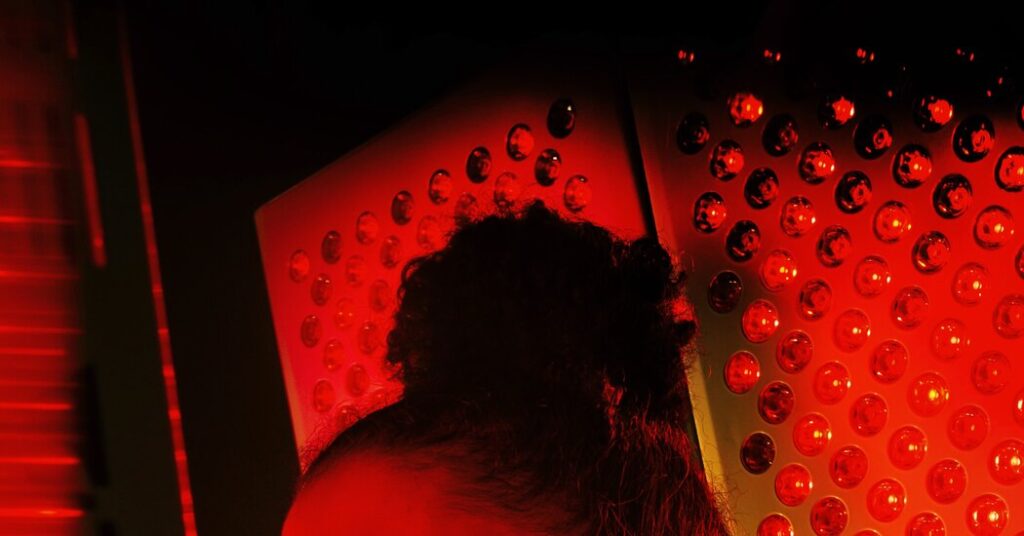
McVay described the Ammortal Chamber, which costs $159,500, as “a human-charging station that levels up the body and mind.” It looks like a prop from the android-printing lab in HBO’s “Westworld” — a translucent bed floating inside a giant waffle iron. (You’re the waffle.) For older athletes, whose bodies are more brittle and recover more slowly, the tool offers something invaluable: time. How do you pack 48 hours of recovery into a 24-hour day? By doing five things at once: (1) red-light and (2) multiwave pulsed electric field and pulsed electromagnetic field therapies, which are supposed to help with cell regeneration, tissue healing and inflammation reduction; (3) vibroacoustics (zapping the body with low-frequency sound waves to relieve stress and enhance mood); (4) molecular hydrogen (an antioxidant said to reduce inflammation) inhaled through a nasal cannula; and (5) voice-guided meditation.
For athletes who spend lots of time in high-stress, fight-or-flight situations, the Ammortal Chamber’s sensorial immersion is supposed to help the body return to a natural parasympathetic state — which is a fancy way of saying it helps them chill out and start healing. About 15 pro athletes, including the M.V.P. first baseman Freddie Freeman and the All-Pro tight end George Kittle, have Ammortal Chambers at home. The Seattle Seahawks brought one to the Super Bowl in February.
None of the contraption’s so-called modalities are especially radical. “There is a known, scientifically proven biologic effect of each one of those things,” Dr. Neal ElAttrache, an orthopedic surgeon at a Cedars-Sinai hospital in Los Angeles, told me. What’s lacking, he says, are studies that capture just how beneficial they are. “That’s where the gap is in the science.”
But star athletes don’t have time to wait for the peer-review process, so even if some of the benefits are psychosomatic at best, nearly all the players I spoke with got a twinkle in their eye at the mention of some particularly beloved recovery toy. Clark told me her current pregame default is the Haelo, a $3,300 pulsed electromagnetic field therapy tool shaped like a vinyl record that you strap around your midsection before selecting a “frequency set” to aid with digestion, inflammation and mental clarity. (“You can feel it, but on a deep, internal level,” she says. “You can feel something, like, change.”)
All these elaborate new devices aren’t much use, though, if they’re locked up overnight at a team facility. They’ve got to be accessible at home, too, and for pro athletes, home changes a lot. Sometimes they get traded in the middle of a season. Joe McLean, a managing partner at MAI Capital, a wealth management firm with many superstar clients, told me he had the install and uninstall routine for home-recovery kits down to a science. “Most of these products they’re using, we have a direct relationship with the owner of the company,” he told me. “And so they’re coming in and removing the sauna, the plunge, the sleep chambers, and getting that all set up in the next destination.” Is that next destination a massive home or a temporary condo? Are there children? “I need to make sure I can get all this equipment in there. It’s expensive, and at the same time, it happens overnight.”
Hilary Knight, 36, captain of the U.S. women’s Olympic hockey team and the Seattle Torrent
The hockey gold medalist Hilary Knight, who turns 37 in July and was the oldest player on this year’s U.S. women’s Olympic team, says recovery tech was “nonexistent” during her college career. Now, when she’s awake, “I’m either warming up or cooling down with some sort of device, for sure.” Knight and Brittany Bowe, 38, her fiancée and an Olympic speedskater, recently splurged on a red-light sauna for their home, but Knight told me this was a compromise. “I lost the battle,” she says. “I wanted a Finnish sauna” — traditional, hard core. A former Finnish teammate kept pushing her to get one. For now, though, Knight and Bowe are on the budget of a one-sauna household.
If Knight had unlimited funds, she says, at the very top of her wish list would be a hard-shell hyperbaric oxygen chamber, which delivers oxygen at air-pressure levels significantly greater than normal, saturating the blood with oxygen, stimulating cell regeneration and reducing inflammation. The evidence for hyperbaric oxygen chambers as a recovery tool is mixed, but the lure is understandable: LeBron James and Novak Djokovic, 38, are among the athletes known to use them. Sticker price: around $60,000.
Sleep
Nick Folk, who recently signed a two-year, $9 million deal with the Atlanta Falcons that will pay him to kick field goals in the N.F.L. at least until he’s 43, can vividly recall the first time he was summoned to a team meeting about sleep. This was in 2015, during his first stint with the New York Jets, when it was their turn to play in the N.F.L.’s annual game in London, the league’s only regular-season matchup outside the U.S. at the time. Out were the days of late-night clubbing and 73-beer flights; in came the era of portable hyperbaric chambers, wearable sleep trackers and experts in “chronobiology,” which examines the impact of things like jet lag, sleep deprivation and biorhythms. “They had a sleep doctor come in,” Folk says, to school them on the importance of “sleep hygiene.”
In the rush to globalize their sports, pro leagues are sending their teams farther and farther afield, more and more frequently, all but sentencing their athletes to disordered sleep. For the 2026-27 season, the N.F.L. has scheduled nine international games on four continents. The Rams will open the season against the San Francisco 49ers in Australia. At least N.F.L. teams play only once a week, and primarily on Sundays. N.B.A. teams play three or four games per week and typically fly about 40,000 miles per season, about 20,000 more than N.F.L. teams do.
Nick Folk, 41, N.F.L., Atlanta Falcons place-kicker
No surprise, then, that the N.B.A. is so curious about the potential of something like Atlas. Older players, in particular, need all the quality sleep they can get because of its critical role in controlling inflammation, which is the body’s natural healing process of bringing nutrients to the site of injury or depletion, in the form of swelling. This process slows down as we age. The best way to speed it up, still unsurpassed after all these years of science and innovation, is sleep.
“There’s a deterioration that comes over time if you’re continually starving yourself of the appropriate recovery via sleep,” says Marco Zucconi, the director of player health, wellness and performance for the Los Angeles Chargers. That’s why he’s insistent with players about improving their sleep hygiene, especially during the all-critical two hours before bedtime. Can they make that bedtime early and consistent? Can they take a warm shower or bath first? Limit their screen time? Turn down the room temperature a few degrees? “You can spend hundreds of thousands of dollars on red-light beds and hyperbaric chambers and boots and pools and oxygen therapy and IV therapy,” Zucconi says. “But if you don’t get the simple thing of sleep correct, then you’re leaving out one of the foundational pieces that will let all of those other things work.”
If only it were so simple, though. Two months before she won an Olympic gold medal as a solo bobsledder, Elana Meyers Taylor, 41, texted her husband before dawn from her hotel room during a competition in Norway that she wanted to quit. The back issues she’d been dealing with since she was 13 were killing her. Her two jet-lagged little boys, Nico, 5, and Noah, 3, would not let her get a minute of rest. “I was just like, This is impossible, this is just crazy,” she told me.
She needed help, but her sons were born deaf, which made it more challenging to find the right person. So her husband, Nic Taylor, a licensed chiropractor and a strength-and-conditioning coach who works with several N.B.A. players, got on the next plane out of Texas. He took care of the boys while she crashed. A couple of days later, she was sleep-restored and her body was competition ready. “He got me back in the right mind-set,” she says.
Elana Meyers Taylor, 41, American Olympic bobsledder
Diet
For a glimpse into how the nutritional habits of pro athletes have evolved in barely a generation, consider Wade Boggs again. His diet also achieved fame, because he ate chicken before every game, preferably his wife’s fried chicken. This was about superstition more than nutrition, really, but it wasn’t as ill advised as it might sound, Michael Joyner of the Mayo Clinic told me. It was consistent — so Boggs’s body was clearly accustomed to it — and it was protein. In those days, the prevailing notion was, as Joyner puts it, “If the furnace was hot enough, anything would burn.” Just pack in proteins — any proteins, any time.
Protein consumption is merely one example of how complex and meticulously managed the diet of your average pro athlete has become: The guidance is not only about how much but also which kinds and when. “What’s changed is that it’s more important to eat a variety of proteins throughout the day,” Nic Taylor told me in an email, because the body absorbs some types of proteins faster than others. Dairy proteins, like Greek yogurt, are slow movers and ideal for long recovery stretches. “Great before bed, horrible right before a race,” he said. Chicken, beef and fish work a bit faster, but pregame chicken doesn’t break down fast enough to be of much metabolic use (though this didn’t seem to hold Boggs back). What’s absorbed fastest are what Taylor called the “ooeys and gooeys” — everything from performance gels to whey isolate powders to those postworkout drinks on sale at the gas station.
Alysha Clark, of the W.N.B.A., is an avid cook, proud to the point of posting clips of her handiwork on Instagram. She only recently surrendered and added a nutritionist to her retinue. Her nutritionist had her log her precise food intake for three days, put her through food-sensitivity testing to root out foods that upset her stomach or caused inflammation and gave her a cortisol test to better understand her daily biorhythms. And Clark quickly learned that she was consuming her proteins all wrong. Already she had noticed that she was losing muscle mass late in her seasons and wearing down more easily, and it turned out that part of the issue was her protein intake: She wasn’t getting enough, and the protein she was getting was coming at the wrong times.
All that poking and prodding and log-keeping led Clark to add more protein at breakfast and during between-meal snacks. “My main meals were already well balanced,” she says, “but my protein intake between meals needed improvement.” She’ll find out this season if the new approaches help.
“When I started doing this, we would maybe consult a nutritionist on occasion,” says Rick Celebrini, the vice president of player health and performance for the Golden State Warriors, a team whose preferred starting lineup last season featured Steph Curry, 38, Draymond Green, 36, Jimmy Butler, 36, and Al Horford, 39. Now nearly every team in the league has a diet and nutrition staff. For the Warriors, that staff provides “not just the quote-unquote ‘fueling for sport’ — it’s the whole meal planning,” he says, from their menus in the morning to the supplements in their smoothies. Celebrini’s best friend in sports is the basketball Hall of Famer Steve Nash, who was a pioneer during his prime in the 2000s for avoiding processed foods and prioritizing grass-fed beef and healthy fats. “He’s still fanatic about it,” Celebrini says. Now the league’s players are, too.
Andrew McCutchen, 39, M.L.B., Texas Rangers outfielder
Surgery
When the world last saw Lindsey Vonn on skis, in February, she was being airlifted off the Olympic downhill course in Cortina, Italy, with a shattered left tibia that nearly required amputation. Two months later, she was out of a wheelchair and getting around on crutches back in Los Angeles. “I’m feeling more myself,” she told me over a video call. “It’s taken a while to get here, but I have makeup on; I’m not in my sweatpants. I feel more human.”
Vonn has had 17 major procedures over the course of her career, five alone after her recent crash at the Olympics, and at least one more to go. But arguably none were more consequential than her partial knee replacement in the spring of 2024, when she was already nearly five years into retirement. “The last four or five years of my career, I wasn’t able to do most of the things that everyone else was able to do,” she said. Even off the mountain, the pain was unrelenting. She had three more knee surgeries after she retired to manage it. “I wanted to live a full life,” she said, “and my knee was not allowing me to do that.”
It’s hard to sell pro athletes on a knee replacement. “There’s a stigma,” Vonn said. “Knee replacements are for old people.” Which, generally speaking, is true. But she was desperate. Not to race again on skiing’s World Cup circuit — that was the furthest thing from her mind. “I wanted to play tennis.”
The robotic-arm-assisted technology used by Dr. Martin Roche at the Hospital for Special Surgery in West Palm Beach, Fla., enabled him to scan her knee, remove the damaged bone in a minimally invasive way and then seal all the cracks and pockets with titanium implants. The robots keep getting more precise, and the titanium keeps getting more durable, but the real breakthrough was using the technique on a pro athlete in the first place. A few months later, during physical therapy, Vonn did a single-leg box jump on her right leg, and “I cried because I hadn’t done that in 10 years,” she said.
In 2023, four plays into his season, Aaron Rodgers, then 39, tore his Achilles’ tendon. He was right back out on the field the next season. As recently as a decade ago, if Rodgers had torn his Achilles at 39, or if Vonn had worn out her knee by 33, they would have received the same medical advice: Enjoy your retirement! The mere fact that they chose surgery reflects a growing faith in what’s possible. When Clark was 33, she tore her Lisfranc ligament in the middle of her foot — another tricky basketball injury — and “there was definitely a part of me that was like, Oh, this might be a wrap,” she told me. In high school, though, she had already come back from the same kind of hip injury that ended Bo Jackson’s football career when he was just 28. “We believe bigger now,” she says.
“We’re better and better at fixing them when they break, there’s no question about that,” said ElAttrache, the surgeon who repaired Rodgers’s Achilles and is arguably the sports world’s foremost fixer of broken bodies. He was calling from the road in the Florida Everglades, on his annual swing through M.L.B.’s spring training camps to check on some of the priceless elbows he has recently reconstructed, including ones attached to Gerrit Cole, the New York Yankees’ ace, and Shohei Ohtani, the Los Angeles Dodgers’ two-way sensation. “And if they do break, we’re not wasting any time. We’re getting to it sooner and with better techniques.”
Lindsey Vonn, 41, American Olympic alpine skier
ElAttrache is one of a handful of orthopedic surgeons who have helped turn the Achilles tear into just another injury that ends a season, not a career. The Achilles “tears like a mop,” ElAttrache said. “It doesn’t tear like two ends of a rope.” Each tendon fiber must be sewn back together at a precise resting level of tension. A key element of his innovation was to add a second set of sutures, bypassing the injury and often anchored to the heel bone, to stabilize the healing tendon once athletes get back on their feet about two weeks after the procedure. Then they relearn to walk and run on an anti-gravity treadmill, dialing down their body weight until their gait is perfectly symmetrical. The goal is to reach 12 weeks postsurgery with the tendon “at least as tight, if not a few degrees tighter than normal,” he said.
For M.L.B. pitchers, ElAttrache said, the next frontier for career longevity is mastering the “revision surgery” — a second reconstructive elbow surgery. Ohtani tore his ulnar collateral ligament for the second time in 2023 and, after a second procedure that summer, returned to become the first two-timer to win an M.V.P. Such revisions “used to have dismal results,” ElAttrache said. “About one out of three would return to professional baseball.” Now the success rate approaches that of the primary operation.
“We used to say, ‘Let’s try to get you back to play a year or two and then retire,’” says Dr. Richard Ferkel, the orthopedic surgeon who repaired Klay Thompson’s torn Achilles in 2020 and then watched him win another N.B.A. title with the Golden State Warriors less than three years later. “Now we don’t even discuss retirement. We discuss, How long is it going to take for them to get back? And when can they sign a new contract?”
According to Forbes, Vonn made $8 million in 2025, though a vast majority of that sum came from endorsements and not from competition. That career-rejuvenating new knee wasn’t cheap, and she intends to get her money’s worth from it. Even now, even after all she’s been through this year, even after nearly losing her leg, Vonn told me she had not ruled out returning to World Cup competition or, for that matter, making a run at the 2030 Winter Games, when she’ll be 45. “If I’m honest, I really think that if I’m healthy, I could probably ski in the next Olympics.”
Devin Gordon is a contributing writer for the magazine. His work explores the intersection of sports and popular culture.
Dina Litovsky is a Ukrainian-born photographer in New York. Her work explores the idea of leisure, often focusing on subcultures and social gatherings.
The post The Longevity Secrets Helping Athletes Blow Past the Limits of Age appeared first on New York Times.