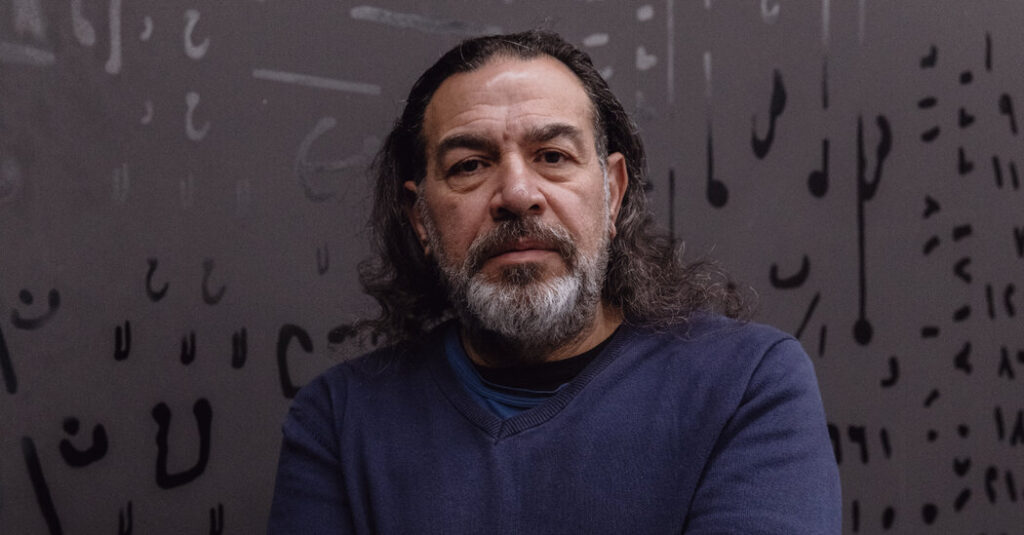
“This work comes from an inner place, it’s about love of humanity,” the artist Khaled Sabsabi said in his studio in the suburbs of Western Sydney, Australia, about 25 miles from the crests of the Sydney Opera House. “We are living in uncertain times, so what else is there but to come from a place of love?”
It was a February morning, and in a few weeks, he and his curator Michael Dagostino would fly to Italy to install two works at the 61st Venice Biennale, one as Australia’s official representative in its national pavilion, and a second in the Biennale’s vast main exhibition. Sabsabi is the first Australian artist to appear in both in the event’s 130-year history.
A year ago, none of this seemed certain.
Sabsabi, who was born in Lebanon, made headlines last year after being appointed to represent Australia by the country’s chief arts funding body, Creative Australia. But the commission was withdrawn six days later, after his appointment was criticized by conservative commentators and politicians who claimed his work incited division and supported terrorism.
The curator of the Biennale’s main exhibition, Koyo Kouoh — before she died from cancer last May — invited Sabsabi and Dagostino to present the intended work in the main exhibition, “In Minor Keys,” instead. It took an outcry from the arts community and an independent review before the pair were reinstated as Australia’s official representatives.
Over cups of tea sweetened with cinnamon, the artist and curator recalled the painful period. “We knew the work would find a way into the world, and there was support from the Biennale, but it was still deeply traumatic,” said Dagostino, who has worked with Sabsabi for 28 years.
Sabsabi said they weren’t angry but surprised and saddened, adding that he lost 13 pounds in a week. “The easy answer would have been not to take it back on,” he said, admitting he considered rejecting the re-offered job. “But art is an invitation to have conversations.”
Sabsabi, 60, is regarded as one of Australia’s most significant contemporary artists, known for immersive installations that combine video, sound, painting, photography and sculpture. Themes of migration, spirituality and conflict run through his work, which is informed largely by his own biography and beliefs. He described the pieces heading to Venice as being “about existence and coexistence,” and an invitation to “contemplate our collective humanity.”
In his studio, which is a converted suburban home garage, there was little evidence of the magnitude of these works, which had components completed in a studio in Bangkok, but there were clues that a multimedia artist was at work. On a desk was audio equipment; cupboards held hundreds of CDs and more audio machines; and stacked shoe boxes contained small paintings on photographs, 6 by 4 inches.
Sabsabi has been making art from this garage for more than 30 years, in a neighborhood where about 73 percent of residents speak a first language other than English, according to Australian census figures. Gesturing toward the houses on either side, Sabsabi listed their backgrounds: Syrian, Kurdish, Greek, Thai. “My community is what grounds me and my work,” said the artist.
Before Western Sydney, there was Lebanon, where Sabsabi was born in 1965 in Tripoli. During his childhood, the Lebanese Civil War broke out, causing his family to flee to makeshift shelters under buildings, “for hours at a time, sometimes days,” Sabsabi recalled. More than 120,000 people, mostly civilians, were killed in the conflict. That experience became the foundation of his first major installation, at the Casula Powerhouse Arts Centre in Western Sydney in 1998.
“Aajyna,” a work that year, drew on a memory of sheltering in a basement during a bombardment, watching the walls, which were covered in dark smears from seeping water and debris, that, to a child, looked like coffee. In the work, a canvas is covered in Lebanese coffee recalling those walls, while 75 small speakers on the floor rumble, mirroring the sounds of bombardment.
Sabsabi and Dagostino first met during the installation of that work. Dagostino would go on to become one of the region’s most respected art leaders. “Installation was just coming into its own,” said Dagostino, who has a mane of salt-and pepper-hair, “and Khaled had this amazing sense of how to use space.”
Sabsabi was 11 when he arrived in Western Sydney in 1976, a region transformed by the dismantling of the White Australia policy — federal laws in force from 1901 that restricted non-European immigration. Despite the dismantling, it was still difficult terrain to navigate for a migrant child. “Within days of starting school, I witnessed and suffered racism, from teachers and from students,” Sabsabi said. The cane was still in use too. “I used to get it often,” Sabsabi said. “I’d just go, here we go again.”
As a teenager, music captured him, first through his parents’ shop, which sold classical Arabic recordings, then through hip-hop, which arrived on the continent via mixtapes and visiting D.J.s. Sabsabi was taken with its message of social justice, inclusion and solidarity: “It said that community was powerful, that we can hold ourselves,” he said.
In the late 1980s and ’90s, Sabsabi would carve out his own hip-hop career, performing under the name Peacefender and backing up Beastie Boys and Ice Cube on tours. Increasingly interested in music and film, he enrolled in a master’s degree program at the University of New South Wales in 1999. Sampling, layering and atmosphere naturally migrated to his visual practice. “Sound remains the essence for me, and it almost always comes first,” he said. He will often paint while listening to anything from classical Arabic to the Weeknd, to Prince, whom he counts among his heroes. “To me, the man is an enlightened one.”
Sabsabi is a follower of Tasawwuf, known in the West as Sufism, the mystical dimension of Islam that emphasizes the individual’s inner journey toward the Divine. He has spoken about how a trip to Tripoli in 2002 ended up being a spiritual quest when he met his Tasawwuf teacher, resulting in nearly a decade of study across Turkey, Lebanon, Syria and Morocco and some deep self-reflection. “It took me approximately nine years until I felt I had a very minor understanding to start exploring these ideas in my work,” he said.
In both pieces at the Biennale, audiences are invited to engage with Sufi-inspired works. “Conference of Oneself,” in the Australian Pavilion, is based on the 12th-century Sufi allegorical poem “The Conference of the Birds” by the Persian poet Farid ud-Din Attar. in the poem, all the world’s different birds set out on a quest to find a mythical Kingbird. That artwork, and both of Sabsabi’s Venice works, suggest global coexistence and unity require personal self-reflection and connection with others.
The idea for the Pavilion took place in the Sydney studio and at the American Academy in Rome, where Sabsabi spent several months in 2024 on a fellowship, and where he would walk the city for hours contemplating how societies form, fracture and mend.
Viewers will find eight canvases that form a levitating octagon in a darkened room. The images appear static at first, Sabsabi explained, but a slow video projection drifting across the painting creates a subtle sense of movement. At no point will a visitor see the whole work from one vantage point; they must journey to see it in its entirety.
Layering defines much of Sabsabi’s practice. In the 2014 work “70,000 Veils,” 100 monitors each played their own layered composite of 700 different photographs. In “Conference of Oneself,” a similar process is used, where footage filmed across different places, such as a procession in Lebanon or a football match in Australia, is layered until they are hard to distinguish. Sufi images on the walls will appear and disappear as light moves across it.
“I want the viewer to see something that looks unfamiliar, but then see something they’re more attuned with,” Sabsabi said, “so they’re able to find similarity and familiarity within the work regardless of ethnicity or faith.”
The message of unity stands in contrast to how the artist was portrayed by some in Australia last year.
The controversy centered on two earlier works, including “You,” which was completed in 2007 and featured blurred imagery of Hassan Nasrallah, a former leader of Hezbollah. The work was in the collection of the Museum of Contemporary Art Australia since 2009 without complaint.
After an article in The Australian voiced concerns that the works were divisive, a conservative senator, Claire Chandler, brought the work up in parliament, suggesting it was evidence of Sabsabi promoting terrorism and antisemitism. “With such appalling antisemitism in our country,” Chandler argued, “why is the Albanese government allowing a person who highlights a terrorist leader in his artwork to represent Australia on the international stage at the Venice Biennale?” Creative Australia held a board meeting and revoked the commission.
“In March 2025, Khaled’s career looked in tatters,” Simon Mordant recalled in a phone interview. Mordant, a philanthropist and former Venice Commissioner, publicly resigned as Australian Ambassador for the Biennale the night the commission was revoked. “But he is about to be celebrated as a hero in Venice,” he added.
After a widespread outcry from the arts community, an independent review was held. It ultimately identified missteps in the Creative Australia decision, and the organization apologized to the artist and curator.
Elizabeth Ann Macgregor, who directed the Museum of Contemporary Art Australia for more than two decades and first encountered Sabsabi when he was a community worker, was among the most vocal defenders. “The way he was described, the way they insinuated he was supporting terrorism, it was just despicable,” she said.
“His whole philosophy is about unifying communities and trying to create harmony. It’s how he lives, and that’s how his art is,” Macgregor said. “For those who say we shouldn’t have chosen an artist from the Middle East at this particular point in time, well, if not now, when?”
Mordant, who has long championed Australian artists overseas, sees the episode as part of a wider, troubling pattern. “The arts should be a place where you can have safe discussion and unity and respect, but this is being eroded,” he said. “Look at what’s happening in the United States with the Kennedy Center.”
When Creative Australia first announced that Sabsabi would be Australia’s representative to Venice — Archie Moore, a First Nation artist from Australia, won the Golden Lion in 2024 — Sabsabi told Guardian Australia he was “quite shocked.” “I have applied four times,” he said, “and I felt that, in this time and in this space, this wouldn’t happen because of who I am.”
The prejudices that Sabsabi is attuned to flared again in Australia shortly after our interview. Sydney’s Bondi Beach was the site of the nation’s worst terror attack, which targeted Jewish people at a Hanukkah celebration and left 16 people dead.
In its wake, the nation registered a spike of Islamophobia-related incidents, and a resurgent Australian right-wing politician suggested on national television that there was no such thing as a good Muslim. By the start of the following month, Sabsabi’s birth country was once again at war. The events echoed what Sabsabi felt as a child arriving in Australia: his birth home embroiled in bloody conflict, and the othering he experienced in his new home.
In late March, Sabsabi and Dagostino were busy installing at the Giardini in Venice. Sabsabi was checking in on family and friends in Lebanon. In a phone interview, he did not seem to want to dwell on current events, but rather look to the Biennale opening and the day the public streams in. “They’re about the idea of human existence and coexistence,” Sabsabi said of his works. “It’s so simple that it’s hard, but we must continue moving toward it.”
Sabsabi took a long pause. “When I watch people taking in the work, in that moment, my soul will be replenished.”
The post Khaled Sabsabi’s Rocky Road From Australia to the Biennale appeared first on New York Times.