When I tell you I went to two different, three-hour-long Shakespeare productions, it won’t surprise you that I spent all six hours thinking about revenge. Shakespeare loved a vengeance plot: His characters are always biting their thumbs at each other and kicking off citywide murder-sprees or finding some knife-thin excuse to shiv a superior.
Currently, New York is hosting Shakespeare’s marquee revenge tragedies, written nearly concurrently: “Othello” and “Hamlet.” Were the English streets particularly mean at the turn of the 17th century? The long-ruling Elizabeth I was finally fading, and perhaps incipient regime change — “Julius Caesar” is also from this period — had men reaching for their daggers.
That may be why the lightness of the National Theater’s modern-dress “Hamlet,” on tour at the Brooklyn Academy of Music, is so discordant. The quicksilver Hiran Abeysekera, sometimes dressed in a T-shirt that reads “tobacco and boys,” plays prince Hamlet as if he’s flicking through options on Tinder: Swipe left on ex-girlfriend Ophelia (Francesca Mills); swipe right on having his college buddies Rosencrantz and Guildenstern killed.
The director Robert Hastie’s oddly desultory production, handsomely realized by the set and costume designer Ben Stones, does, at least, begin in darkness. In an unlit banquet hall of Castle Elsinore, the ghost of the old King Hamlet (Ryan Ellsworth) — wearing military camouflage — materializes out of the forest wallpaper, and the guards draw their guns in panic.
So far, so atmospheric. But once the two Hamlets meet, the tension goes slack. The ghost seems kind of tired of stalking uncannily, so he pulls up a chair to chat about his “most foul” murder by his dastardly brother Claudius (Alistair Petrie). As the prince, Abeysekera, is even more casual, constantly breaking the fourth wall to roll his eyes sarcastically at us. This irony-laden “Fleabag” approach fights Hamlet’s language of self-loathing candor: Abeysekera, racing through his speeches while scarcely seeming to mean them, is often difficult to understand.
Mills also plays her Ophelia as a modern, insouciant spirit, retching delicately when her brother Laertes (Tom Glenister) tells her to guard her “chaste treasure.” Mills, though, maintains control of the verse, and when she looks at her father, Polonius (Matthew Cottle), we perceive the intensity of feeling that will drive her mad, should he die.
Hastie sees Ophelia’s passion and shapes a significant moment of his textual modification around it. Hastie has been dramaturgically busy, inserting, for instance, a rarely used scene with Hamlet’s mother, Gertrude (Ayesha Dharker), from the so-called Bad Quarto. His more interesting intervention, though, lies in the “To be or not to be” soliloquy — which he moves to follow Ophelia’s burial scene — so Hamlet seems to be referring to Ophelia when he talks about suicide. “When she herself might her quietus make with a bare bodkin,” he says, changing the pronouns, and at long last, he seems to feel something beyond mild curiosity for a fellow character.
If intensity is what you want, then Bedlam’s electrifying D.I.Y. “Othello” at the West End Theater will better fit your needs: Shakespeare’s thriller moves faster than a freight train with broken brakes; I spent so long on the edge of my seat, I actually wrecked my back.
In “Othello,” the spider Iago ensnares his prey, seemingly at random. He mentions many hypothetical motives for his plot to destroy Othello’s life, but there’s an on-the-fly, jury-rigged quality to both the reason and execution of his schemes. “Let me see now: / To get his place, and to plume up my will / In double knavery — How, how?” he says. As in the more beautifully metered soliloquies of existential delay in “Hamlet,” thought coalesces on the word.
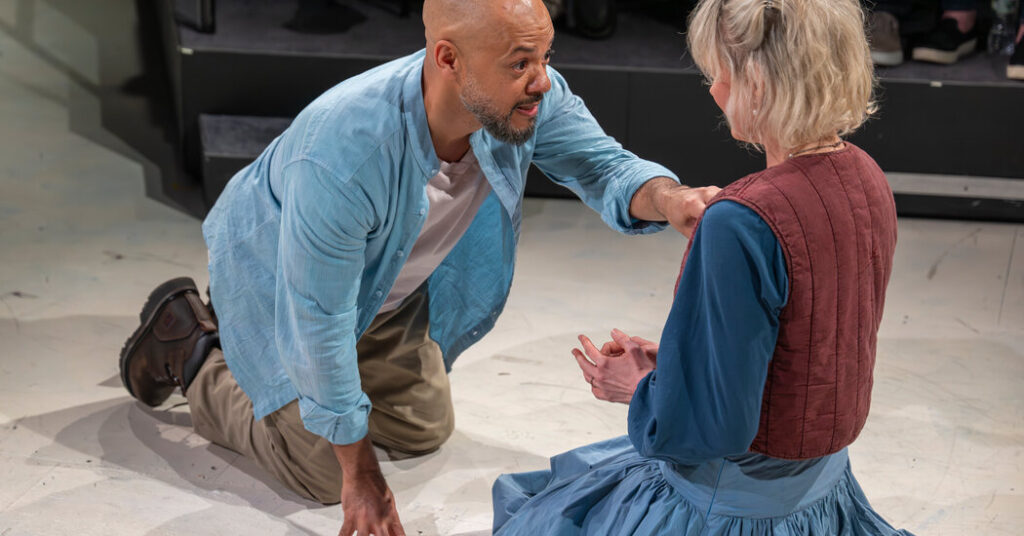
Bedlam started out back in 2013 by staging tiny-cast productions; here the director Eric Tucker returns triumphantly to that stripped-down technique. On a tiny area (not even a stage) slapped with white paint, four actors play everybody: Tucker himself becomes a hilariously normie Iago; Ryan Quinn is jealous Othello and a Cypriot lady, Bianca; Susannah Millonzi plays the gullible Rodrigo and Iago’s wise wife, Emilia; and Susannah Hoffman essays both Othello’s bride, Desdemona, and his rival Cassio.
No one changes costume; there are basically three props. This radical economy ensures both our attention and their creativity. Tucker surprises us with spectacle made from sound — the clatter of boots hastening behind our seats, say — and well-deployed darkness. The actors, all superb, sometimes conduct solo conversations with themselves; one grief tableau serves two different scenes.
Out of a night of wonderful moments, the one that haunts me is Millonzi — one of Off Broadway’s sharpest weapons — as Emilia, her face in shadow, talking bitterly about the wrongs men do women. Iago has no real reason to kill, but Emilia finds that she and her half of humanity have plenty. Shakespeare moves into a modern, even feminist, register for an instant, but then it vanishes on a knife’s thrust. Oh, Emilia! In another time, what a vengeance you would have had.
Hamlet Through May 17 at Brooklyn Academy of Music, Brooklyn; bam.org. Running time: 2 hours 50 minutes.
Othello Through May 31 at the West End Theater, Manhattan; bedlam.org. Running time: 3 hours.
Helen Shaw is the chief theater critic for The Times.
The post Revenge, Served Two Ways: Cold in ‘Othello’ and Lukewarm in ‘Hamlet’ appeared first on New York Times.