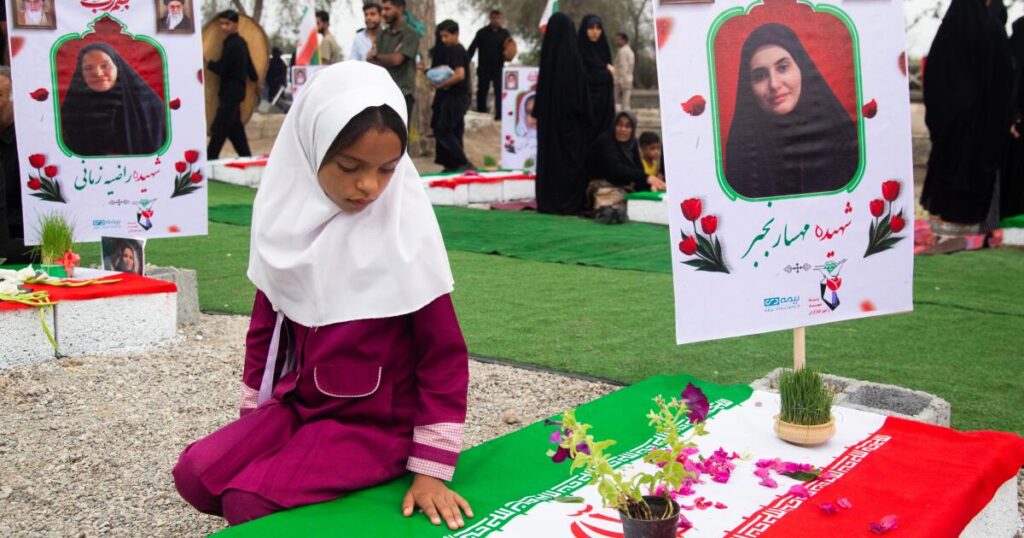
MINAB, Iran — Posters featuring the faces of the children and their teachers — often smiling — now line the boulevards and main square of Minab, a city that has been submerged in a state of perpetual mourning.
They died in a missile strike on the Shajareh Tayyibeh Elementary School on Feb. 28, the first day U.S. and Israeli bombardments in Iran. Among the dead were 120 students, 26 teachers and several parents who had rushed to the school to retrieve their children after hearing reports of airstrikes on Tehran. Most arrived too late.
In all, local authorities say, 156 died, including one teacher, Zohreh Shahriyari, who was six months pregnant.
Minab has been transformed into a landscape of collective grief, where the rhythm of daily life now includes frequent visits to the cemetery, where small graves are arranged in neat rows, just steps apart, mimicking the order of a school assembly.
The outlines of the graves are, in way, misleading because it suggests entire bodies are buried there. In many instances, there was little for families to recover after the explosions and fire that followed.
Alieh Zakeri had two children at the school, Maryam Barazni, a fourth-grader, and Reza Barazni, a second-grader. “His hair was straight; it used to fall over his face,” she said of Reza.
“My husband found him in the morgue,” Zakeri said. His father identified the boy not by his face, which had been destroyed, but by the sport shorts and socks he had put on that morning. “He had his arms and legs,” his mother said, “but they were in pieces.”
Maryam, however, survived. A mother who had raced to the school was able to evacuate her and a few other students. Other parents, alerted by the school that Iran was under attack, also converged on the school.
A firefighter said many of the dead children were found wearing their backpacks, a sign they had been prepared to evacuate.
It’s unclear how many people survived the attack, but Musa Khabar, a firefighter in Minab, recalled the rescue of a girl who had fallen from an upper level and and was partially pinned by concrete. First responders had to cut her hair to free her.
Iranian state media have put the death toll at 168 or higher, but Ebrahim Taheri, the prosecutor of Minab, provided a breakdown of the 156 casualties local authorities counted.
Among the students, there were 73 boys and 47 girls. All 26 teachers were women. Also counted were seven parents died, a school bus driver, a pharmacy technician from an adjacent clinic and the 6-month-old fetus Shahriyari had been carrying.
Though President Trump initially blamed Iran for the attack, a preliminary investigation and news reports based on expert analysis suggest a U.S.-made Tomahawk missile slammed into the school, possibly because of outdated intelligence. A base of the Iranian Revolutionary Guard Corps is located near the school. The Pentagon has launched an investigation.
Alireza Dadkhodai, an emergency operations expert with the Red Crescent, recalled the moment the missiles hit. Around 11:30 a.m., he was monitoring news of airstrikes on Tehran via the messaging app Telegram when a massive explosion rocked Minab, followed by the rise of a giant column of black smoke.
Two more explosions followed within a minute.
“At first, I didn’t know the school had been hit,” Dadkhodai said. He described a scene of chaos in which half the population of Minab seemed to be running toward the smoke.
Fire crews attempted to extinguish the flames erupting from the upper-floor classrooms. Walls crumbled and the roof collapsed.
Heavy machinery arrived two hours later to begin the three-day excavation. Dadkhodai noted that parents worked alongside rescue teams, fueled by a desperate hope that their children might still be alive beneath the concrete.
“But everything we found was fragmented,” he said, describing the recovery of severed limbs, hair and bloodied skulls from the debris.
Ali Nassiri, a local welder, spent 30 consecutive hours at the site, using his professional tools to cut through steel beams. The sights he witnessed, he said, are permanently etched into his psyche.
The danger was not limited to the initial strike. Mostafa Karimi, head of the local Culture and Guidance Office, reported that on the second day of recovery efforts, a heavy concrete slab fell from the upper structure, crushing the leg of a man who was searching for his child. The man’s leg had to be amputated.
For the families, the horror shifted from the ruins of the school to the cold tiles of the morgue.
Mohaddeseh Falahat lost two children: Mahdieh, a sixth-grader, and Amin, a first-grader. She identified Amin by his fingernails. “He had cut them himself the night before, very unevenly,” she said. She found her daughter’s body in a “distressing state” beneath the ruins.
Fouzieh Ranjbari, the mother of 7-year-old Alireza Shahrjou, spent three days searching for her son. When she finally found him at a mortuary in Minab, she recognized him by his scent and the small portion of his face — his mouth and eyebrows — that had escaped the flames.
Some victims were identified through DNA analysis, including Razieh Zamani, a 34-year-old teacher. Her family had waited in agony for a month, praying that even a small part of her body would be recovered so they could hold a proper burial.
Each parent is processing the tragedy in his or her own way.
Tayebeh Farahizadeh goes into the bedroom of her 7-year-old daughter, Esra, to be surrounded by Esra’s belongings, holding onto the dolls that she says still carry her daughter’s scent. Esra, a first-grader who dreamed of becoming a pilot, was found in the school’s prayer hall alongside her cousin Fatemeh Yazdanpanah.
The mother of Setayesh Ali Hosseini, a 9-year-old fourth-grader, finds herself unable to enter her daughter’s room.
“I’m afraid to go inside and not find her,” Masoumeh Mehran said, clinging to the hope that one day “the door will open and Setayesh will walk in wearing her school uniform.”
Among those helping prepare victims for burial was Kazem Pourzahedian, a fabric merchant in Minab who for 10 years has volunteered at a local mortuary to perform the ritual washing of the dead.
The process began one day at 4 p.m. and finished the next morning at 8. He worked on about 60 male students.
Few bodies were intact. To minimize the psychological distress of the families during the burial process, Pourzahedian said he used cotton and paper to reconstruct the physical form of the victims within the shrouds. To each shroud he attached a note in red: “This shroud must not be opened under any circumstances.”
At the Minab cemetery, a new row of graves marks the final resting place of five of the students killed in the missile strike: siblings Esra and Salma Zakeri, along with Khadijeh Darvishi, Masih Salari and Makan Nasiri.
Makan’s casket, however, is empty — a symbolic burial for a child whose body was never recovered from the wreckage. DNA testing has been used to identify the remains of some victims and to return them to their families. Of the 156 people killed Feb. 28, he remains the only one unaccounted for.
Sirus Nasiri, Makan’s father, recalled how the boy loved sports. On the day of the strike — which was also his 7th birthday — the first-grader wore a blue sweater because of the morning chill.
“We found that blue sweater in the morgue, bloodied and dusty, but there was no body inside it,” Nasiri said.
Of the 23 students in Makan’s class, four were absent that day. The other 18, who were killed, were identified.
Weeks after the attack, Nasiri went back to the school and found one of Makan’s shoes in the grass. But there was still no trace of his son.
Times staff writer Steve Padilla in Los Angeles contributed to this report.
The post ‘We found his sweater in the morgue, bloodied and dusty, but there was no body inside’ appeared first on Los Angeles Times.