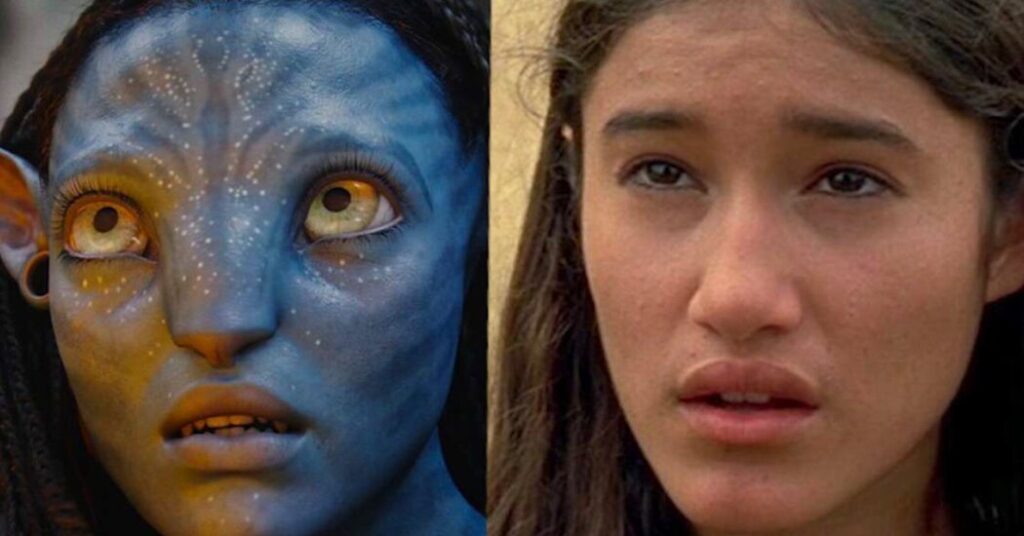
An actress accused the director James Cameron of stealing her likeness to create an “Avatar” character in a lawsuit filed on Tuesday in California — a case that reflects a core fear among Hollywood performers in the artificial intelligence age: losing control of their own faces.
The actress, Q’orianka Kilcher, also sued Disney, which controls the multibillion-dollar “Avatar” franchise, which started in 2009.
“In the age of A.I., our likeness is no longer safe,” Ms. Kilcher, 36, said in an interview. “While what happened to me is personal, it’s also a big warning that, if we don’t act now, this type of thing will become standard. This case is about the future of identity.”
The lawsuit involves Neytiri, the digitally created, blue-skinned warrior princess in Mr. Cameron’s three “Avatar” blockbusters. According to the complaint, Mr. Cameron used a photo of Ms. Kilcher as a teenager — without her knowledge — as the foundation for Neytiri, incorporating her features “directly into his production art” and digital production pipeline.
“Neytiri’s lips, chin, jawline and overall mouth shape” in the trilogy “are Q’orianka Kilcher’s,” the complaint said. “This was not a fleeting inspiration or a vague homage; it was a literal transplant of a real teenager’s facial structure.”
In 2010, Ms. Kilcher, who is also an Indigenous rights activist, met Mr. Cameron by chance at a charity event in Hollywood, where he told her that she was the “early inspiration” for Neytiri’s look, according to the complaint. “She did not take this to mean that her actual face had been replicated,” the complaint said.
Ms. Kilcher is suing now, the complaint said, because of an interview that Mr. Cameron gave to a French media outlet in 2024. In the interview, Mr. Cameron mentions Ms. Kilcher and “points to an image of Neytiri and says unambiguously: ‘This is actually her lower face,’” the complaint said. The interview came to her attention a year later.
“For the first time in a public forum, Cameron explicitly admitted the full truth about Neytiri’s design,” according to the complaint, which was filed in the U.S. District Court for the Central District of California in Los Angeles. “One of Hollywood’s most powerful filmmakers exploited a young Indigenous girl’s biometric identity and cultural heritage to create a record-breaking film franchise, without credit or compensation to her.”
A lawyer for Mr. Cameron did not respond to a request for comment. Disney had no immediate comment.
Ms. Kilcher’s action is the latest in a large number of legal attacks on “Avatar” over the years — almost all of them resolved by courts in Mr. Cameron’s favor, including five separate lawsuits accusing him of copyright infringement or the stealing of ideas. A sixth infringement lawsuit is ongoing and was expanded last month.
In part, Ms. Kilcher is suing under California’s decades-old “right of publicity” statute, which allows people to bring claims against unauthorized use of their identities. It’s a complex area of the law that has taken on a new immediacy in the age of generative A.I., an emerging technology that allows anyone with an internet connection to easily create images that replicate existing art, photographs and human likenesses.
Generally speaking, right-of-publicity laws (about 25 states have one) balance First Amendment protections by distinguishing between commercial exploitation (using a likeness to sell a product) and expressive works (such as news, art, parody). But “there is not always a bright line,” said Jennifer E. Rothman, a professor at the University of Pennsylvania’s Carey Law School who is viewed as a leading authority on right-to-privacy law.
Ms. Kilcher’s break in Hollywood came in 2005 when, as a 14-year-old, she was cast as Pocahontas in Terrence Malick’s “The New World.” She has since acted in films like “Dog” and TV shows like “Yellowstone,” and is a member of the Academy of Motion Picture Arts and Sciences.
Ms. Kilcher is asking for damages that include “all profits” attributable to the unauthorized use, including from the sale of “Avatar” tickets; the three “Avatar” films have collected $1.8 billion at the North American box office alone.
“The damages we are asking for are commensurate with the exploitation,” Arnold P. Peter, one of Ms. Kilcher’s lawyers, said in an interview.
Brooks Barnes is the chief Hollywood correspondent for The Times. He has reported on the entertainment industry for 25 years.
The post ‘Avatar’ Suit Focuses on Hot Topic in A.I. Age: A Character’s Face appeared first on New York Times.