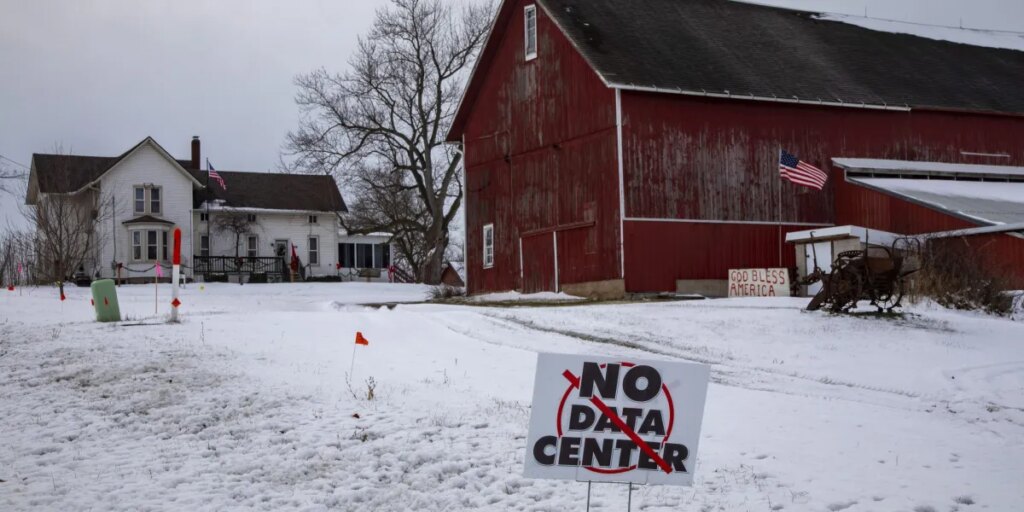
In Saline Township, Michigan, as in most municipalities, homeowners who want to build a new house know what a complicated and lengthy process it can be: Navigating permit requirements, zoning changes, or variance requests for even a small construction project can take weeks or months. An error in the paperwork, a challenge from a neighbor, or a resistant local official can slow things even further, or kill a project entirely.
So it surprised many in this agricultural community of red barns and dirt roads that an enormous AI data center—at 21 million square feet, the largest construction project ever undertaken in the state and one almost universally opposed by local residents—seemed to race through the process from application in late summer to groundbreaking in November.
Even more surprising: The $16 billion data center for OpenAI and Oracle’s Stargate AI infrastructure initiative, which will fundamentally reshape the area with its construction, traffic, electricity demand, and environmental impact, was flat-out rejected by both the town’s board and its planning commission in September. But those votes turned out to be only minor bumps on the project’s path: The developer quickly sued, the town settled, and the construction vehicles rolled in.
The story of how the mega AI data campus became an unstoppable inevitability—over the vocal objection of residents who picketed the vote and posted “no data center” signs outside their homes—reveals a broader dynamic of the nationwide AI data center boom: Once projects of this scale are underway, local governments often have limited leverage to block them. They are constrained by zoning laws, financial risk, and the realities of negotiating with developers backed by deep-pocketed AI companies, with formidable legal teams and plenty of political clout.
These pressures are only intensifying as the AI boom moves from software into physical infrastructure, and demand for computing capacity grows exponentially. The Trump administration has aggressively accelerated US data center construction in its effort to beat China to AI dominance, with a July 2025 executive order streamlining permitting for projects over 100 megawatts or $500 million. Big Tech’s “hyperscalers” are projected to invest roughly $630 billion to $700 billion in 2026 in AI-related infrastructure and data-centers, and capital expenditures are expected to reach $5.2 trillion by 2030.
Politicians from both sides of the aisle are embracing the build-out, trying to get a piece of the economic development it promises for the communities they represent—including Michigan Gov. Gretchen Whitmer, who has been actively courting the hyperscalers building massive data centers since late 2024. At the end of October, Whitmer lauded the Saline Township project, saying the facility expected to create 2,500 union construction jobs, alongside 450 permanent jobs on-site and 1,500 more in the community.
Meanwhile, the rural communities that are increasingly being asked to absorb the environmental and economic tradeoffs of these airport-size projects landing in their midst are scrambling to find new avenues of resistance, legal and political.
“I feel like people don’t understand what’s coming,” one resident fighting Saline’s incoming data center in court told Fortune. Kathryn Haushalter, a 42-year-old former U.S. Marine and mother of five who lives in a 200-year-old farmhouse across from the data center site, noted that she has prior construction experience and her husband is in the trades. “We know what a big project this is, and what a nuisance it’s going to be, and what environmental impact it’s going to have on this area,” she said. “I’m just so nervous for everybody else that doesn’t realize.”
To Barry Lonik, a Michigan-based land preservation consultant with more than three decades of experience, the Saline Township data center project is fundamentally out of place. “No other industrial project had ever tried to come in here,” he said. “It’s all farmland.”
But that’s exactly what attracts large-scale data center projects, which require high-voltage transmission lines, as well as hundreds of contiguous acres—something rarely available in urban or industrial sites. Rural areas can offer both the space and access to utilities, Lonik said, and it’s those characteristics that make places like Saline vulnerable.
“It’s a small township—a handful of people on the board, trying to do their jobs,” he told Fortune. “And then they get hit with something like this.”
Why ‘no’ was not enough to stop the data center
Eight months ago, when Saline’s planning commission gathered in the 200-year-old white clapboard township hall to weigh arguments for and against the proposal from Related Digital to rezone 575 acres of farmland for the AI data center, the reasons for rejecting the plan looked straightforward: The land was zoned for agriculture, and much of it was considered prime farmland. The project would introduce industrial noise and environmental stress into a rural landscape and place new demands on emergency responders. It also conflicted with the township’s long-standing master plan, which envisioned development elsewhere.
And the residents the commission represented largely hated the idea of a data center, and let that be known with signs and impassioned pleas during the public comments. “If you polled everyone on the township board, they would have said the same thing: They didn’t want a data center there,” Fred Lucas, the township’s attorney, told Fortune. “We didn’t invite them, we didn’t encourage them.”
The commission rejected the plan to rezone the farmland. The township board followed suit, voting 4–1 to deny it. But locals quickly discovered that amid the frenzied AI infrastructure gold rush, “no” does not always mean no.
Two days later, on Sept. 12, Saline Township was sued by Related Digital and the site’s landowners. Their lawsuit alleged “exclusionary zoning”—that the community had unreasonably barred a legitimate land use under Michigan law, and it hinged on the fact that Saline Township had no land zoned for industrial use, and that a data center qualified as a “necessary” use that could not be excluded altogether.
The lawsuit underscored the township’s limited leverage. Even if officials had fought it, their lawyers advised them, the project could likely have moved forward via other avenues, such as partnering with an institution like the nearby University of Michigan, which can build projects that are not subject to local zoning in the same way as private developments. Meanwhile, a prolonged legal battle against well-resourced developers risked significant costs for the township, without securing concessions.
Lucas, the town’s attorney, says the township board had little choice and did its best to be transparent. It was “between a rock and a hard place,” he said. “I’m not sure there were any good solutions.” Within weeks, the township had settled: It signed a court-approved agreement allowing the project to proceed, and construction began soon after.
In exchange, the township secured roughly $14 million in community benefits—a relatively small sum in the context of a multibillion-dollar project, but more than 10 times its roughly $1 million annual budget. It includes funding for farmland preservation, local projects, and fire departments; along with a series of environmental and operational limits: restrictions on water use, noise caps, preserved agricultural land, and limits on expansion.
Just seven weeks later OpenAI and Oracle would announce the site as part of their global Stargate initiative. And after several months of construction activity, with hundreds of trucks hauling dirt to and from the site, Related Digital said in April that it had secured financing for what is now a $16 billion mega AI data center campus.
Months before Saline saw the proposal, Michigan was courting the AI boom
It wasn’t just money that the Saline Township was up against; it was also months of planning and behind-the-scenes dealmaking, from Lansing to Silicon Valley, that made this massive facility in a quiet farming community all but a foregone conclusion.
Michigan, like other Midwestern states such as Indiana and Ohio, is emerging as a focal point of this AI data center boom, thanks to its combination of available land, access to fresh water, and existing power infrastructure. Developers have identified at least 16 potential data center sites across 10 counties in Michigan’s Lower Peninsula.
An OpenAI spokesperson told Fortune that Governor Whitmer’s office had reached out to the startup in February 2025, following the initial announcement of its Stargate initiative to build AI infrastructure, right after President Trump’s inauguration. She wanted to discuss opportunities for a Stargate site in Michigan.
“The governor’s team and other stakeholders involved in the project had a series of conversations with OpenAI, including a meeting in the spring between Governor Whitmer and [CEO] Sam Altman,” said the spokesperson, who noted the meeting was virtual and included representatives from Midwestern energy company DTE and Related Digital.
Whitmer’s office declined to comment on what was discussed at the meeting, and there is no evidence that Saline Township was specifically identified. But in the spring of 2025, a Related Digital spokesperson said the company evaluated four potential sites in Michigan with DTE and Detroit-based construction firm Walbridge—including the Saline Township location.
Saline was selected partly for its access to power, and existing transmission lines with the excess capacity to serve a data center, said the Related Digital spokesperson, adding that states like Michigan want to be able to attract these types of projects. “There was a clear national imperative to keep us competitive,” she said. “This is a project in support of American technology companies.”
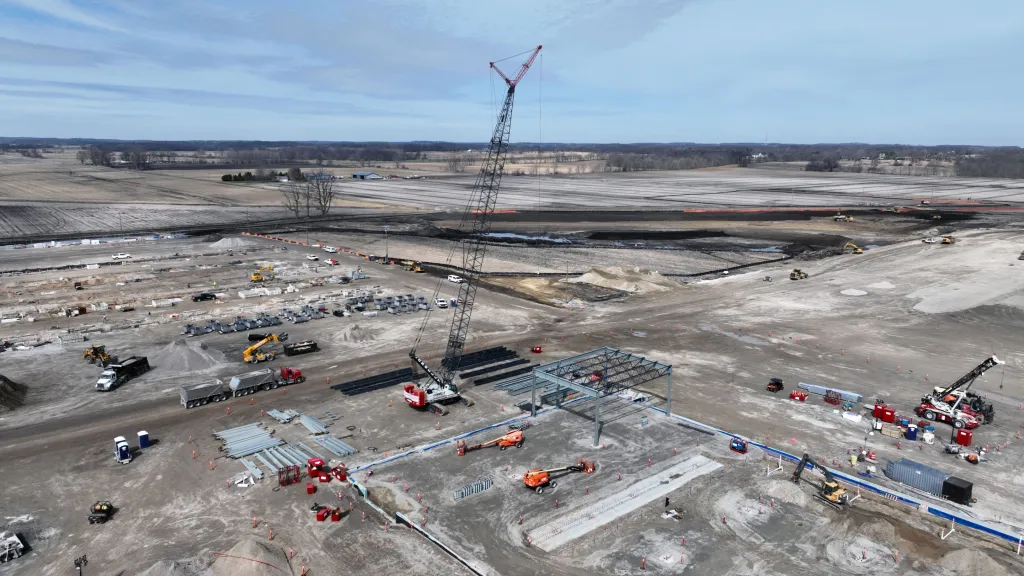
A DTE Energy spokesperson confirmed that it was engaged with Related Digital in the spring of 2025 to help evaluate a site for its potential for connecting to the electrical system. The company will supply roughly 1.4 gigawatts of electricity to the Saline Township site—an amount of power comparable to that of a nuclear plant. (Now, regulators and consumer advocates are pushing back on special contracts between DTE Energy and data center developers, warning they could shift costs onto other ratepayers and strain the grid.)
By May of 2025, still months before the proposal made its way to Saline Township hall, Related Digital had made a deal to purchase the site from three local landowners, descendants of farmers who said they had no intention of farming again. In a letter to a local paper, the sellers said that if the site were not used for a data center, they might have sold it to a solar power operator or for large-scale housing, uses that didn’t require a zoning change. Alan Greene, an attorney who represented the landowners, attributed some of the resistance to the project to general anti-AI sentiment. (In addition, the data center builder purchased 475 acres in nearby Bridgewater Township—expected to remain undeveloped.)
Asked by Fortune about her involvement in negotiating the deal for a Stargate site in Michigan, Whitmer’s office released a statement asserting that she welcomes such projects, as long as they’re done in an environmentally responsible way. “Governor Whitmer has worked very hard to attract new high-tech companies to Michigan in an effort to create good-paying jobs and diversify our economy,” the statement said. “Whether it’s a semiconductor chip fab, AI, or the auto industry, we want to bring jobs and supply chains back home from overseas. At the same time, we also want to make sure that Michigan is only welcoming companies that are going to be good neighbors.”
Residents say the township caved. Officials say they had little choice
The speed of the project’s approval—and the township’s seeming inability to stop it—left residents shocked and angry. Some locals who oppose the project argue that township officials did not do enough to fight it, that they caved too easily. That frustration has now turned into political action: One resident, E. Frederick Gall, has launched a recall effort targeting three members of the township board, including Kelly Marion, the lone official who voted in favor of the proposal. “My issue is that I don’t think they fought hard enough for us,” Gall said in local reporting. “We need someone different.”
David Landry, the attorney who represented Saline Township in the Related Digital lawsuit, told Fortune that he stands by his recommendation that the board settle with the developer. “The zoning power of any municipality—a township, a city, a village—is not absolute,” he explained. “In this case, exclusionary zoning was substantive—the municipality has to have a reason to say no. They just can’t say, ‘We don’t want it.’”
Sarah Mills, a professor at the University of Michigan who studies land use planning, agreed that the town had few good options once the lawsuit was filed. “States determine how much authority local governments have in zoning, and those systems vary widely,” she said. “What local governments can do through zoning is highly controlled and regulated by the state.” Local governments are also often strapped for cash, making it difficult to defend against zoning challenges, she added.
Marion, the township clerk and sole board member who voted in favor of the proposal, said this reality was on her mind when she voted yes. It wasn’t because she favored a data center, she said, but because she did not believe the town could win in a showdown with Related Digital. “They were doing studies,” she said. “They were pulling permits.” Township attorneys and consultants had warned that a denial could trigger a lawsuit—an outcome Marion said felt intimidating. “Everything was drafted and filed with the county within two days of the meeting,” she said of the lawsuit. “They had this all prepared.”
If the township had continued to fight and lost the lawsuit, Marion said, homeowners could have been on the hook for tens of thousands of dollars in tax assessments to pay for the legal battle. “The insurance company was only going to pay for an attorney to defend us up to so much money if we decided to fight it,” she said.
For some residents who oppose the project, the sense of being outmatched extends beyond the township hall or the courtroom. They point to the scale of the companies and powerful people involved—and their perceived connections—as further evidence of the imbalance.
Related Digital’s parent, Related Companies, for example, was founded by billionaire Stephen Ross, an alumnus and major donor to the University of Michigan, whose business school bears his name. And a vice president at Related, Ryan Friedrichs, is married to Michigan Secretary of State Jocelyn Benson, who is running for governor. (Friedrichs said recently he would recuse himself from any projects before the state if Benson is elected governor in 2026.)
Across the road from the bulldozers, one mother keeps fighting
Not everyone in Saline Township accepts that the data center is inevitable. Haushalter, the former U.S. Marine and mother of five, and her husband bought their 60-acre property and renovated the farmhouse on it after she returned from Afghanistan in 2012. She plants about 150 native trees on her property each year, part of an effort to preserve the land for her children, ranging in age from 5 to 13. Now, she’s not sure how long she’ll want to stay. She says she can see the bright lights of the construction site from her bedroom window before sunrise and hear backup alarms from trucks throughout the day.
In December, Haushalter took the unusual step of trying to insert herself into the lawsuit against Saline Township—as a defendant alongside the municipality that had already settled the case. Because she lived close enough to the site to have standing, she sought to challenge the settlement that allowed the data center to move forward. She argued that township officials approved the agreement without doing so properly in a public meeting, as required under Michigan law, and that as a nearby landowner, she should have had an opportunity to weigh in.
“Maybe I’m just stubborn,” she explained. “Maybe it’s because I was a Marine. But this is wrong—and the way it was done is wrong.”
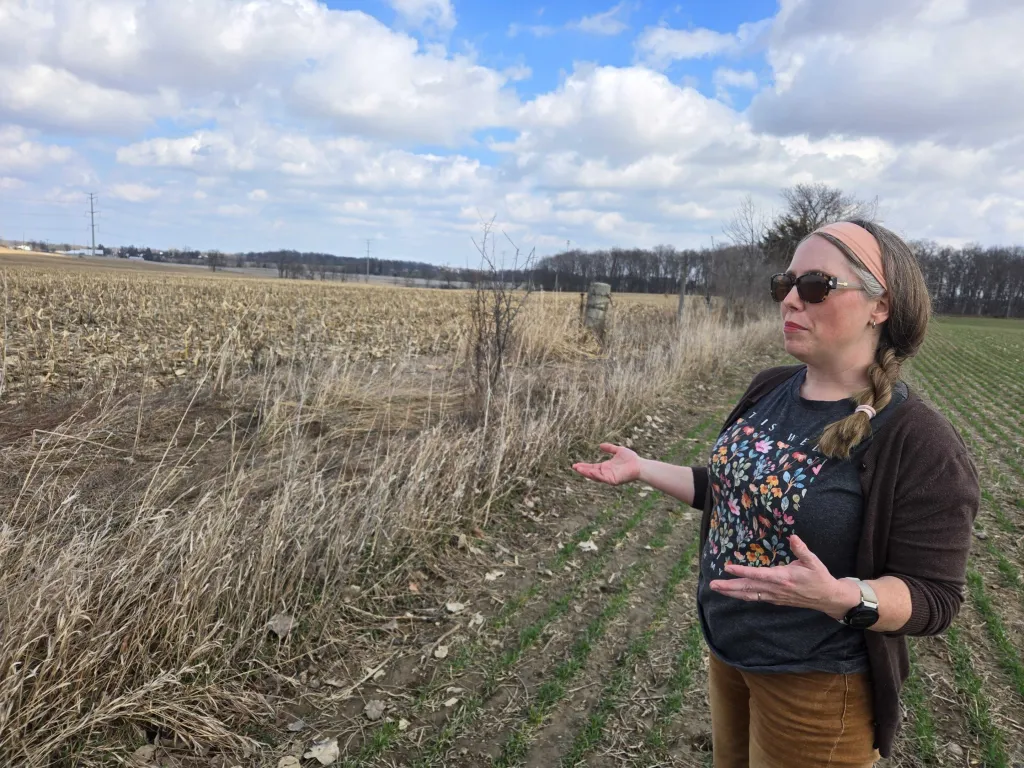
Separately, Haushalter and several other residents filed an appeal with the township’s zoning board, arguing that permits had been issued improperly because the land remains zoned for agriculture. Under Michigan law, such an appeal can trigger an automatic stay on construction until the board makes a final decision. Haushalter said that despite this, residents have not been given a hearing before the zoning board, and construction has continued. Her lawyer, Robert Dube, said Saline Township is trying to get the case dismissed. (Lucas, the township’s lawyer, confirmed this, saying that the Saline Township has filed a motion to dismiss the lawsuit.)
Related Digital has been “moving dirt” in Saline Township since November, said Joshua LeBaron, another resident involved in the group opposing the project. “I think the plan was to move as fast as possible—so by the time anyone challenged it, they could say it was too far along to stop.”
And indeed, in February a Washtenaw County judge rejected Haushalter’s motion, citing its late timing and the difficulty of undoing a deal already in motion. The judge also pointed to video showing the vote occurred in an open meeting, despite conflicting meeting minutes. A request for reconsideration was denied, and Haushalter is now planning an appeal.
“I feel like I’m playing by a different rule book,” Haushalter said. “Like I’m playing baseball and they’re playing football.”
Haushalter’s dispute centers in part on process. Under Michigan law, rezoning land for industrial use can trigger a public referendum, giving residents a chance to challenge the decision at the ballot box. In this case, critics argue, the township approved the project through a court settlement without formally changing the zoning—effectively sidestepping that part of the process.
During a recent visit by Fortune, Haushalter trudged through her muddy post-rain fields in high rubber boots. Water is one of her biggest concerns, she said: Covering hundreds of acres with buildings and pavement changes how water moves through the land. Rain that once filtered into soil could instead run off into surrounding areas, increasing the risk of flooding and putting pressure on nearby waterways.
And in an area where she and others rely on private wells, with no municipal water system, residents worry that a data center drawing large amounts of groundwater could affect supply over time. Groundwater contamination is another worry that keeps her up at night: “I don’t feel like there’s going to be any warning label,” she said. “If something gets into the water, you’re not going to know. It’ll just be a surprise.”
Then there’s the question of energy use: As well as the concern that a facility using as much electricity as a small city will drive up residents’ utility bills, she pointed out that data centers require a constant power supply, and when outages occur—and they often do in a rural area like Saline Township—backup systems often rely on diesel generators that can run continuously.
“If the power goes out, they don’t just shut it down,” Haushalter said. “They bring in generators and run them around the clock. My kids are going to be outside breathing that.”
As three of her children bounced on a nearby trampoline, Haushalter looked across the fallow winter cornfields that she leases out. Trucks hauling dirt and bulldozers and backhoes tearing into the earth were visible across the two-lane road that separates her from the data center site.
She has considered leaving, she said—selling the property and moving somewhere where her family won’t be living in the shadow of a gigantic tech facility. “It would have been the easiest thing for me to sell my farm and go somewhere so it doesn’t affect me,” she said. “But would that really benefit my neighbor down the road—the farmer who’s been here for 100 years?”
The companies behind the project say fears about water, noise, and costs are overblown
A spokesperson for Related Digital disputed some characterizations of the Saline Township project, saying there has been “misinformation” about its impact—particularly around water use, cooling systems, and noise—and noted that the project has drawn support from some nearby residents and local organizations. (Residents retorted that the few supporters are mostly related to the sellers or benefiting financially in some way.)
The spokesperson particularly pushed back on concerns about the project’s water use, saying the facility would rely on a closed-loop cooling system that does not consume large amounts of water. Instead, she said, ongoing water use would be limited to levels comparable to a standard office building. The system would not use evaporative cooling or discharge wastewater through so-called blowdown, she added, and she said the project includes stormwater management improvements designed to better control runoff than current conditions. On a website referring to the Saline Township data center project as “the Barn”—after a classic red barn on the property—Related Digital also says that the project will pay fully for its energy usage, “with no costs passed on to Michigan families.”
When reached for comment, an Oracle spokesperson said the company “is committed to being a responsible partner to Saline Township,” and made similar points about its limited water consumption, as well as pointing out that approximately two-thirds of the 1,000-acre campus will be preserved “for open space, farmland, wetlands, and natural woods.”
With the project underway, residents turn to farmland preservation
Since the Saline project broke ground, county officials in Michigan have begun to respond to area pushback against AI data centers: In Washtenaw County, where Saline Township is located, leaders are calling for more time before additional projects move forward, citing unanswered questions about land use, water, traffic, and long-term community impact. This month, the county’s Board of Commissioners approved a resolution supporting local municipalities considering temporary moratoriums on new data center development.
In Saline Township, that ship has already sailed. At a local council meeting in March that Fortune attended, Haushalter, her husband, and their five children filed into Saline Township Hall, joining a packed room of residents who had spent months protesting the project.
There was a palpable feeling of defeat. Officials offered only brief updates. The project, they said, was moving forward. Questions from the audience focused less on whether the project could be stopped and more on what it would mean in the short term: the steady stream of trucks, the noise, the dust, the strain on local roads.
Outside the meeting, those impacts were already visible. Heavy trucks full of gravel rattled through downtown Saline—the neighboring city distinct from the more rural Saline Township where the project is sited—prompting complaints about speeding, debris, and damage to newly repaved streets. (Related Digital says it has taken steps to address those concerns with traffic regulations and rules for its vehicles. The company also said it briefly paused work to address complaints about mud and debris, adding additional street cleaning and truck washing measures.)
But residents were at the meeting in part because there’s still more land to protect—especially given that data center projects across the nation have tended to balloon in size after they get a foothold. That evening’s guest speaker was Lonik, the land preservation consultant, who had been invited to talk about one of the few tools residents still have: conservation easements. Lonik has helped protect thousands of acres by placing legal restrictions on development—an approach some in Saline Township now see as a way to guard against future data center projects.
Over breakfast the next day at a nearby diner, Lonik said that if enough landowners acted together, they could still draw a line—placing restrictions on their property to prevent future industrial development and preserve what remained of the township’s farmland. “They’re not just NIMBYs,” he told Fortune. “This is a community that regularly updates its master plan and zoning and decides what it wants to be. And then something like this comes in and just blows everything out of the water.” As for concerns about environmental pollution, plus water and electricity use, Lonik said, “there’s a lot we still don’t know. But people are right to be asking these questions.”
The Saline project has brought at least one positive outcome. The settlement includes roughly $4 million for farmland preservation—a sum that may seem tiny given the project’s scale, but could help protect open land: some 1,000 acres via preservation agreements such as conservation easements, that might otherwise be lost.
“It’s ironic—[the money] is only there because the data center came in,” said Lonik, who pointed out that until now the township had not moved to preserve its farmland in this way. Still, he admitted that even preservation efforts like conservation easements, while they offer additional hurdles for developers, can’t guarantee more industry won’t come Saline Township’s way. Zoning rules, he said, are temporary, and can be changed by new administrations.
The next AI data center fight
Saline will almost certainly not be the last Michigan AI data center. Across southeast Michigan, similar projects are already in motion: Anthropic is the intended end user of a proposed hyperscale data center in Lyon Township, an hour northeast of Saline Township, while Google is considering a one-gigawatt campus in Van Buren Township, near the Detroit airport.
Resident Joshua LeBaron said that he and the rest of the opposition group know that their options to fight data centers have become very limited. “An AI stock market crash is probably the only thing that could stop it now—which is not out of the realm of possibility,” he said.
For Haushalter, that possibility is cold comfort as she watches the development rise and continues to appeal her case. She wishes more people were paying attention.
“It’s a very complicated situation and a lot to take in,” she said. “I’ve had to learn more about ordinances and state law and zoning than I ever thought I would want to. But now I realize how important these nitty-gritty, seemingly boring things really are. They can upend your whole community.”
This article is part of the May 6 2026, Special Digital Issue of Fortune.
The post A Michigan farm town voted down plans for a giant OpenAI-Oracle data center. Weeks later, construction began appeared first on Fortune.