A federal grand jury in D.C. indicted the alleged gunman who was arrested outside the White House correspondents’ dinner, charging Cole Tomas Allen with four felonies, including the attempted assassination of President Donald Trump.
In addition to that charge, the indictment returned Tuesday accuses Allen of assault on a federal officer with a deadly weapon, transporting firearms across state lines, and discharging a gun during a violent crime. If convicted, Allen faces a minimum prison term of 10 years and a maximum life sentence.
Prosecutors say Allen, a 31-year-old who worked as a tutor in the Los Angeles area, meticulously planned an act of political violence at the black-tie dinner where Trump had gathered with members of his Cabinet and the media on the evening of April 25.
An FBI special agent said Allen booked a hotel room at the Washington Hilton nearly three weeks before it was scheduled to host the gala, then traveled across the country with a 12-gauge shotgun and other weapons in his luggage, according to an affidavit in the case. Allen sent messages to people he knew calling administration officials “targets, prioritized from highest-ranking to lowest” and signaled his plan to use buckshot ammunition, according to court records.
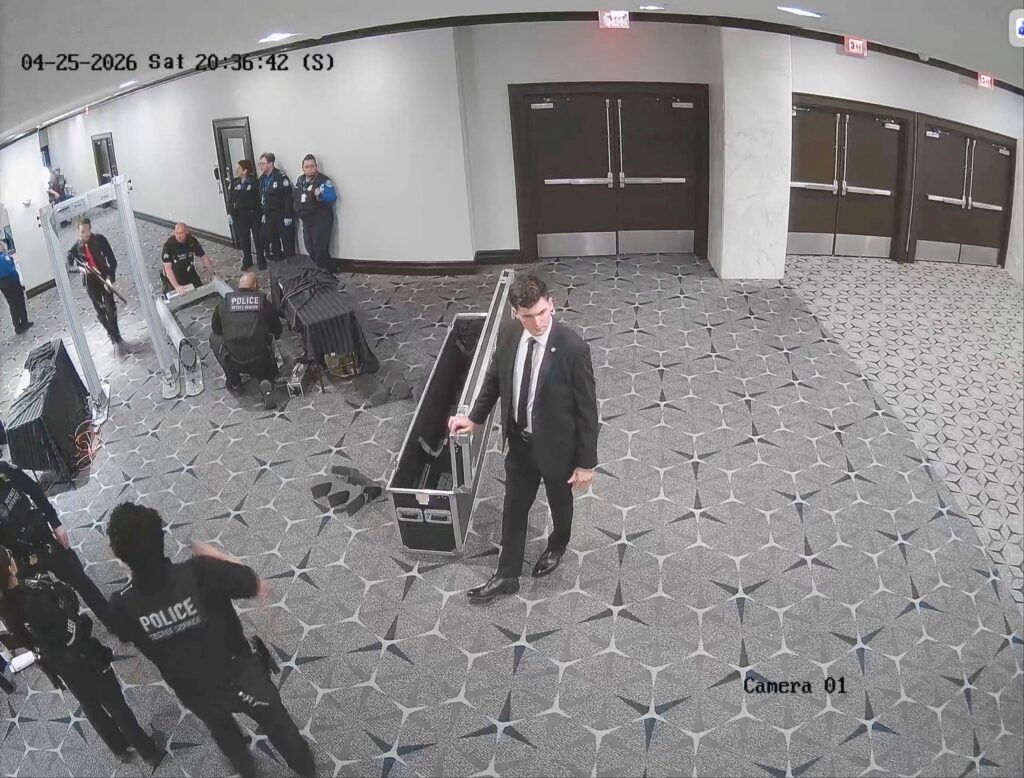
U.S. Attorney Jeanine Pirro of D.C. said Allen could be seen on surveillance footage “casing” the hotel hallways around the ballroom the night before the dinner. The next evening, authorities said, he ran through a security checkpoint carrying a shotgun and also armed with a pistol and knives.
Pirro said Allen fired the shotgun at a Secret Service officer, who was not seriously injured. A buckshot pellet was found in the Secret Service officer’s bulletproof vest, she said.
Allen was apprehended outside the ballroom, where the president and other guests were gathered. His public defenders did not respond to a request for comment Tuesday.
At a hearing in U.S. District Court this week, a defense attorney said officials at the D.C. jail, which is run by the D.C. Department of Corrections, had improperly placed Allen under onerous suicide prevention measures during the days following his arrest. Allen had been denied unfettered access to his attorneys, to a Bible, to a chaplain, to a tablet device that other inmates would get, and was on lockdown for 23 hours a day, one of his attorneys said.
“He hasn’t had any [recreation] time at all,” the attorney, Eugene Ohm, said.
A corrections official said at the hearing that a psychiatrist initially recommended stringent lockdown measures. Allen was no longer under those restrictions as of Monday, the official said. A prosecutor, Jocelyn Ballantine, said Allen told FBI agents upon his arrest that “he did not expect to survive the attempted assassination of the president.”
U.S. Magistrate Judge Zia M. Faruqui said at the hearing that Allen’s initial confinement conditions raised concerns, because he was seemingly being treated more harshly than the hundreds of rioters who were charged with political violence after the Jan. 6, 2021, insurrection. Faruqui said the rioters came closer to killing then-Vice President Mike Pence, who was at the U.S. Capitol as the mob broke in, than Allen allegedly had gotten to Trump.
“This is not the jail’s first go-round with political violence,” Faruqui said. He added later that Allen “should not be in solitary confinement.”
The post White House correspondents’ dinner suspect indicted on 4 felony charges appeared first on Washington Post.