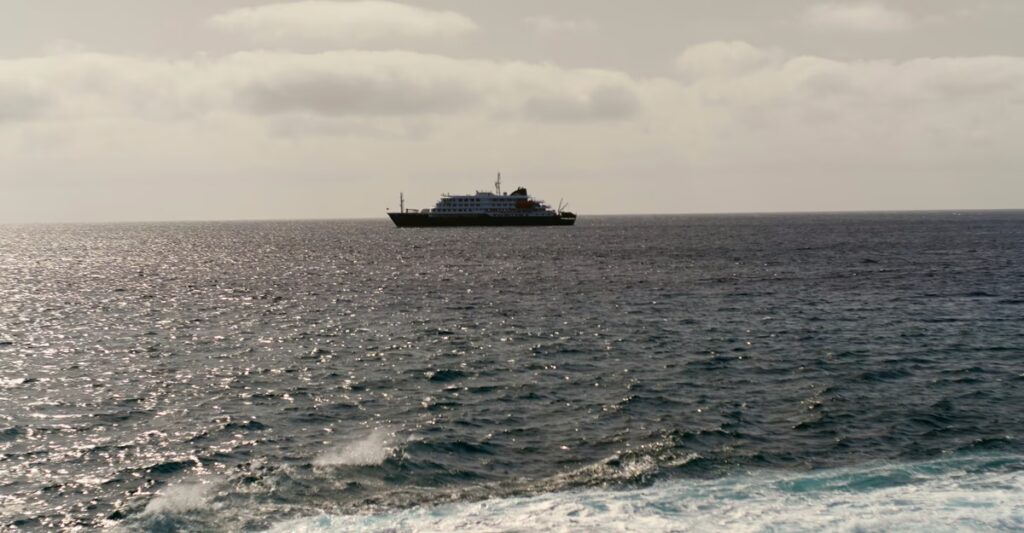
Norovirus loves a cruise ship. So did the coronavirus responsible for COVID-19. The crowded rooms, stuffy air, and communal dining of a giant boat filled with humans create the ideal conditions for pathogens to spread. Now hantavirus—a highly deadly rodent-borne pathogen that typically spreads when people breathe in the aerosolized feces or other bodily secretions of infected animals—may have discovered this too: The world now appears to be experiencing its first documented cruise-ship hantavirus outbreak.
Over the weekend, health officials contacted the World Health Organization to report a cluster of serious illnesses aboard a cruise ship bound for South Africa. Among the roughly 150 passengers and crew on board, three have died and four have fallen ill—one critically. The vessel, the MV Hondius, is now anchored off the coast of Cabo Verde, as those on the ship await further instructions.
The situation is serious and frankly a bit unnerving. For now, officials are scrambling to assess the situation. Only two of the seven supposed cases of hantavirus have been confirmed by laboratory testing; the rest are still “suspected,” according to the WHO. And as health officials investigate, more cases may appear. Hantavirus can simmer in the body for weeks before sparking symptoms, and the seven people who have fallen sick so far might have all caught the virus through a common animal exposure before they got on the ship.
But that’s not guaranteed. The possibility remains that hantavirus-ridden rodents stowed away on the ship, which could mean more exposures, more illnesses, and perhaps even more deaths. A less likely, but still very real alternative: People could be catching the virus from one another, which could pose an additional threat to those at the ship’s destination and beyond—and to the health-care workers treating them. At least one type of hantavirus may be capable of limited person-to-person transmission, in situations involving close and prolonged contact—the sort that a cruise ship certainly encourages. And that version, known as Andes virus, just so happens to be found in Argentina, from where the ship departed just weeks ago. Researchers are sequencing the virus detected on board to confirm its identity, but currently, “our working assumption is that it’s Andes virus,” Maria Van Kerkhove, the acting director of epidemic and pandemic management at the WHO, told me via email.
No matter which version of reality this is, scores of people are now trapped on a cruise ship, potentially with a lethal virus that is perhaps being ferried about by infected rodents and/or humans. The virus can kill up to half of the people it infects, so any further spread could have horrifying results. At least one person who fell ill was taken off the ship to be treated in a hospital; more evacuations are planned. But most of those on board have no clear indication of when they’ll be freed. Oceanwide Expeditions, the company operating the cruise, has said that the ship is facing a “serious medical situation” and that the company is cooperating with authorities and working to “uphold stringent health and safety procedures.”
Eventually, of course, all of the ship’s passengers will have to disembark; Spain has agreed to receive the ship in the Canary Islands. Still, health officials can’t yet say how much risk the passengers and crew will pose to the broader global community. All told, this incident is a deeply sobering reminder that cruise ships can be the setting for infectious-disease nightmares—because they offer pathogens so many simple opportunities to spread.
The perils of cruise ships became painfully apparent during the early days of COVID, when the coronavirus zoomed through hundreds of people aboard the Diamond Princess. In many ways, the ships represented—and, really, embraced—the exact conditions that the pandemic-wary were cautioned to avoid: close quarters, communal indoor dining, crummy ventilation in public spaces.
That setup also favors the norovirus, one of the most common pathogens aboard cruise ships, Vikram Niranjan, a public-health researcher at the University of Limerick, in Ireland, who has written about the vessels’ risks, told me. Norovirus is wildly contagious, and transmitted when people come into contact with infected feces or vomit. Contaminated food, water, and surfaces are common culprits—easy to come across when dealing with shared utensils and cafeteria-style dining.
What’s more, cruise-ship interiors, where passengers from all around the world mingle and breathe in stale air, are especially friendly to any respiratory pathogens that make it onboard—COVID, flu, and now perhaps hantavirus. And for a virus that seems capable of human-to-human spread, prolonged journeys that last for several weeks, like this one, are ripe for facilitating repeated exposure. The people suspected to have been sickened with hantavirus started showing symptoms several weeks apart, which raises the possibility that the illnesses represent a chain, rather than a cluster of cases with the same source. Plus, one of the individuals who is ill and will soon be evacuated is reportedly the ship’s doctor, a likely common contact of the confirmed cases.
Van Kerkhove said the WHO team suspects that “there may be multiple ways in which people have been infected—through exposure to rodents but also possibly through human to human transmission via close contact.” The researchers were told rodents weren’t on the ship, but “I, obviously, can’t confirm that,” she added. “As it’s a ship, there is always the possibility.”
All things considered, “it’s increasingly looking as if there is at least some human-to-human transmission,” Bill Hanage, an epidemiologist at Harvard’s School of Public Health, told me. At the same time, Hanage noted, the cruise-ship conditions that might have allowed for that sort of spread could be making it harder for scientists to confirm the possibility. Even on land, human-to-human transmission is very difficult to confirm: People who tend to spend a lot of time together are among the likeliest to spread disease to one another, but they’re also prone to having the same exposure to an external source. Aboard a ship, even strangers are constantly schmoozing, widening the net that researchers have to cast.
Neither Niranjan nor Hanage thinks the takeaway is to swear off cruise ships. (Quite the opposite, Niranjan said: He’d still love to go on a cruise someday.) But realistically, the risks are at least as high as they would be for any other packed, prolonged party. If nothing else, pathogens thrive on our fondness for one another.
The post The Horror of a Hantavirus Cruise appeared first on The Atlantic.