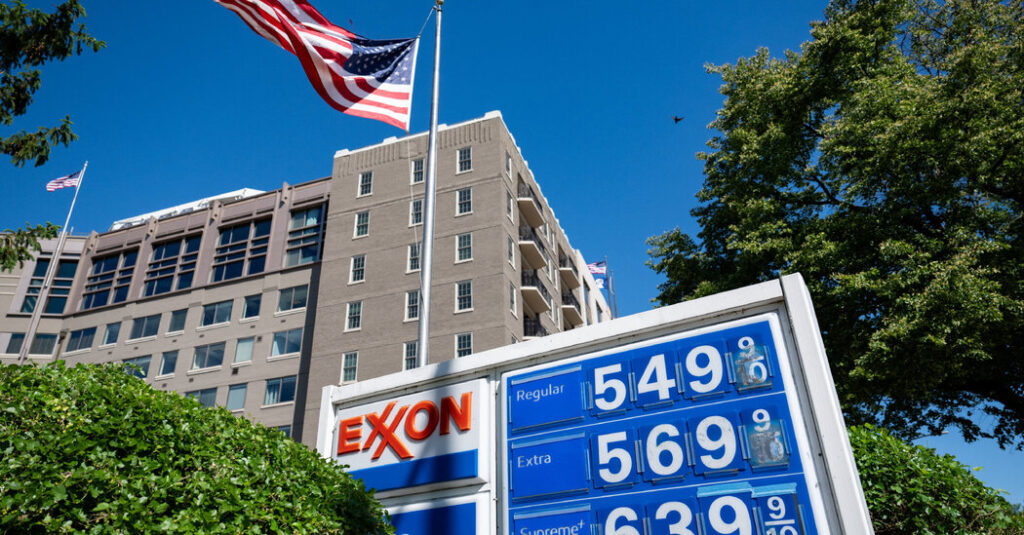
As U.S. gas prices soar to their highest levels in four years, it’s becoming clear that the war in Iran has been very profitable for oil and gas companies. BP boasted about “exceptional” performance in the first quarter of this year, and TotalEnergies, which is based in France, announced $5.4 billion in net profits, Patricia Cohen reported last week.
Now, the finance ministers of a handful of European countries, including Germany and Italy, along with a few Democrats in the Senate, are calling for windfall taxes on the war-related gains of oil and gas companies. These excess profits are the result of the war in Iran, the argument goes, as opposed to savvy business decisions, and should be taxed more. Governments could then use the proceeds to send money back to consumers saddled with high energy bills or invest in renewable energy sources.
This is not a new idea. In 2022, E.U. countries, Britain and India imposed windfall taxes on fossil fuel suppliers after Russia’s invasion of Ukraine sent energy prices soaring. In the 1980s, the U.S. imposed its own windfall tax on oil companies, and at one point President Jimmy Carter planned to use some of the proceeds to subsidize solar loans.
But efforts at taxing oil and gas windfalls have run into a fundamental problem: Sometimes, they just don’t raise as much money as expected. Today, we’ll explain a few of the reasons.
Shell games
When France implemented a temporary windfall tax on the net income of fossil fuel companies in 2022, policymakers expected it to bring in up to $3 billion in revenue. Instead, businesses paid just $69 million.
What happened?
Researchers at the Paris School of Economics came up with an explanation based on an analysis of international corporate earnings data. Oil and gas companies seemed to be shifting their profits from high-tax countries to tax havens where effective rates were around 6 percent.
In a typical year, they found, companies reported around 12 percent of their profits in countries with very low tax rates — like Mauritius, Macau and Malta, for example. When oil prices were higher, the proportion of profits booked in tax havens rose to 20 percent.
How is this possible? “In theory, the company is supposed to book the profits where the activity is really happening,” said Alice Chiocchetti, one of the authors of the paper.
But oil and gas companies tend to have complex webs of subsidiaries that buy goods and services from one another, and they have some leeway to determine how much one part of the company charges the other.
That means a company making 50 percent of its profits in France might find a way to shift a few percentage points of revenue to its other businesses headquartered in tax havens, lowering its taxable income in France and its global tax bill overall.
There are additional reasons the tax underwhelmed. The tax applied to fewer companies than policymakers had anticipated. And companies deducted previous years’ losses from their income, a common corporate accounting practice that lessened the companies’ tax bills, said Manon Francois, a postdoctoral researcher at Stanford University who studies corporate taxation.
A U.S. experiment
In the 1970s, as the U.S. began ending its price controls on oil, many foresaw a boon for oil and gas extraction companies on the horizon. A new tax on the oil industry was viewed as a political necessity. (The Times editorial board came out in support of the tax in 1979, arguing that something needed to be done about oil and gas profits.)
This wasn’t a typical windfall tax, imposed as a one-time levy in response to extraordinary circumstances. Instead, it was designed to tax crude oil production over time. Different producers were taxed at different levels in a complicated system the Government Accountability Office called, in a 1984 report, “perhaps the largest and most complex tax ever levied on a U.S. industry.”
But after the tax passed, oil prices didn’t reach the dizzying heights that some had predicted. And the tax didn’t bring in nearly as much revenue as expected. In its final two years, it brought in no revenue at all. President Ronald Reagan campaigned against it, and lawmakers worried that it was dragging down domestic production.
Congress repealed the Crude Oil Windfall Profits Tax in 1988. By that point, The Times editorial board, formerly supportive, had turned against it.
What’s next
The findings from the Paris School of Economics researchers could help lawmakers close loopholes in future versions of a windfall tax. Chiochetti and her co-author Ninon Moreau-Kastler said a more effective structure could be based on a number that is “not manipulable.” Instead of taxing local income, which companies can often shift, countries might opt to tax energy companies based on their domestic sales or refining volume.
In the U.S., there are more straightforward ways to force the fossil fuel industry to pay more than imposing a new windfall tax. As the Congressional Research Service pointed out in a 2022 report, lawmakers could simply revoke some of the many industry-specific subsidies that lower companies’ annual tax bills.
We also know more than we used to about what happens when lawmakers do nothing. After the 2022 Russia-Ukraine fuel crisis resulted in record profits for fossil fuel companies, the wealthiest 1 percent of Americans reaped about half of the benefits globally, recent research has found.
The Trump administration
Soil at Washington golf course where East Wing debris were dumped contains toxic metals
Soil at a public golf course in Washington where the Trump administration dumped debris from the demolition of the White House East Wing has tested positive for lead, chromium and other toxic metals, according to data from the National Park Service.
The data, which the Park Service published on its website last week, showed relatively low levels of these contaminants in the soil at East Potomac Golf Links.
Yet the dump raised questions about the decision by the Trump administration to bypass environmental laws when it dropped truckloads of mud, rebar, plaster and other debris in the middle of the popular public course near the Jefferson Memorial. — Maxine Joselow
Numbers of the day
150 wind projects, totaling 30 gigawatts
Brad Plumer reports that, according to a wind industry trade group, the Trump administration is blocking more than 150 onshore wind farms across the United States by delaying military reviews that were once considered routine. Together, those wind farms would have been expected to generate 30 gigawatts of electricity. One gigawatt, he writes, can provide enough electricity for more than 300,000 homes, although wind turbines can’t produce power at all hours.
What the science says: Wind turbines create two problems for radar on ships and for ground-based systems looking for aircraft, Eric Niiler writes. First, the steel support towers can reflect electromagnetic waves, making it more difficult for radar to pick up nearby objects. And, second, the rotating blades can create a “blade flash” on a radar screen, appearing to be another object where there is none. But researchers say the problem is manageable, by using new technologies and by adjusting where companies build wind turbines.
More climate news from around the web:
-
A first-of-its-kind global carbon tax on maritime shipping is moving forward, for now at least, The Associated Press reports.
-
A new study highlighted by The Guardian finds that the process of relocating people from New Orleans should start immediately because the city has reached a “point of no return” and could be largely underwater by the end of the century.
Read past editions of the newsletter here.
If you’re enjoying what you’re reading, please consider recommending it to others. They can sign up here.
Follow The New York Times on Instagram, Threads, Facebook and TikTok at @nytimes.
Reach us at [email protected]. We read every message, and reply to many!
Claire Brown covers climate change for The Times and writes for the Climate Forward newsletter.
The post Is It Time to Tax the Oil and Gas Industry’s Windfall? appeared first on New York Times.