This should be a season of electoral hope for Democrats. Donald Trump’s disapproval ratings are reaching new highs. The war with Iran is overwhelmingly unpopular. As of early May, Polymarket gives the party a 51 percent chance of winning the Senate and an 83 percent chance of taking the House.
But Americans still harbor deep doubts about Democrats: A recent Pew survey shows only 39 percent have a favorable view of the party, against 59 percent who don’t. And Democrats are deeply divided about whether to steer centerward or move further left.
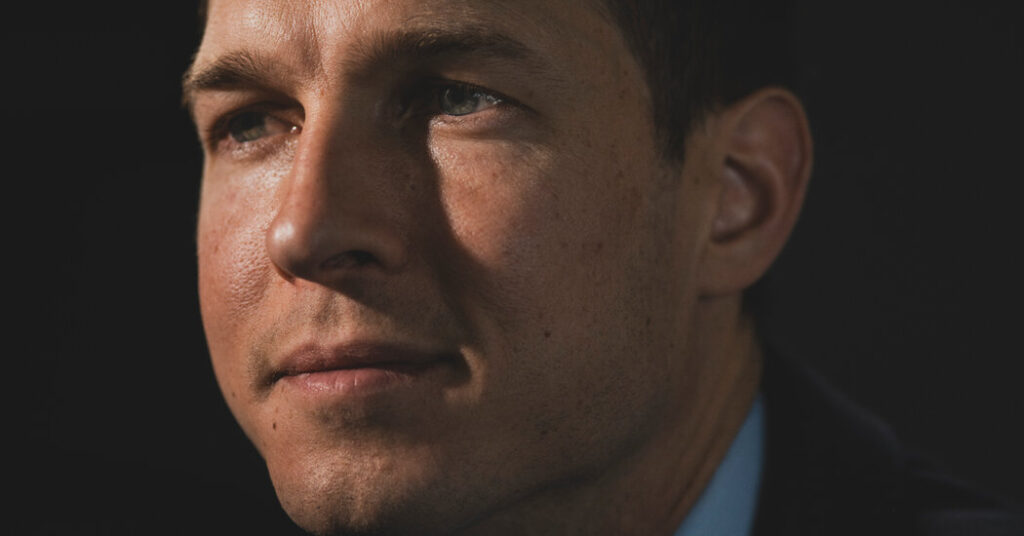
Jake Auchincloss — it’s pronounced AW-kin-kloss — is one of the most thoughtful voices in this conversation. The 38-year-old Harvard and M.I.T. graduate and Afghan war veteran, where he served as a Marine officer, is now in his third term as the representative from Massachusetts’s Fourth Congressional District, which stretches from the wealthy Boston suburb of Newton to the working-class city of Fall River.
Politically, he’s often described as moderate, even somewhat right-leaning when it comes to fraught issues like Israel. But as he made clear over two in-depth interviews with me, his thinking is not neatly categorizable on a simple centrist-to-progressive x-axis.
Auchincloss is also the inaugural chair of Majority Democrats, an ideas shop and political action committee whose guiding conviction is that it is not sufficient for the Democratic Party to be anti-Trump, much as that may help its candidates in the midterms. It also must be a party that reaches beyond its core — and often highly ideological — constituencies.
Among Majority Democrats’ founding members are Abigail Spanberger, the governor of Virginia; Mikie Sherrill, the governor of New Jersey; Ruben Gallego, the senator from Arizona; and Elissa Slotkin, the senator from Michigan.
What Auchincloss and other Majority Democrats have in common is a determination to meet voters where they are. That includes acknowledging mistakes like the Covid-era school closures and the Biden administration’s lax border enforcement. Mainly, though, it’s about championing working- and middle-class concerns against the interests of what he calls “an ossified American aristocracy.” And it’s about restoring an old type of patriotism, based on foundational American ideals, against the blood-and-soil patriotism championed by the likes of JD Vance.
In the interviews, I sometimes found myself disagreeing with Auchincloss. But I conducted them to learn things, not to get into an argument. He thinks deep and provoked me to think more deeply, whether the subject was the estate tax or the war with Iran. Our talks have been condensed and edited for clarity.
Bret Stephens: It looks right now like Democrats will do well in the midterms. Does that mean the overall state of the party is improving?
Jake Auchincloss: Yes, but I think what you’re also asking is: Can Democrats extrapolate from the midterms to potential for 2028? And my argument would be no. I think that we should be pretty cleareyed and introspective about that. You’ve written a lot, Bret, about “move to the center, Democrats.” I would complicate that a little bit because I think what you’re saying is move to the center as though there’s sort of a one-dimensional tug of war. And I’d say if we played that game, we’d probably lose in ’28.
Stephens: Why?
Auchincloss: Because the actual leverage in American politics is not a tug of war on one dimension. It’s defining what the center is; it’s defining the terms of debate. That is where the Democratic project has a lot more ideological spadework to do going into ’28.
And it starts with JD Vance’s speech to the Republican Convention in 2024. He described his family’s cemetery in Eastern Kentucky, and then he declared, “People will not fight for abstractions, but they will fight for their home.” He is claiming that, literally, his blood is in the soil, and that America is defined by blood and soil.
That is the contest that Democrats should seize and use to define the new center, and say: “Actually, Mr. Vice President, you’re wrong. Americans will fight for ideas, whether it’s Bunker Hill, whether it’s Shiloh, whether it is Selma, whether it’s Normandy. Americans do fight for ideas, and we are the party of patriotism, and we will use patriotism to redefine the new center.” And if we can do that, the terms of debate are in our favor for ’28.
Stephens: If I were a campaign strategist for Vance, I would say: “Right, and your ideas are diversity, equity and inclusion, racial identitarianism, a war on merit and a war on success and capitalism. By all means, let’s make it a war of ideas.”
Auchincloss: You’re right that that’s what they want to argue about. And if we are not muscular in defining the patriotic center, then they could control those terms. Which is why we have to have two really strong veins of attack here. One is constitutional patriotism. And one is economic patriotism.
On the constitutional patriotism front, it is expressly rejecting Vance’s blood-and-soil populism and saying, the founders expressly thought that this was an experiment about whether a free people can govern themselves under the rule of law. It was founded on the concept of the inherent worth and dignity of every individual. And we believe as Democrats that every human being has equal freedom and equality under the law.
I do this all the time. Talking about ICE, you start the conversation: We believe in border security. We believe in deporting criminals. We believe in the rule of law for immigration enforcement. Let’s just stipulate that. We also don’t think that a free people should be terrorized by a paramilitary, and if you have a badge and a gun, you shouldn’t have a mask. Because free people don’t want to quarter the king’s troops and they don’t want to quarter the president’s troops.
Stephens: How is “economic patriotism” different from Trump’s tariffs?
Auchincloss: If the core idea of America is that the circumstances of your birth shouldn’t determine the condition of your life, you cannot have a durable “demos,” a durable sense of a shared American future, if you have an ossified American aristocracy. And that is what has happened. The top 10 percent of the American economy are people just increasingly divorcing themselves from the rest.
We absolutely should be taxing wealth and paying it forward to ensure that every kid in this country gets a fair start. The way that it is being implemented at the state and local level is unworkable. But here’s what would be workable at the federal level with a federal tax code rewrite: Make death a realization event. Tax inheritance at the same rate as income.
Stephens: Explain what “death as a realization event” means.
Auchincloss: So, Jeff Bezos qualified for the child tax credit in 2011. Because, you know: He was a billionaire, had assets, borrowed against those assets. Debt is very tax-advantaged in this country in a lot of different ways. So he borrows against his assets for his income. Let’s say he dies. All of his assets get transferred to his kids or his foundations or whatever. They’re not taxed upon that transfer, except for an increasingly irrelevant estate tax. Death is not a realization event in the way that selling your stocks would be a realization event.
That is deeply un-American. The idea that if I work hard and I earn $100,000 and I pay an income tax on that, my income tax rate could be higher than someone who does no work and inherits $10 billion? That is not patriotic. That is not the meaning of America.
And so my view is, death’s a realization event. Remove the step-up in basis provision and levy the wealth by taxing the heirs at the income tax rate, with a modest exemption. And those monies should be invested back into a strong floor, a strong future for American children.
Stephens: In theory that sounds very fair. But the United States pays much more in dollars per student than most other wealthy countries, and our outcomes are dreadful. Not for lack of input, but because everything gets gummed up in bureaucracies that are overwhelmingly controlled by Democratic constituencies.
Auchincloss: If your core critique is that neither party has a plan for education, I 100 percent co-sign that. In many ways the school closures were a parable for where the Democratic Party went off the rails. We were renaming schools away from Abraham Lincoln and the schools were closed.
And we should say as a party: Closing the schools and opening the borders was wrong; not going to happen again. That then sets the stage for, well, what’s our program going forward? Rather than talk about it intellectually, I’ll just point you to a bill that I just introduced called the Education Not Endless Scrolling Act.
Stephens: Is that an acronym?
Auchincloss: No, I don’t really try to do the acronym stuff. Politicians are always like, I really tortured that bill title to get that acronym.
It’s a levy on the digital advertising revenue of the social media platforms, which have productized our kids’ attention spans and have corroded our civil discourse. And it channels those monies, (1), to the construction of 1,000 trade schools across this country to train the next generation in a lifelong way to work with A.I., and (2), to one-on-one high-dosage tutoring for every student in America.
In Massachusetts, there was a pilot program that surged one-on-one, live, online, high-dosage literacy tutoring for first graders to a few hundred kids in my district. I went to the schools; I saw it. Unbelievable results. This stuff works. Teachers absolutely love it. It’s not that expensive, and it is not a fight with the unions, and it’s something that we can scale across states.
Stephens: You’re kind of the young wing of an old guard that wants a Clintonian version or an Obamaite version of the Democratic Party.
Auchincloss: I don’t accept that I want a Clinton- or Obama-era version of the Democratic Party. I don’t agree that the new center is sort of a resuscitation of the neoliberalism of the 1990s. Building a new center is expressly about debating patriotism with the blood-and-soil nationalists of the Republican Party. And it is, in that debate, taking the best ideas from various factions of American life.
The populist libertarians have this real deep-seated opposition to centralized power and corruption and the status quo. I think we should tap into that and talk about an arrogant and out-of-touch Washington, D.C. The traditional conservatives have always prioritized faith, family and the flag. I think that we should tap into that.
James Talarico, who is a member of my group, Majority Democrats, is out there in Texas with a Christian populist message. That’s great. We have progressives who believe that it’s not enough to have one set of rules for everybody: You also have to have a level playing field for everybody to compete on. I agree with that, and we should tap into that as well.
The urge that you’re seeing, though, from Mamdani, from California, is this economic progressivism. And as I said earlier, I think the right framing is economic patriotism.
Stephens: You’re aware of the need for deep capital markets, for a culture of risk-taking and innovation. If you were having a conversation with a young Democratic Socialist, explain to that person where he or she goes wrong.
Auchincloss: Free enterprise is a core way that you make manifest our thesis as a party that every individual has inherent dignity and equality and that they should be able to pursue their happiness in the world. Because if you want to go start a socialist commune, you can. Go to a socialist country and try to start a capitalist commune, it doesn’t work out so well.
So what’s a Democratic case for how capitalism should work? To me, it’s an understanding that markets work, markets can be impaired by government overregulation, and markets can be impaired by corporate monopolization. And while that is pretty obvious to most economists, it’s somehow become a partisan football in a way that’s just not productive.
For example, with housing, the problem is mostly the government, right? State and local land use laws have inhibited the construction of the several million units of housing that we need in this country, and our platform for housing should be very deregulatory. I’ve co-led legislation to do that at the federal level, and we’re seeing a strong faction within the Democratic Party to pursue that.
Cambridge, Mass., went for Kamala 86 to 8. Cambridge just passed, under the leadership of a very progressive city councilor, Burhan Azeem, land-use reforms that might actually be the most muscular land-use reforms in the country. Of that 100-page bill, Burhan told me that 92 of those pages were crossing out regulations. That’s a progressive Democratic city that has nine-tenths of a law about housing crossing out regulations.
Stephens: Democrats, it seems, are very much of two minds about the utility and the wisdom of having people like Hasan Piker campaign for particular candidates and the prominence that he and other far-left progressive firebrands have gotten at least in certain parts of the left-of-center media ecosystem. How should the Democratic Party be thinking about them?
Auchincloss: I think Democrats can learn from successful media strategies without co-opting them into the party’s brand. We need many more channels, whether it’s YouTube, TikTok, livestream or podcasts. We just need many more individuals who are experimenting with ways to reach audiences. And Democrats should be willing to go on those platforms and have conversations about current events, about politics, about sports or culture. Because the nature of reaching an audience is radically changing.
I’ll give you an example. In my district, there’s a small-business owner, a machinist, who has a podcast where he talks about trade schools and machining with young apprentices, a largely male audience. I’m going to go on that show and we’re going to talk about trade school, we’re going to talk about a bunch of stuff. And we need that kind of approach.
Unfortunately, what’s happened is that media saturation has horseshoed. It’s “enrage to engage.” And I don’t think we have to buy into that strategy, but we still need to experiment with the center of the horseshoe and how do you make that more resonant.
Stephens: You have been, much more so than most of your caucus, outspoken in your defense of Israel’s right to defend itself. Do you worry that the Democrats are becoming an anti-Israel party? And do you worry about the antisemitic current running in at least some parts of the progressive left?
Auchincloss: Yes, about the antisemitic current running in parts of the Democratic left, and the antisemitic current running on the MAGA right. We have a horseshoe phenomenon here. Tucker Carlson and Nick Fuentes are much more influential in their party than any antisemitic hashtags are in the Democratic Party, and we should be cleareyed about that. It’s unacceptable on both sides, and it needs to be called out by political leaders of their own parties when it happens on both sides.
When I think about antisemitism, in the arc of history, it’s usually a symptom of a failed society, of a rotten society. Whether it was medieval European cities, whether it was 19th-century Imperial Russia, whether it was parts of the Middle East, it’s usually societies that are degrading.
One of the early symptoms of that is the othering of the Jew and the scapegoating of the Jew. And when I think about modern antisemitism, I think of it as a very clear example of the fact that our digital realm has become a failed society. And antisemitism on TikTok and on X, which is where it is mushrooming, is really just an example that these social media platforms have become failed states and failed societies.
Which is why I’ve been directing so much legislation against them about their liability, about their tax profile and, frankly, just trying to drive the pitchforks toward them.
Stephens: Let’s pivot to foreign policy: Iran.
Auchincloss: This president owns the fact that we’ve replaced one hard-line regime with a younger, more-hard-line regime. We have yielded to Iran a new strategic deterrent in the Strait of Hormuz. The highly enriched uranium is still at large. And the regime has been given the ideological tailwinds of having been seen globally withstanding more than 13,000 strikes and surviving.
I think we come out of this in a position where Iran is operationally degraded, no doubt, but strategically stronger. And this president is thereby the first president in American history to single-handedly start and lose a war by himself.
Stephens: Then what’s the best way of going forward?
Auchincloss: The assertion Democrats make right now is: This war was a failure. We want to insist that any agreement inked with Iran would require a two-thirds vote in the Senate. We say, War Powers Resolution, going to take over the steering wheel from a guy who should not be in charge of war and peace.
Then we have an “ideas primary” for the 2028 presidential contenders on the Democratic side, because we have to have a point of view about how to build back from strategic failure. My core argument would be that it has to be based on knitting together NATO with the Abraham Accords through energy, defense and infrastructure.
Stephens: Say more.
Auchincloss: So you’ve got a few projects underway. One is, you’ve got an air-defense concept of an Abraham Accords air-defense system. [Under relations established by the Abraham Accords, Israel is said to have sent air-defense systems to the United Arab Emirates to defend against Iranian attacks.] That needs to be put on the urgent level where you bring in Ukraine.
Ideally, you actually take the Russian frozen assets, you use them to invest in the Ukraine defense industrial complex, and you help Ukraine monetize its drone and counter-drone capabilities by selling them to the Gulf states to harden their energy infrastructure, which they desperately need.
Then we need to double down on IMEC, the India-Middle East-Europe Economic Corridor, which was put in place a few years ago. It’s sometimes called the new Golden Road — really the counter to China’s Belt and Road Initiative. Functionally, it’s a series of energy and infrastructure investments that knit together India, the Middle East and Europe.
Stephens: Is part of the idea here a strategy of containment for the newer, younger, more hard-line Iran that emerges from this war as you see it?
Auchincloss: Yes, it’s neutralizing not just Iranian, but I would argue Sino-Iranian influence. In an even bigger context, it is finally making good on President Obama’s pivot to Asia.
It’s basically saying to NATO and to the Abraham Accords, all right, we’re going to work with you. We’re going to invest in you. We want to do all these things with you as allies. But you’re paying for it. And you’ve got to harden yourselves and knit yourselves together because we can’t let China have home field advantage in the Indo-Pacific. We’ve got to be there in the South China Sea. We’ve got to be there in Southeast Asia. And that’s where our focus has to be.
Stephens: Final question. If there is one thing you learned in the Marine Corps which every American should know, what is it?
Auchincloss: Officers eat last.
The Times is committed to publishing a diversity of letters to the editor. We’d like to hear what you think about this or any of our articles. Here are some tips. And here’s our email: [email protected].
Follow the New York Times Opinion section on Facebook, Instagram, TikTok, Bluesky, WhatsApp and Threads.
The post A Democrat Who Makes Me Listen appeared first on New York Times.