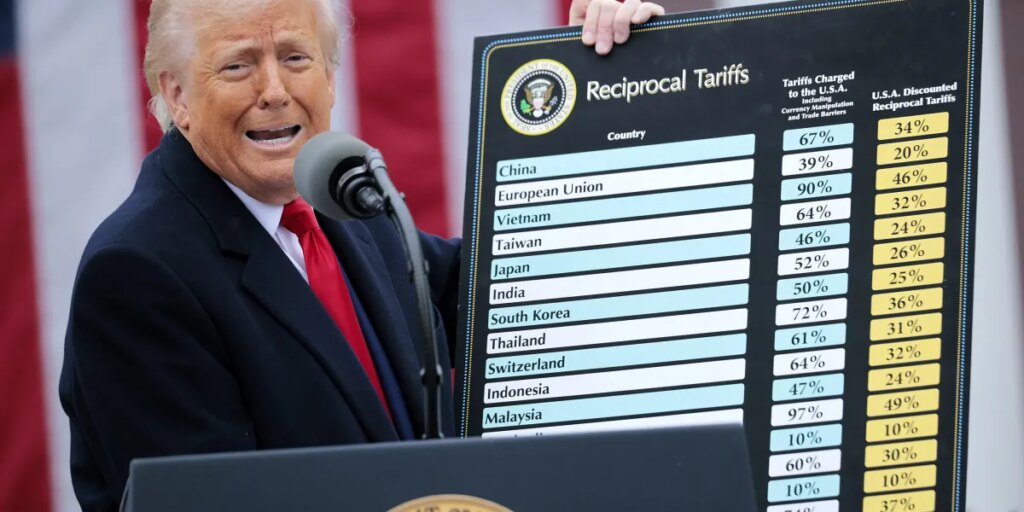
“This will be indeed the golden age of America,” President Donald Trump proclaimed on April 2, 2025, better known as Liberation Day. On that day, the president lauded tariffs as a way to “make America wealthy again.” Americans invested in the market lost about 10% of their wealth as the market reeled with one of the worst short-term crashes in recent memory, with the Dow shedding nearly 4,600 points as it tumbled 11% over four days. The tariff regime was rolled back, then reinstated bit by bit, then ruled illegal, but tariffs fueled inflation all the while.
That was just the appetizer, according to Mark Zandi. “The higher energy and other commodity prices caused by the war threaten to do even more economic damage than the tariffs, further undermining growth and pushing inflation higher,” the Moody’s Analytics chief economist said in a post on X.
Americans are facing a barrage of economic headwinds. Many employers have paused hiring, adopting a wait-and-see approach thanks to Trump’s tariffs. A growing number of tech firms have cut workers in the wake of AI adoption. Inflation also remains hard to tame, down from a high of 9.1% in July 2022, though stubbornly above pre-pandemic levels. But while many economists predicted at the beginning of 2026, the tariff-related headwinds would begin to relent, the Iran war threw a wrench in those plans. Inflation is now trending upward as a result of the energy shock stemming from the war. And Zandi predicts job growth will stagnate, developing a noxious combination of higher inflation and slow growth.
That combination has some economists whispering the dreaded S-word: stagflation, economists’ favorite portmanteau for a brutal combination of stagnating growth and persistent inflation. That’s as the Strait of Hormuz remains under a double blockade and a resolution to the conflict seems further and further down the line as hostilities briefly resumed Monday.
How Moody’s predicts the war will impact the U.S.
While the Supreme Court overturned Trump’s tariffs issued under the International Emergency Economic Powers Act, the president reimposed tariffs under Section 232, levies that aim to protect U.S. national security. A March report from the nonpartisan Tax Foundation found that these tariffs, though smaller in scale than those imposed under IEEPA, will shrink long-run GDP by 0.2%, and lead to 154,000 lost jobs.
Zandi—who has warned since the war’s outbreak of the recessionary implications the conflict could have on the U.S.—doubled down on his warning. In a recent post on LinkedIn, the Moody’s economist said that while the U.S. should avoid a recession, he expects the economy to further diminish even if the war concludes in the next few weeks.
“The economy should avoid a recession, but growth will fall well short of potential, jobs will remain largely flat, and unemployment will drift higher,” he said.
Higher fuel prices will spread out across the economy, according to Zandi. Higher energy costs are set to drive up delivery packages, airfares, and food prices in the coming months. What’s more, a recent Goldman Sachs note gives it to July until the U.S. starts to run out of jet fuel, meaning airlines would likely dramatically cut back on flights, as some European airlines have already done.
Although Zandi said in his note that he expects the economy to avoid a recession, Moody’s recession odds hit 49% in March. Similarly, Goldman Sachs forecasts a 30% risk of recession and EY-Parthenon has the odds at 40%.
And while Zandi claims the war will hamstring the labor market, it’s not so clear if it will hit hiring. Bloomberg reported that forecasters expect the April jobs report on Friday to show an estimated 62,000 jobs added, with private-sector hiring expected to be even stronger, according to a survey of economists conducted by Bloomberg. That’s riding off the momentum of a better-than-expected March jobs report where employers added 178,000 jobs and the unemployment rate ticked down to 4.3%.
Still, Zandi is skeptical about whether the U.S. economy can withstand the economic blows reverberating from the Strait of Hormuz.
“The U.S. economy is resilient,” he said, “but just how resilient is set to be tested.”
The post You had a miserable 2025 because of tariff inflation. The Iran war will be even worse, top economist says appeared first on Fortune.