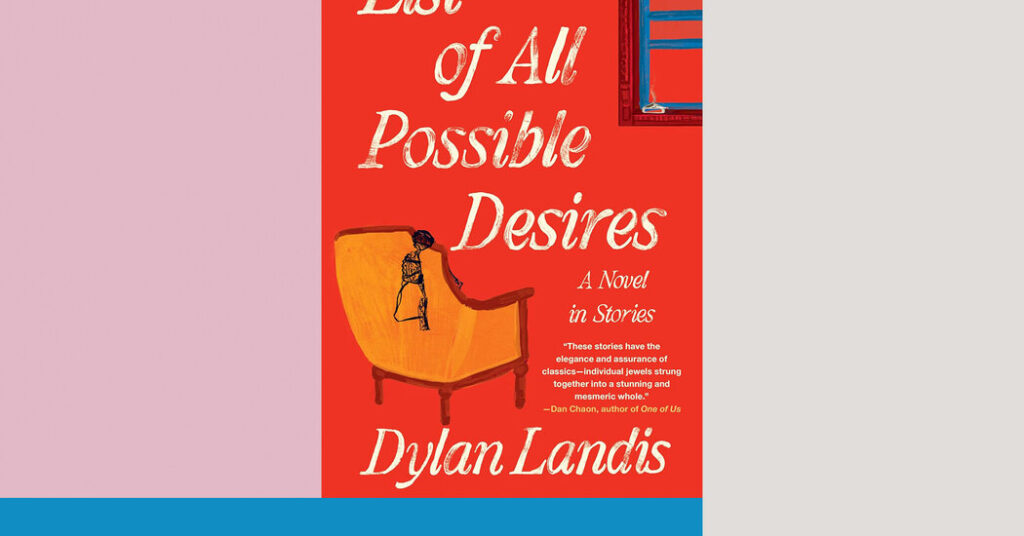
LIST OF ALL POSSIBLE DESIRES: A Novel in Stories, by Dylan Landis
At the start of Dylan Landis’s new novel, Howard Royal, an awkward 11-year-old American, is led around Paris in 1947 by his nounou, or babysitter. He’s a little old to have a babysitter, but hints pile up that her adventures with him include unspoken explorations and sexual secrets.
As Howard, the misled innocent, falls into spite and subterfuge, we see a longer fate foretold. Since 2009, Landis has been writing fiction (a story collection and another novel) about the prematurely worldly girl Rainey Royal, who grows up in the 1970s with a jazz pianist father who fills the family’s Greenwich Village brownstone with friends, lovers, music, booze and his own ego. In “List of All Possible Desires,” a novel told in interlinked stories, we meet this unstoppable father as a child.
Landis is a sublime observer. Her characters feel several things at once and even the most deluded and destructive have their own motives and intricacies. Rainey, with her unprotected childhood, is both victim and manipulator, but the author does not view these categories simply.
In the fifth story, “Fear Knot,” the teenage Rainey hears someone at school talk about a girl who got into a car with a boy she didn’t know and miles later had to choose between sexual compliance or finding her way home with no money. Rainey knows what really happened; we get the truth in staggered stages of flirtation, menace, betrayal and disguise. It’s not an unfamiliar story, but the mode of telling has its own design.
Rainey is not always the focus of the stories, and we hear viewpoints sharply at odds with hers: the mother who runs off to Colorado and abandons Rainey at 13, the father’s best friend who feels free to slip into her girlish pink bedroom to “bother” her from time to time. The events span four decades, and the last story takes place in 1987, when a fragile cousin comes back to the house to die of AIDS, freedom’s plague.
The list of desires invoked in the title belongs to an Austrian character who has been rendered all but speechless by a stroke. She can utter just a single word, wunderbar (“marvelous”), to indicate any wants and pleas, which listeners must try to intuit from tone and context.
Other stories in the world of Rainey’s household offer their own illustrations of what happens when “all possible desires” are aired and honored — bared and felt and acted out. More than one family member acknowledges that this isn’t “normal,” but the drama of it — convincing, startling, wrenching — brings revelations at every turn.
Public attitudes about the glories of liberation have shifted several times over since the decades chronicled here, and while Landis’s work has the advantage of distance, it doesn’t lose any immediacy. Rainey, despite her own constant outrage — and the reader’s on her behalf — is never defeated or crushed; this is crucial in the work’s final effect.
The structure of each story uniquely conveys its main character’s illusions, the stubborn assumptions he or she lives on. The citizens of this world always think they know what’s wrong and always manage to mess up their attempts to fix it. We are left viewing them with far more generosity than we would expect at the outset. When Rainey climbs into bed to hold the hand of her emaciated relative dying of AIDS — “though she barely knows him, he’s her cousin” — this gesture of love is vividly credible, even in a household with its own long habits of bad behavior.
LIST OF ALL POSSIBLE DESIRES: A Novel in Stories | By Dylan Landis | Soho | 286 pp. | $28
The post What Happens When You Try to Fulfill All Possible Desires? appeared first on New York Times.