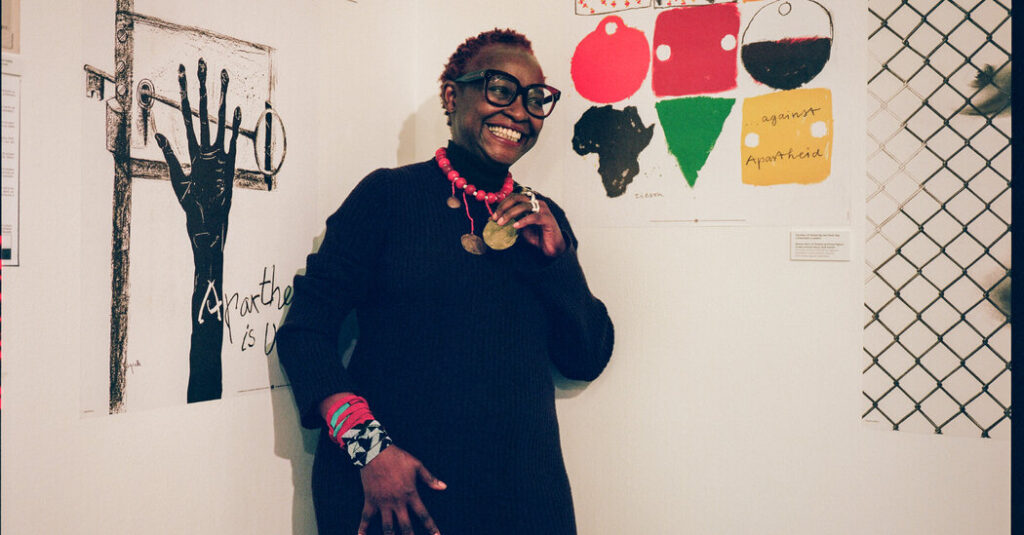
Last year, news of the Cameroonian curator Koyo Kouoh’s sudden death sent shock waves through the art world, leaving not only the Venice Biennale itself in question, but also the constellation of surrounding events.
Among these was the African Art in Venice Forum, a gathering of African artists, curators, academics and collectors that has taken place in Venice alongside the Biennale since 2017. Kouoh showed her support by coming to panels each year, said Alexandra Topalsky, a co-founder of African Art Dialogues, the organization that manages the forum.
“There were a lot of questions about what was going to happen with the Biennale in general,” Topalsky said. “We were thinking, ‘What are we going to do? Do we have an edition this year?’”
Kouoh, the first African woman to curate the Venice Biennale, died suddenly of cancer last year, but her vision for the Biennale, under the title “In Minor Keys,” is being enacted by her team. Throughout her career, she championed African artists, curators, gallerists and their work.
After speaking with past participants, it was clear that this year’s forum had to go on. After all, Kouoh’s ethos when it came to fostering conversations about African art and representation had long inspired the event.
“Koyo always resisted the idea of simplification,” said Neri Torcello, founder of the African Art in Venice Forum. “She always aimed at exposing the complexity of things.” And that was precisely what the forum was created to do, specially for African contemporary art.
Kouoh rose to international prominence in 2008 upon founding Raw Material, an art space in Dakar, Senegal. When the 1-54 Contemporary African Art Fair started in 2013, Kouoh created its forum program, a series of talks, panel discussions, artist conversations, film screenings, and performances.
Torcello said that when he first thought to create the African Art in Venice Forum in 2015, he recalled the 1:54 fair.
“She was unveiling the complexity and dynamics of something that from an ignorant perspective would seem flat and simple,” he said. “In a way, it informed me personally and my passion for investigating the complexity of things.”
The forum officially launched two years later, driven by Torcello’s frustration over the lack of African representation in the Biennale, both in country pavilions and in spaces for Africans to connect during the event.
“It was not just about responding to the lack of national representation in terms of pavilions,” Torcello said. “It was also a space to interrogate what was happening in the African art scene.”
During the forum’s first year, there were seven African countries with pavilions. While that number has grown slightly, the gap remains enormous. At the 2024 edition there were just 12 African national pavilions out of 88 total, despite Africa comprising 54 nations. This year, there are 13 represented: Cameroon, Democratic Republic of Congo, Egypt, Equatorial Guinea, Ethiopia, Guinea, Morocco, Senegal, Sierra Leone, Somalia, Tanzania, Uganda and Zimbabwe.
This year’s forum includes panels on North Africa’s art scenes, on what it means to make art as a queer person in a country where queerness is criminalized or met with violence, and on how to present traditional art practices like West African urban masquerades — inspired by the “New African Masquerades” exhibition from the New Orleans Museum of Art last year.
Kevin Dumouchelle, curator at the National Museum of African Art in Washington, D.C., a sponsor of the forum, said that the forum allows the museum to feature some of the projects it has in Washington.
“The forum is this unique opportunity to have conversations that often can’t happen elsewhere,” he said, pointing to the panel titled “Beyond Here: Queering African Art History,” which expands upon the “Here: Pride and Belonging in African Art” exhibition that is currently on at the National Museum of African Art.
Pamina Sebastião, an Angolan artist and activist whose work is in the exhibition and who is speaking on the panel in Venice, said they wanted to participate in the forum because it will allow them to meet and learn from queer artists and curators from across the continent, not just Southern Africa, where they are based.
“I’m excited to listen and engage; to talk about the existential questions I have with my work and think about creating a dialogue in our contexts,” said Sebastião, who uses they/she pronouns. “Angola is still an anti-L.G.B.T.Q.I.A. society,” they said, making opportunities to discuss queerness across the continent more important than ever. (Being gay isn’t criminalized in Angola, but Sebastião said the country remains “culturally heteronormative.”)
Dumouchelle said his museum is looking to increase its engagement with artists and players in the art world in North Africa, for example — something reflected in this year’s forum program.
“One of the panels will be looking at North Africa as a region and trying to frame the conversation around North Africa as its own center, not as a place that sits at the margins in the Middle East or the Mediterranean or Africa itself, but as its own creative place of dynamism and energy,” he said.
Despite being created in response to the shortcomings of the Biennale, the programs do not compete, participants said. The Biennale runs for several months while the forum lasts just a day or two; the latter also isn’t a place where people necessarily come to view art, but is where they can discuss ideas, issues and trends. The forum’s leaders acknowledge that the size and popularity of the Biennale is, in part, what makes their event a success.
“The forum benefits from this concentration of people, thinkers, artists, curators and people who are involved in the arts in many lateral ways,” Torcello said.
He and Topalsky said that while the first iterations of the forum were about the lack of representation of contemporary African art within the Biennale, with each edition, that became less of a focus.
“Many of our collaborators have become curators of pavilions or artists who are representing one of the countries,” Topalsky said.
Raphael Chikukwa, who curated Zimbabwe’s pavilion from 2011 to 2017, participated in the forum in 2017 and 2019. Simon Njami, curator of the 2024 Ivory Coast Pavilion, spoke during the 2024 forum, and Buhlebezwe Siwani, who participated in the forum in 2017 and will be on a panel this year.
“The forum creates an additional and alternate space for meaningful dialogue and conversations to be had,” said Kate Fellens, the head of international business development at Strauss & Co., the fine art auction house in South Africa and one of the main sponsors of the forum. “The Biennale is very much in the center of the world’s art stage and to have the moment to promote the work, and the challenges, of our region is crucial.”
This cause runs through both the forum and lies at the heart of Kouoh’s vision for the Biennale.
Janine Sytsma, an art historian and founder of Third Space Art Foundation, and the curator of “1922 Revisited,” a live arts program presented during the preview week of the Biennale, said Kouoh’s influence runs through the performance program of the forum.
“Her call to celebrate ‘the harmonies of those repairing wounds and worlds,’ that is what this performance program is about,” Sytsma said.
Dumouchelle agreed: “Koyo’s vision for the exhibition is beautifully thoughtful,” he said. “This idea of bringing voices to the table that have not previously had an opportunity, doing curatorial work that challenges our preconceived notions of boundaries between disciplines and sub-disciplines and sub-regions — that spirit, I hope, you will see animating the forum.”
The post A Forum for African Voices Draws Inspiration From a Former Champion appeared first on New York Times.