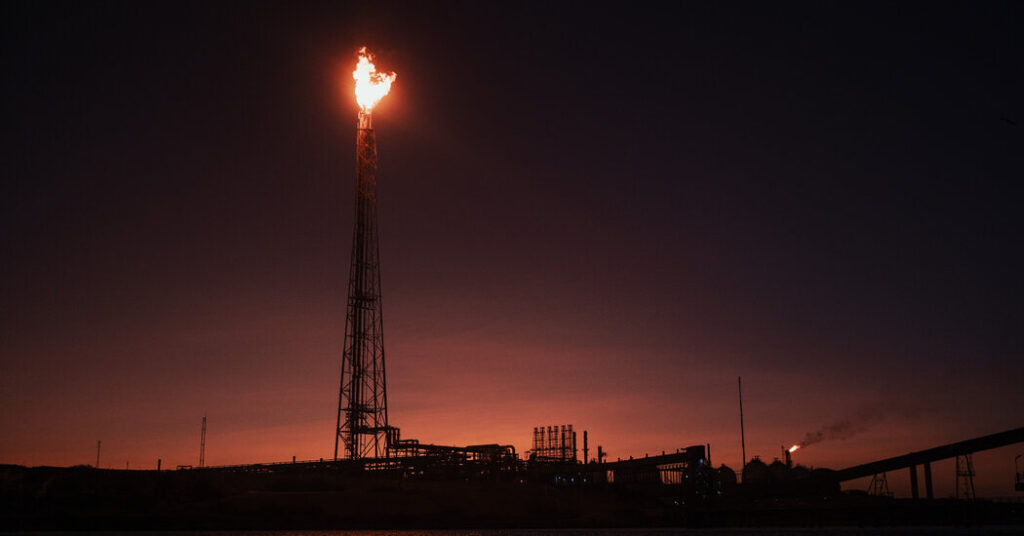
U.S. and Venezuelan officials have promised a new era of accountability for Venezuela’s lucrative oil industry after the downfall of President Nicolás Maduro.
President Trump said the United States would control Venezuelan oil sales. Venezuela would submit monthly budgets to the White House, the Trump administration said, and the United States said it hired auditors to check receipts.
Venezuela’s new leader and Mr. Trump’s ally, Delcy Rodríguez, said the public could trace every oil dollar on a new website.
None of these initiatives, however, have thus far shed light on where Venezuela’s oil money has been going, prompting questions about the political will in Washington and Caracas.
Yet even with the best intentions, Washington’s plan to show how and where Venezuela’s oil riches are being spent would be a gargantuan task. Decades of plundering have left Venezuela with an opaque and deeply corrupt oil industry, which Ms. Rodríguez had largely failed to solve during her previous role running the national economy.
For every two dollars that Venezuela earned selling oil earlier this decade, one dollar was stolen, internal documents and official statistics show.
The stakes are even higher today. For Mr. Trump, his plan to unlock Venezuela’s massive oil potential with $100 billion of American investment hinges in part on convincing U.S. oil executives that his administration can establish the rule of law.
For Ms. Rodríguez, assuring Venezuelans that the oil industry, a core part of the country’s national identity, benefits many and not just the few is vital to improving her long odds of winning a competitive presidential election that the United States is pushing for next year.
It’s unclear how much corruption Ms. Rodríguez would tolerate in order to keep her grip on the government, which remains filled with Mr. Maduro’s apparatchiks and their businessmen patrons.
During Mr. Maduro’s 13-year rule, Venezuela’s omnipresent state oil company, known as PDVSA, had become his family’s personal estate, allowing relatives and cronies to sell oil at highly preferential terms. The patronage greased the wheels of the ruling apparatus, ensuring its loyalty to Mr. Maduro, who survived multiple crises before being captured in January by U.S. Special Forces.
The opaque oil trading schemes continued right up to Mr. Maduro’s fall, and some beneficiaries have kept quietly doing business with PDVSA under Ms. Rodríguez, according to internal documents and interviews with Venezuelan oil officials and people close to the industry.
The questionable deal making is testing her promise to make a clean break with Mr. Maduro’s economic policies, which she has blamed for Venezuela’s prolonged financial crisis.
These previously unreported documents provide a rare glimpse of the scale of graft during Mr. Maduro’s final years, which were shaped by an economic standoff with the United States and mounting repression at home.
The documents and interviews also show the central role played by a relative of Mr. Maduro, Carlos Malpica Flores, who several Venezuelan oil officials and industry insiders have described as the guardian of the Maduro family’s wealth. The people interviewed for this article spoke on condition of anonymity to avoid reprisals.
The Trump administration imposed sanctions on Mr. Malpica, 53, in December, claiming he had “facilitated the continued corruption of the Maduro regime.” Mr. Malpica did not respond to questions sent through a business partner and two relatives.
PDVSA documents show that shell companies controlled by Mr. Malpica and other businessmen close to Mr. Maduro exported oil worth $11 billion in 2021 and 2022 without paying anything to the state company. That amount represented half of all of Venezuela’s oil revenues in those two years, statistics from the country’s central bank show.
The off-the-books oil sales appear to have violated Venezuelan law at the time, which gave PDVSA sole custody of the country’s oil wealth.
Since Mr. Maduro’s removal and the imposition of U.S. control of Venezuela’s oil exports in January, Mr. Malpica appears to have lost access to crude sales, according to people close to the industry. But the people, as well as a senior Venezuelan oil official, say Mr. Malpica continues profiting from his companies that run oil fields, provide services to PDVSA and ship oil products locally.
Venezuela’s government did not respond to requests for comment. The Trump administration declined to comment publicly for this article.
An administration official said Venezuela’s government was providing commitments that funds were being properly spent.
A senior State Department official, Michale Kozak, told Congress last month that the U.S. government hired KPMG, a global financial services firm, to audit Venezuela’s oil sales, adding that the firm will provide reports at a later, unspecified date. Venezuela’s central bank said last week that it separately hired another auditing firm, without providing additional details.
The story of Mr. Malpica, 53, epitomizes the transformation of the Venezuelan economy into a personal fief of the Maduro family, a system still partly in place despite a leadership change.
A former bus driver and union leader, Mr. Maduro lacked the technical understanding of Venezuela’s byzantine economy when his cancer-stricken mentor and predecessor, Hugo Chávez, bequeathed him the presidential office in 2013.
Mr. Maduro needed allies to run the country. And those people needed to be loyal to him, not to Mr. Chávez, a self-styled revolutionary who commanded his followers’ adoration. Mr. Maduro and his wife, Cilia Flores, a senior politician in her own right, embarked on creating a new elite.
Among Mr. Maduro’s recruits was Ms. Rodríguez, a lawyer from a prominent leftist family.
Mr. Maduro and Ms. Flores also began appointing dozens of relatives without any apparent qualifications to public posts, where some remain today.
One relative was Mr. Malpica, a nephew of the first lady, who at the start of Mr. Maduro’s term convinced the president to let him manage dealings with the oil sector, according to senior officials at the time.
Mr. Malpica’s career quickly took off. Months after talking power, Mr. Maduro appointed him to the board of Venezuela’s development bank, known as Bandes. Soon after, he became the national treasurer and PDVSA’s head of finance.
The positions gave Mr. Malpica unchecked access to Venezuela’s oil wealth, which he continued to exploit after leaving the public sector in 2016 and becoming a PDVSA subcontractor and oil buyer.
In late 2022, PDVSA’s board met to take stock of years of unpaid oil bills left by Mr. Malpica and other Maduro confidants, according to the meeting’s presentation seen by The Times. The board counted nearly 240 oil tankers that left without payment between 2019 and 2022, costing the Venezuelan state $13 billion.
The board voted to effectively write that money off, the presentation shows.
Months later, Ms. Rodríguez took charge of PDVSA after orchestrating the downfall of her predecessor Tareck El Aissami, a protégé of Mr. Maduro who is on trial on corruption charges. Under her management, PDVSA’s most blatant irregularities, such as unpaid oil sales, largely stopped.
But Mr. Malpica and other businessmen close to Mr. Maduro continued receiving preferential access to oil, showing the limits of her initiatives.
In 2023, for example, a shell company connected to Mr. Malpica became the second largest exporter of Venezuela’s crude, just behind Chevron, a multinational firm that has produced oil in Venezuela for a century, the documents show.
Copies of some of the contracts show that the shell company, China-registered Hangzhou Energy, received oil from PDVSA on highly favorable and unusual terms despite not having any history of business activity. A contract for 2022 shows that Hangzhou was allowed to sell about a tenth of the country’s export volumes that year in return for providing the government with an unspecified amount of “humanitarian aid.”
It is unclear how much aid Hangzhou eventually delivered or what it included. Ostensibly set up in response to American sanctions, oil-for-food deals similar to the one obtained by Hangzhou became a major source of corruption during Mr. Maduro’s final years, siphoning billions of dollars from the state at a time of humanitarian crisis, according to the U.S. government and investigations by a Venezuelan news outlet, Armando.Info.
An email to Hangzhou’s operations manager, Zhang Junling, went unanswered.
Though Hangzhou’s legal representatives were ostensibly in China, in practice it was Mr. Malpica and a partner, Ramos Carretero, who represented Hangzhou in meetings with PDVSA, according to several PDVSA officials and people in Venezuelan oil industry, implying the two men were the company’s ultimate beneficiaries.
Hangzhou also had other unusual and lucrative payment arrangements.
Most oil buyers had to pay PDVSA in dollars. Hangzhou, however, paid Bandes, the development bank, in bolívars, the local currency, according to PDVSA documents, internal messages seen by The New York Times and interviews with Venezuelan oil officials.
The scheme defied the basic reason nations export oil: to obtain hard currency for imports.
Venezuela’s controlled currency rate meant that buying oil for undervalued bolívars and selling it to Chinese refiners for stable currencies such as dollars would allow Hangzhou’s owners to reap a huge profit.
And Venezuela’s runaway inflation meant that any bolívars that Hangzhou ended up depositing in Bandes, an opaque institution tied to Mr. Malpica, became practically worthless.
Mr. Malpica’s close relationship with Mr. Maduro and his wife helped him survive PDVSA’s periodic purges, which have landed four of its recent presidents and dozens of executives in jail, including most of those who signed contracts with Hangzhou.
Mr. Malpica also managed to strike up a friendship over the years with Ms. Rodríguez, according to several people who know both of them well. This connection appears to have spared him thus far from the new president’s housecleaning, which has led to dozens of Maduro relatives being fired or ostracized.
Several oil businessmen close to Mr. Maduro have been detained since his capture, but so far none has been publicly charged with any financial crimes.
The oil industry accountability website, called Transparent Sovereignty, promised by Ms. Rodríguez in January today displays a single entry.
The website says that the government sold $300 million-worth of fuel oil in March, which was used to increase the minimum wage.
The website did not say who bought the oil or for how much.
Mariana Martínez contributed reporting from Caracas.
Anatoly Kurmanaev covers Venezuela and its interim government.
The post In Venezuela, Trump Promised Transparency. But Secret Oil Deals Linger appeared first on New York Times.