Javier Milei, president of Argentina and perhaps Donald Trump’s closest ally in the Western Hemisphere, likes to call himself “the libertarian, the anarcho-capitalist, the minarchist.” In practice this means he seeks to dismantle the state. With his mop of tousled brown hair, his tapering rockabilly sideburns and his ice-blue eyes, he is a rebel bent on free-market revolution. Opponents are “cockroaches,” the Argentine Congress a den of “rats.”
The goal of the president, an obsessive laissez-faire economist elected in 2023, is to rescue his country from what he calls the “filthy hole” of a corrupted public sector and forge a new entrepreneurial culture. For a nation richly endowed in minerals and farmland, accustomed to perverse economic failure, this has come as a shock. Printing money was long the inflationary answer for a bloated state. Milei has stopped the presses, eliminated 10 ministries and laid off some 63,000 public-sector workers, or more than 15 percent of the federal work force. He has slashed federal spending by 30 percent; cut inflation to 32 percent from over 200 percent annually; and produced a budget surplus in a country where, in 110 of the last 123 years, there was a deficit.
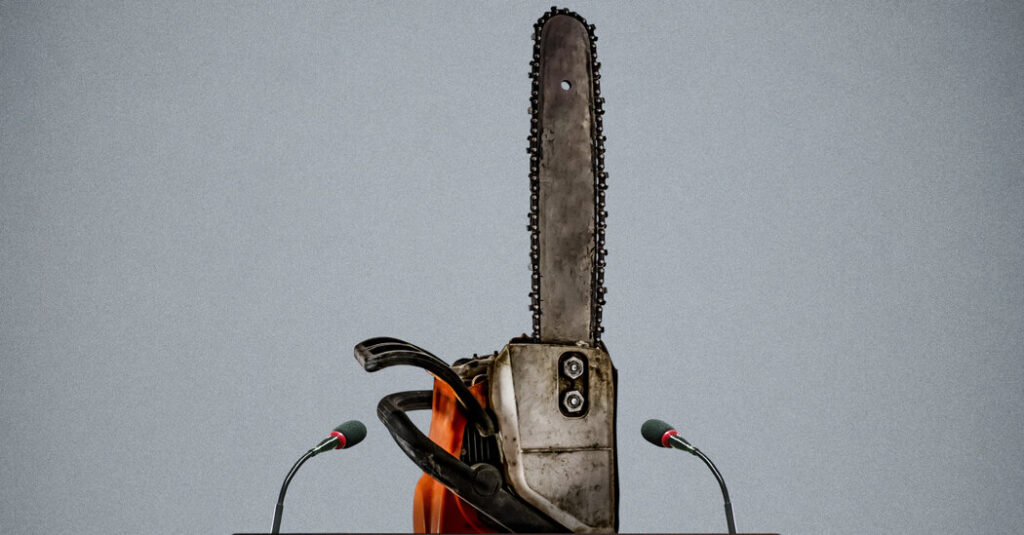
This purge, symbolized by the chain saw Milei adopted as his campaign totem, enthralled Donald Trump, who viewed the administrative state as a den of unelected bureaucrats out to thwart him. Milei was the first foreign leader to meet the newly re-elected Trump in November 2024. They bonded in their contempt for international institutions, conventional diplomacy, human rights and climate change policy. There are differences — Milei is a voracious reader and dismissive of tariffs — but these hardly matter when MAGA is used interchangeably for the two countries. “He’s MAGA all the way, he’s ‘Make Argentina Great Again!’” Trump said of Milei at the White House last year.
When Trump took office, he embarked on an assault on the federal bureaucracy that looked a lot like the drastic measures Milei adopted in Argentina. At the Conservative Political Action Conference last year, Milei presented a chain saw to Elon Musk, whose short-lived Department of Government Efficiency took charge of the cutting. Since then, the chain saw has become an icon for the nationalist right-wing leaders at the forefront of a global backlash against the liberal establishment.
Its targets are not only economic; they are cultural. Milei, working the image of the leather-jacketed man of the people, wants to slice through progressive assumptions, in line with other New Right leaders, whose followers range from Silicon Valley potentates like Peter Thiel to outcasts from the knowledge economy. Milei snarls at the word “woke” and opposes abortion in one of only five Latin American countries where it is legal. Not given to modesty, he has declared himself “one of the two most relevant politicians on planet Earth. One is Trump and the other is me.”
That is a wild assertion, but the two leaders are in the vanguard of the right’s attempt to eviscerate the cornerstones of the postwar order, including international law and the United Nations. Their promises to blow up a system that many perceive as rigged for a political or economic elite (known in Argentina as la casta, or the caste) have catapulted them to power. They loathe no word quite so much as “multilateralism.”
Together, they belong to an age of instinctive rabble-rousing leaders contemptuous of process; they know how to get the blood up, a condition for social media notoriety, the key to political success. “We live at a time when truth has become a question of tone, where ‘telling it like it is’ is the antidote to perceived progressive hypocrisy,” says Tamara Tenenbaum, an Argentine philosopher and screenwriter.
For the postliberal movement embraced by both men, the sapping of church and nation, uncontrolled immigration and the spread of D.E.I. policies symbolize the collapse of Western civilization. Deploying hatred and fear, seemingly at ease with wars, they see themselves as its saviors. For Milei, the core method of restoration is to cut.
Perhaps no society was as ripe for this as Argentina. For decades, an ideology or unfathomable mishmash called Peronism, named after the postwar ruler Juan Domingo Perón, wrought untold havoc on the country’s economy. Clothed in a Robin Hood aura, Peronism claimed to take from the rich to give to the descamisados, or shirtless ones. Evita, Perón’s wife, was revered as a saint for her role in a movement that gave women the vote and workers paid vacations. But over decades, corruption and mismanagement ensured the poor remained poor. Milei inherited a 54 percent poverty rate. The U.S. dollar reigned; nothing else could be trusted through repetitive cycles of recession, default and financial crisis. Hyperinflation was such that so-called remarcadores, or price taggers, darted around supermarkets raising prices as people shopped. Argentines have hidden an estimated $250 billion under their mattresses.
“Argentina is an incredible story of destruction and theft,” José Luis Daza, the secretary of economic policy, told me of a nation that, in the early 20th century, was among the world’s richest. “Politics was the business.”
Milei’s aggressive effort to sweep away this broken system has made him a global celebrity, a new status for an Argentine leader. Patricio Giusto, an Argentine professor of international relations who was a visiting professor in China a year ago, told me that he could not believe his eyes when he saw “a Chinese student watching a video of Milei with Chinese subtitles, fixated on a faraway place he’d never seen.” Without alluding to Milei, Friedrich Merz, the center-right German chancellor, called this year for “a true deregulation mind-set.” The Argentine ambassador to France, Ian Sielecki, told me he was inundated with French politicians seeking advice on how to become the “French Milei” ahead of next year’s presidential election. His usual response is, “OK, are you ready to raise the retirement age, not from 62 to 64, but from 62 to 68, and make that clear before the election?” The conversation tends to end there.
The idea of an Argentine president on a pedestal in Shanghai and Paris is shocking. If Argentina came up, it used to be as a unique example of a country moving from the first world to the third. Milei has yanked his country out of the periphery, much as President Trump has moved Latin America from the sidelines of U.S. foreign policy to its center. Argentina’s unrealized potential is no longer a curiosity of history. It is an invitation to make a buck on its oil, or gas, or lithium, or copper, or gold, or uranium, or the uniquely fertile soil of the vast Pampas. Trump’s America wants all of that — and it does not want China to grab it.
The new American-Argentine bond has economic, military and strategic aspects. But there are also strong headwinds confronting the game plan of the right. The defeat last month of Viktor Orban, the longtime Hungarian leader and MAGA idol in Europe, could be a warning sign for Trump and his political allies. An untethered world has looked more dangerous since the Iran war began; President Xi Jinping of China recently warned of a return “to the law of the jungle.”
Milei, however, could survive in that jungle. One significant factor in Orban’s demise was corruption, the very thing Milei has vowed, albeit falteringly, to eliminate; and Argentina, down at the bottom of the world, tends to look like a safe haven in times of war. Numbers, including growth and foreign investment, point in the right direction for Milei. “He has put Argentina on the map,” Lucila Lasry, a senior manager in the lithium mining business, told me. “But we will only know after the presidential election next year if most people are on board or not.”
Milei is in a race against time to prove that his approach delivers more benefit than pain. I saw vivid examples of both as I wandered across the great expanse of Argentina, a country four-fifths the size of India, populated by just 47 million people. I started in Resistencia, in the sultry Gran Chaco lowlands of the north. Even here, nearly 500 miles from Buenos Aires, close to the border with Paraguay, I found evidence of Milei’s deregulatory frenzy.
Walter Javier Detzel, 37, a slim and vigorous man of chiseled features, grows watermelons on more than 60 acres. The grandson of German immigrants, he spent his childhood walking to school shoeless, returning to help his father clear weeds. But a passion for the land led to a viable business.
In 2018 he reached a deal to sell 140 tons of his fruit to a Paraguayan customer, which he loaded onto five trucks. It was his first international sale. Four passed the border without incident before customs officials informed him that Regulation No. 554 of the 115-page Decree-Law No. 9,244 of Nov. 16, 1983, issued in the final days of the last military dictatorship, prohibited the export of large fruits like watermelons unless they were packaged in a netted bag, or a white bag without markings sewn shut.
“Wrapping watermelons makes no sense,” he said. “I couldn’t believe it.”
When Detzel complied, his client was outraged at the time lost unwrapping and the consequent damage to the fruit. He canceled subsequent orders. In the years that followed, whenever the domestic market was saturated, Detzel watched his crop rot in the field. Then, in December 2024, a year into Milei’s presidency, he saw a TV show featuring Federico Sturzenegger, who leads the Ministry of Deregulation, which Milei likes to call the Ministry of Increasing Returns.
“My message was please, please, whoever is listening, tell me how the government is making your life miserable!” Sturzenegger, 61, an imposing M.I.T.-educated former governor of Argentina’s central bank, told me as he pointed to a towering paper stack of laws rescinded since Milei took office. “And this guy writes me and says, ‘Federico, can you help me with my watermelons?’”
Detzel heard back within 72 hours. An investigation revealed decades-old “regulations for fruit production that were so obscene,” Sturzenegger said. “I mean, we’re not talking about enriched plutonium here.”
Two months later, in early 2025, the netted-bag regulation was rescinded, one of 15,144 deregulations enacted in the past two years. Detzel’s exports took off. He has exported 25 truckloads to Uruguay alone over the past year, quintupling the volume and earning him the sobriquet “the Messi of watermelons.”
“We are a rich nation that is impoverished,” Detzel said. “All we need is clear rules and an end to subsidies the state cannot afford.” If only it were that simple. At the Amérian Hotel Casino Gala in downtown Resistencia, where I met Detzel, pensioners arrived to try their midmorning luck on the slot machines. It was a bleak sight in a poor province where many rely on welfare. Though chain-saw deregulation has worked out for the Messi of watermelons, not everyone is so lucky. Social assistance programs — including income support to worker cooperatives, assistance to victims of gender-based violence and aid to soup kitchens — have been cut by $12.8 billion since Milei took office; that equals hardship for many. Milei says this is the price of a transition to a better future. He has 18 months left in his term to convince voters of that.
Back in Buenos Aires, I circled around Milei, twice receiving messages from his chief of staff, Manuel Adorni, that the president was ready for an interview, either in Argentina or the United States. Silence ensued. Perhaps Milei had a cold. As runarounds go, it was elaborate. Ministers and friends pleaded with him on my behalf, but Milei tends to see what he calls “woke communists” everywhere, not least in the press. Last month, in an extraordinary and repressive move, he barred all accredited press from the presidential palace, the Casa Rosada, or Pink House, for more than a week, accusing TV broadcasters of espionage.
On Sundays, when he is not jetting around the world as the rock star of the risen right, Milei invites friends to Quinta de Olivos, the lavish 85-acre official residency of the president, in a northern suburb of Buenos Aires. This, not the downtown Casa Rosada, is where he prefers to work.
The meal is anything but elaborate, often steak and mashed potatoes, followed by flan. There is no alcohol; Milei is a teetotaler. He sometimes wears the blue-and-gray overalls of Y.P.F., the state-owned Argentine oil and gas company. “He dresses up for Davos, but that’s about it,” says Juan Carlos De Pablo, 82, an economist friend who is a regular at the Olivos soirees.
Milei has few airs. He is said to have crawled around on his hands and knees to find a cellphone when it slipped beneath an airplane seat. “His main quality is transparency,” says Sielecki, the Argentine ambassador. At times, Milei’s personal obsessions are so powerful they override social awareness. He spent a half-hour speech at Davos this year deep in the impenetrable weeds of economic theory in order to demonstrate that state intervention to correct market failures is wrong because such failures “from my perspective, do not really exist.”
For Milei, free-market capitalism is unerring: “the only morally desirable system,” the “way to end hunger and poverty across our planet.” The state, financed “coercively,” is a predator, “the pedophile in the kindergarten.” His biggest bugbear is the phrase “social justice,” which he sees as thinly veiled camouflage for socialism, itself little more than a euphemism for communism, all of it put to use by Peronists to ruin Argentina and enrich themselves.
The Sunday dinners are preceded by the screening of a movie, generally an opera, often Verdi’s “Nabucco,” which De Pablo reckons he has seen some 30 times. The opera traces the suffering of the Jews as they are driven from their homeland by Nebuchadnezzar II, the Babylonian king. Its most famous chorus, “Va, pensiero,” also known as “the “Chorus of the Hebrew Slaves,” includes these lines: “Oh, my homeland, so lovely and so lost! Oh memory, so dear and so dead!” They clearly resonate with Milei, a Catholic who identifies with the Jews, particularly Moses, whom he often cites as a man leading his suffering people from serfdom to freedom — an allusion close to his own self-image.
The messianic streak is marked in Milei, part of what makes him a natural fit with Trump, who has conditioned U.S. support for Argentina on Argentina’s support for Milei. “If he wins, we’re staying with him — if he doesn’t win, we’re gone,” Trump said last October, before Argentina’s midterm elections. “If he loses, we’re not going to be generous to Argentina.”
The $20 billion bailout provided then by the United States proved critical in averting a run on the peso and was consistent with the Trump administration’s explicit policy of supporting MAGA leaders around the world. The U.S. electoral interference worked. Milei’s party duly triumphed, winning 64 seats to the main opposition party’s 46 and freeing up the president’s sweeping legislative agenda. It’s one thing to bet against the Argentine central bank, another the U.S. Treasury.
Little presaged a political future for a tempestuous young man given to outbursts in school that earned him the nickname el Loco (the Madman). Milei’s childhood in a leafy, middle-class district of northern Buenos Aires was troubled, marked by physical abuse from his parents when his grades collapsed as a result of a passion for soccer and rock music. “My mom was ready to knock my teeth out with slaps,” as he once put it.
Milei’s one consolation was his younger sister, Karina Milei, whom he has now installed as general secretary of the presidency, routinely calling her “el Jefe,” or “the Boss.” “El Jefe” — not the feminine form, “la Jefa,” which strictly would be correct — is the chief of his entourage, feared gatekeeper of his inner circle and wielder of the ax when someone falls from favor. She previously ran an online cake business.
His father, of Italian descent, parlayed a job as a bus driver into a transport company in the 1980s. He did well, but hyperinflation was a constant of Milei’s youth. So, as he told a group of high school students in 2024, if predicting the dollar rate was the only way to stay solvent, “I have to be an economist to make money.” He became a follower of the Austrian School of limited government and free markets and secured a position as an economics professor at the private University of Belgrano in Buenos Aires. He also worked as chief economist at the Corporación América, a conglomerate that is the largest private operator of airports in the world.
Carolina Barros, now the company’s chief communications officer, worked beside Milei, whose job was to research future investments, including a possible freight tunnel through the Andes to Chile that never came to fruition. Despite such setbacks, Milei was an upbeat colleague, she recalled, whose one moment of grief came when his mastiff, Conan, died in 2017. “He was distraught,” she told me over lunch.
Milei, single and childless, had Conan cloned by an American laboratory and now says his “children have four legs.” The four cloned mastiffs, Murray, Milton, Robert and Lucas, are all named after free-market economists. The fate of the dogs — and even their number; there could be a fifth — is akin to a state secret.
Eduardo Eurnekian, 93, Corporación América’s visionary president, was a mentor to Milei, but they clashed when Milei, before becoming president, declared that Pope Francis, his fellow countryman, was a “filthy leftist.” (Insulting popes is another trait shared with Trump.) Eurnekian suggested this might be ill advised. Milei balked, but after becoming president eventually reconciled with the pontiff, who died last year.
Eruptions like this had helped usher Milei from anonymity. His breakthrough came on a political talk show called “Animales Sueltos” (“Animals on the Loose”). In a 2017 show, Milei, shouting and gesticulating, declared, “We’re bleeding ourselves dry to fund a state that serves no purpose whatsoever.” That silenced everyone.
He became a fixture on talk shows as the screw-loose free-market pundit. Armed for politics only with “two toothpicks,” as he has put it, he used them well. His national recognition grew, laying the groundwork for his emergence in 2021 at the head of a new party, La Libertad Avanza, or Liberty Advances. He won a seat in Congress that year.
By the time of the presidential election in November 2023, inflation had risen to over 200 percent. Milei, still an outsider candidate, conveyed lurid fury through a hyperactive presence on X, Instagram and TikTok. “Liberty Advances was always a political party that consisted of one man,” says Ramiro Marra, an associate at the time. “We made sure that the algorithms chose us.”
Milei’s election slogan, “Viva la libertad, carajo!” weakly translatable as “Long live liberty, dammit!” struck a chord. (Milei argues that only “self-important liberals, the sommeliers of etiquette,” consider “carajo,” Argentina’s favored expletive, a bad word.) The voting age is 16 in Argentina. Young voters who had lost hope liked Milei’s rage. He was a change agent who seemed to have little or no interest in material things.
This was far from the case with the Peronist incumbents, of a faction known as Kirchnerismo, after the two-time former president Cristina Fernández de Kirchner, 73, and her husband, Néstor, who died in 2010 during his presidential term. Convicted of enriching herself in office, she is serving a six-year prison sentence for corruption, but has been allowed to do so at home with an ankle bracelet.
Confronted yet again by economic wreckage, Argentina was looking for a way out, even if Milei’s chances of victory appeared remote. Emmanuel Alvarez Agis, the director of PxQ Consultants in Buenos Aires and a former deputy economy minister in a Peronist government, used to predict voting patterns on the basis of the economy alone. He has given up. “It’s useless, I find, because you miss all the black swans, like Milei.”
Barros, Milei’s former colleague, sent Milei a message on WhatsApp while we sat at lunch, urging him to accept the interview. A response popped up within minutes. Milei is an online fiend; he will send a math problem or an economic theorem at 2 a.m. to his team. He was certain, he said, that The New York Times would “ambush” him. Nobody would “change my opinion on journalism,” he said, especially “of the left.”
Under Milei, deregulation has cleared away not only the regulations that frustrated watermelon farmers but also those that protected domestic industry from foreign competition. Unlike Trump, Milei is hostile to tariffs; he believes they undermine the natural hand of the market. In eliminating tariffs, his message to Argentine businesses has been: Compete with China or die.
One victim of such a death is Alejandro Assumma, 50, who returned from his annual summer vacation in February to find the gates padlocked at the tire factory just north of Buenos Aires where he had worked for 21 years. “I was chain-sawed,” he told me.
The only Argentine-owned tire manufacturer, the Fábrica Argentina de Telas Engomadas, or Argentine Rubber Fabric Factory, closed its doors on Feb. 18, with the loss of 920 jobs. FATE (pronounced fah-teh), as the company is known, survived 86 years, but not the sudden influx of cheap Chinese tires. U.S. Treasury Secretary Scott Bessent said last year that Milei was “committed to getting China out of Argentina,” but there is little evidence of that. Argentina’s imports from China soared to $18 billion last year, a 54 percent increase on the previous year. Brazil and China remain Argentina’s biggest trading partners.
At least 50,000 jobs in manufacturing have been lost since December 2023 under the new competitive pressures, according to government data. More than 2,000 companies have shut down.
Assumma stood outside the factory gates, gazing at the eerily silent plant. He and other workers have not been paid since early February despite a court order, surviving on donations like half a beef carcass from a meat processing plant. A small encampment sits on the factory’s outer rim, occupied every night by a dozen workers pressing for the reinstatement of jobs. Banners hang from the fence. One reads “Socialism or Barbarism,” another “Reborn Peronists.” Assumma, who represents the local labor union, recalled lifting 1,200 to 1,500 tires a day weighing 11 to 17 pounds, and double that for 4x4s. “I look at it now and I see half my life,” he said. “And I just feel anguish.”
Marcelo Lator, 55, who described himself as a proud Peronist, joined us at the fence. Milei was installed by the great powers, he said, “to destroy the working class, and he’s doing that by destroying domestic industry, toys then textiles then tires —— ”
“Yeah, Milei’s completely dehumanized,” Assumma interjected. “No empathy. He has a mental problem. He talks to dead dogs. He’s Trump’s pet.”
“Not his pet,” Lator said. “His lap dog.”
Milei argues that FATE’s demise, and that of other cosseted Argentine industries that were protected from global competition, was inevitable. “Jobs eliminated in one sector will be created in other sectors” with better salaries, he said this year. He is bigger on policy coherence than Trump, for whom “America First” now appears to mean the right to wage war anywhere, anytime. Milei won’t budge on open borders for trade and free markets. For him, tariffs are an assault on freedom.
Before his presidency, domestic companies “hunted in the zoo,” an Argentine expression I heard often. A small group of national enterprises milked a rigged, closed system. Intellectual property law was flimsy to the point of near-nonexistence, enabling the theft of international patents and copyrights. Argentines paid much higher prices than on the world market.
Milei’s economy now presents a mixed picture. The government says many Argentines have emerged from poverty because the 25.5 percent monthly inflation that Milei inherited fell to 3.4 percent in March. “Inflation is a tax billed mostly to the poor,” Sturzenegger, the deregulation minister, told me, noting that they have no assets to hedge against it. Although the official poverty rate has been almost halved to 28.2 percent, the calculation is questioned by some who say that many agencies that collected data on precarity have been shut down.
Sectors like oil and gas are booming, while thousands of workers are laid off from national industries exposed to global competition. It is also a difficult moment for Argentina’s large middle class. Inflation is down but rising faster than real income. Prices are often at American levels; salaries are nowhere near that.
Assumma ordered coffees from a cafe near the FATE gates. Victorio Rodolfo Piacenti, who owns the cafe with his wife, Mirian Flores, said they might have to close: Business was down 80 percent. Another worker, César Serrano, pulled up, carrying a motorbike helmet. He worked 19 years at FATE as an electrical technician and has a 21-year-old son whose psychological issues require regular medical care.
“I went for an interview for a job,” Serrano said, his voice unsteady. “The first question was: How is your family? I started crying. It was a company that makes cardboard boxes. They won’t take me. They gave me a test. I had a mental block. … ”
Lator, the Peronist, burst into tears. He struggled to speak. “I can’t stop fighting for people like César who need stability and work,” he managed.
Flores observed the distress. “I voted for Milei, I wanted change,” she said, “but he cut too much, too fast. It’s all too traumatic.”
Milei’s goal is not only to create a nation of entrepreneurs; he is also waging a culture war to redeem the military and the authoritarian right. When I first visited Argentina in the 1980s, not long after the fall of the military junta that “disappeared” at least 9,000 people between 1976 and 1983, a pall of horror hung over Buenos Aires. I spent many hours with parents describing through tears the last time they saw a child. It was not yet known that many of the victims of the military’s Dirty War had been dropped alive into the torpid waters of the Río de la Plata.
President Raúl Alfonsin, the leader whose election in 1983 marked the return of democracy, faced a hostile army, especially after five leaders of the junta were jailed in 1985 for their role in the killing, a first in Latin America. The convictions were a source of pride. The prevailing view was that a decent society cannot be constructed on the basis of impunity. The military disagreed and mutinied twice in 1987 to protest convictions of officers engaged in what they called a justified response to leftist terrorism. Having tracked down, in 1987, an Argentine police officer, Samuel Miara, who was living in Paraguay and had made off with the twin boys of a murdered young woman, I was not persuaded by such equivocation. Miara was later convicted and jailed.
Milei’s government chose the 50th anniversary of the 1976 coup to issue a statement in the name of “complete history.” It denounced the “revanchist” aims of prior governments that presented one “manipulative” side of the story — that of the disappeared — and offered instead the testimony of what it called the silenced victims of leftist terrorism. Rather than an attempt to complete history, it appeared to be an attempt to rewrite it.
To find myself four decades later in Argentina, with a debate again raging over the country’s darkest hour, was to experience a feeling familiar in this country: that time had stood still. Modernity and Argentina have an uneasy relationship. Buenos Aires looks inward, not out to sea.
At his capacious office in the Ministry of Defense, Lt. Gen. Carlos Presti received me in military uniform. Presti, who was appointed defense minister last year by Milei, has not resigned from the armed forces, a controversial decision. I was surprised; democratic Argentine governments, in a land long bedeviled by coups, have for decades avoided such blurring of lines. He told me the armed forces had been neglected until Milei pushed through a 10 percent increase in the military budget this year. As for disputed history, Presti said he adhered to Alfonsin’s National Commission on the Disappearance of Persons, which “registered 8,000 people” (in fact the number was 8,961), now the low end of estimates of victims, which some human rights groups put as high as 30,000.
After I left Presti’s office, I made my way to the large military compound in Buenos Aires that was the principal center of torture and killing. It is now a museum of peeling paint and spreading weeds. There I gazed at the faces of dead Argentines, most of them in their 20s, many of them women. If pregnant, they were allowed to live until childbirth so that their babies could be given to childless members of the armed forces or the police. The mothers were then executed. Their stories, related in brief recordings, all ended with the phrase Aún se encuentra desaparecida. That’s all those grieving parents I met long ago ever got: She is still disappeared.
Like Stephen Miller, Trump’s prominent political adviser who told CNN earlier this year that it was time to move on from “this whole period that happened after World War II, where the West began apologizing and groveling and begging,” Milei is not about to apologize for the Dirty War. He has denounced the “scam of human rights.” He does not care about women’s rights or Palestinian rights or gay rights or the rights of people who are not Christian or Jewish or the international laws and treaties and institutions that enshrine and defend such rights. This has earned him respect among Trump acolytes, who see human rights as a liberal plot to spread progressive views through leftist organizations.
On the international stage, Milei’s extreme ideas have caused mayhem at times. “Milei does not believe in social contracts,” says Ricardo Lagorio, a veteran diplomat, who was Milei’s first permanent representative at the United Nations. “He likes to live in a state of nature.”
Lagorio’s U.N. tenure was excruciating. In March 2024, Milei reprimanded him over the Argentine vote in favor of the conclusions of the Commission on the Status of Women. A vote on Israel-Palestine two months later became a fiasco, because Milei is against a two-state outcome even though Argentina recognized Palestine in 2010. The final straw, in October 2024, came when Lagorio cast Argentina’s vote against the U.S. trade embargo on Cuba, in line with past practice and his country’s laws.
Milei was apoplectic. Argentina aligned with Cuba against the United States! That day, he fired the foreign minister, Diana Mondino. Lagorio’s replacement had already been named. Milei did not inform Mondino directly and never spoke to either of them again.
Both view him as unstable but still believe he was the best choice in 2023 because, as Lagorio put it, “he finally confronted the fiscal deficit and inflation in a serious way.” Milei understood that people were angry and “need blood.” He could explain his program — Viva la libertad, carajo! — in the time it takes an elevator to go one floor; other candidates, Lagorio noted, took 30 floors to explain theirs.
Since taking office, Milei has made more than a dozen trips to the United States to commune with Trump and spread his economic message. On March 9, he was scheduled to speak at Yeshiva University in New York. A hush fell on its small auditorium. He was late. Then, at last, a man with a rolling gait and a lot of hair, stocky, dressed in a dark gray suit with vest and a blue tie, hustled down the stairs onto the stage. Milei! The crowd cheered. Milei was anything but succinct — the new breed of rightist leader likes to talk almost as much as Castro and Chávez once did. At the 65-minute mark he paused his speech, which was delivered in Spanish, to say, “So as not to saturate you, I will skip.” He spoke for another 10 minutes.
His credo slowly emerged: Capitalism is just. It delivers freedom. Argentina had been “on its way to becoming Cuba with a stop in Venezuela.” Socialism is theft. It will take $400 from someone with $500, deliver $100 each to four people, and call that social justice.
His mission is to “save the West.” By this Milei understands affirming Judeo-Christian values found in the Bible and the Torah, which he studies assiduously, along with Greek philosophy and Roman law. These texts, for him, enshrine the absolute value of life, property, freedom and justice. Debt, accumulated by his predecessors, is immoral. His balanced budget is moral. Only a chain saw could return stolen money to the Argentine people.
“The world was saved by just a centimeter,” Milei said, “and that was the bullet that did not hit Trump.” He also said, “I am proud to be the most Zionist president in the world.”
There it was, his foreign policy in two sentences: unconditional support of the United States and Israel, period. It has replaced Peronist cozying up to Venezuela and Iran but come at a price. Of Trump’s wars and the growing violence of a more lawless world, he has little to say. Of course, Milei’s strategy delivered the critical $20 billion bailout last year and earned him a seat at the table of Trump’s Board of Peace, the gallery of acolytes who think international institutions are passé but international deal-making is not.
The day after the speech at Yeshiva University, Milei appeared at the opening day of “Argentina Week,” a showcasing of new opportunities on the 15th floor of JPMorganChase headquarters on Park Avenue. The large room was full to overflowing. Organized principally by the Argentine Embassy, Chase and Bank of America, the event opened with Milei declaring that “corrupt Argentina is over!” He thanked “the Boss,” his sister, Karina, for all the government’s achievements. She smiled awkwardly.
Daza, Milei’s secretary of economic policy, who is Chilean, said: “Why did I go to Argentina? Because this is an epic transformation. An economic program like no other with a president who is unwaveringly forceful.”
Andrew Macdonald, the president of Uber, described his company’s growth in Argentina as “vertical.” Executives made clear that the mining and energy sectors are flourishing as investment pours into the immense shale gas and oil reserves in Vaca Muerta in northern Patagonia, which has become Argentina’s Texas. Big investments are also being made in lithium mines in the north, and in new copper mining projects in the Andes. Simon Trott, the chief executive of the Rio Tinto mining group, said the company was making Argentina the cornerstone of its lithium strategy, with a couple of mines already operating and a handful more coming.
After a century of chronic instability, the old jokes — “Nice asset, pity it’s in Argentina” — won’t vanish overnight. The country is desperately short of roads and other needed infrastructure. Without a Milei victory in the presidential election next year, his reforms could unravel. Already he finds himself in a delicate moment.
Last year, in a post on X, Milei urged people to buy into a cryptocurrency project called $Libra. Investors poured in; the meme coin spiked, then quickly collapsed. There is no suggestion Milei made money from this, but plenty of people lost a lot, and in recent weeks the extent of his relationship with the scheme’s backers has emerged. He has not apologized but has conceded he has “something to learn.” At the same time, his inner circle is rife with feuding, particularly over Karina’s favorite, Adorni, the chief of staff, who is in trouble for bringing his wife on the presidential plane to New York in March and traveling in a private jet to Uruguay, not a good look given Milei’s fixations.
Still, the fundamentals favor the incumbent. “Our camp is in total disarray — for now, there is no alternative to Milei,” Caren Tepp, a congresswoman who ran as a Peronist in the midterms, told me, adding that the task today was to build a broad opposition front. Trump, it seems clear, will back Milei to the hilt. In a world where critical minerals have become what coal and iron were to the industrial revolution, and where oil and gas supplies from the Middle East appear choked, Argentina has the assets Trump seeks in his so-called Donroe Doctrine push to control the hemisphere: oil and gas in abundance, lithium for Teslas and robots and the copper that is the irreplaceable mineral for electrification of vast new A.I. data centers.
Trump appointees made their case forcefully at Argentina Week. Benjamin Black, the chief executive of the U.S. International Development Finance Corporation, said transforming the Western Hemisphere was impossible without Argentina. The strategic aim, he emphasized, was to catalyze private capital to counter China’s attempt to to gain geopolitical heft in Latin America and elsewhere. Given the challenge, Black said, it was fortunate that Milei is widely seen as “a rock star, a sports hero and a matinee idol rolled into one.”
A week later, I made my way to the lunar landscape north of Jujuy, home to the Argentine lithium boom, where salt flats stretch to the horizon like frozen lakes set against russet-colored mountains. Beyond a pass in northwestern Argentina that rises to over 13,500 feet, in the village of Susques, I saw in the crystalline air the small figure of Luz Vázquez descending from a van in an orange jacket and trundling a suitcase.
Vázquez, who is 30, had come off a week of 12-hour day shifts at the Exar lithium mine and would now have a week at home with her 9-year-old son, who wants to be an astronaut. Then she would return to work with a week of 12-hour night shifts. Her son, she said, does not understand why she has to go away so much.
Exar, a Canadian-Swiss-Chinese consortium that exports lithium carbonate to China for its colossal electric-vehicle sector and other industries, brought unimagined financial opportunity to the region when it began operating in 2023. After an initial investment of almost $1 billion, the company last year submitted a plan to expand the plant and double production under Milei’s investment incentive program, known as RIGI, that guarantees favorable tax terms and other advantages over 30 years to companies investing over $200 million.
The mine, about an hour’s drive away from Susques, is bringing new prosperity. Toyota Hiluxes are parked where stooped figures once lugged firewood for stoves, and the “communities,” as the Indigenous people (mainly Atacama in this region) are known, have generally benefited. Life for Vázquez had consisted of working odd jobs for a pittance. Now she earns around $1,400 a month. Still, Vázquez told me, “it can be difficult. As a mother, I am missing a lot of things from my son’s childhood.”
Jobs at Exar are among the better-paid new ones that Milei says will replace the old jobs at factories like FATE as Argentina joins the world. “People chose change,” Lucila Lasry, who works as Exar’s community- and institutional-relations manager, told me. “If it had not been this brutal, we would not have achieved what we have.”
There are glimpses in Milei’s Argentina of a country that seems invigorated by his push for self-reliance. In his essay “The Return of Eva Perón,” V.S. Naipaul wrote of Argentina that “there was no pioneer or nation-making myth of hard work and reward. The land was empty and very flat and very rich; it was inexhaustible; and it was infinitely forgiving.” All that grain and beef from the Pampas produced the Paris-like elegance of Buenos Aires in the Barrio Norte. It also contributed to a culture in which paying taxes was considered an admission of stupidity. The land was there to be commodified, less to be inhabited by citizens than to be exploited by plunderers.
There are also moments, however, when Milei’s complete faith in the justice of the market looks like no more than a guarantee that the rich will get richer in their gated communities and the poor poorer in their villas, while the large middle class that has distinguished this country in Latin America and produced all the wonderful bookstores and movie theaters and public universities of Buenos Aires is eroded through reduced funding for education and health care.
Certainly sharp divisions are everywhere apparent. Myrian Beatriz Núñez Fariña, 55, has been living for 35 years in the Buenos Aires slum of Villa Barracas. I found her wheeling a shopping cart down an alley under tangles of wire that deliver stolen electricity. In the midst of drugs and delinquency, there are still homes with no running water. Her husband died of a heart attack on the way to his father’s funeral. With three children to raise she “plugged in her battery and got to work!” She labors in a soup kitchen, although such social assistance has been largely defunded. Her salary comes in the form of the food she was wheeling. She has a $140 monthly pension left by her husband.
Her son told her he voted for Milei because he would bring change for the villas. She has yet to see any.
Argentines are not much interested in the fish from their 3,000-mile coastline. Their myths scarcely involve the Andes, where Milei’s glacier law, opposed by environmental groups, has just freed up land for exploitation by mining companies. No, their focus is on the Pampas and the noble, rebel figure of the gaucho cowhand, whom Milei is also seeking to attract.
Back in the steaming Chaco, David Ayala, an agent in the cattle industry, ushered me into this world. He drives as much as 600 miles a day between ranches. He used to be off the grid a lot, and therefore paralyzed, because satellite internet and Elon Musk’s Starlink were banned while the Peronist government contracted a state-owned company to install outdated fiber optic cable throughout the country at a cost of $7 billion.
“Taxpayers lost $7 billion and they didn’t have the internet!” Sturzenegger told me. “Of course, all the regulations were built to benefit someone, OK? You needed courage to get rid of the crooks in the middle.”
Ayala, a bundle of energy in his boina, a beretlike Argentine hat, took me along for the ride in his S.U.V. with its new roof-mounted Starlink antenna. The dirt roads led through flat, lush countryside with scattered trees. “We’d go somewhere,” he said, “and there was a problem and no way to communicate. It was infuriating.” His day’s task, he explained, was to oversee the sale of 20 calves from a farm about a 90-minute drive east of Resistencia.
Two farmhands, one with leather chaps and a whip, threw their arms wide as they maneuvered the calves into a wooden pen that was also a scale. They did not look up for visitors. The gaucho, by legend at least, is proud and solitary. The calves would not be confined to a feedlot. It’s pasture feeding that makes Argentine beef legendary.
The sun beat down. A jacaranda tree provided the only shade. In an adjacent paddock, 160 cows, some of which had lost their offspring, mooed and bawled, a terrible, unceasing plaintive chorus.
Melissa Benítez, the wife of César Justo Gamarra, one of the cowhands, made a small bonfire from gathered wood. Her son Maximiliano, 5, watched, transfixed. The flames grew. She plunged branding irons into the fire. She handed them to Gamarra, who stood on a rickety platform beside a cattle chute into which the calves had been herded.
The calves were wide-eyed, contorting themselves into impossible, panicked positions in the narrow corridor before being yanked upright by their tails. Gamarra plunged the branding iron into their rumps, twice, once to mark ownership, the second with inverted letters to mark the sale. He stapled the calves’ right ears with yellow tags and snipped a piece of the left ear as an identifier.
He turned to me and said: “Before, the system was built around maintaining laziness. Now at least you have to work.” He is a Milei convert.
Benítez told me the cows look for their lost calves for days. They mourn the calves ripped from them, as any parent would a child. A truck was backed against a ramp at the end of the chute. The calves balked at the ramp. Slapped and whipped, they eventually stumbled into the trailer. They seemed to know where this journey would end.
Prices in the cattle business are rising because of high demand and smaller herds caused by drought. César’s older brother, Oscar Ramón Gamarra, who owns the farm, said that these days it was enough to sell one calf to build a thousand yards of fencing; you used to have to sell three. At the worst of times, in 2001, a calf bought a sack of flour.
He explained that he had to go to the nearest town for paperwork, but that it shouldn’t take more than 15 minutes. It took two hours. Deregulation is unfinished business. We had left, but thanks to the internet connection, Gamarra advised us that he was almost back. We turned around. The calves stood silent in the truck. The cows still wailed. The deal was done.
Gamarra was satisfied. “We were a world power once — now we are nothing,” he told me. “But maybe with Milei that’s changing.”
If there is a symbol of the Argentine nation, it is perhaps the curved saber of the Argentine liberator, Gen. José de San Martín. It resided in the National Museum for a decade before Milei decided in February to hand it back to the Regiment of Mounted Grenadiers during a ceremony in San Lorenzo, a three-hour drive from Buenos Aires. There in 1813, on what is now called the “field of glory,” San Martín won a decisive battle for independence from the Spanish crown.
Milei made his motives clear in his speech. They included furthering his rapprochement with the military and getting back at the former president, Cristina Fernández de Kirchner, who had transferred the saber in the opposite direction. The ceremony also gave Milei the opportunity to invoke a march to freedom, his favored theme.
“The sword reminds us that liberty is unswerving and that, if one makes the sacrifices it demands, immense summits may be attained,” he told a cheering crowd.
Having arrived in a blue-and-white helicopter, the president walked onto the field of glory accompanied by his sister, who wore a blue-and-white pantsuit, and by Adorni. Abruptly Milei broke ranks. He sprinted across the field to embrace the crowd. I watched as his bodyguards followed him in alarmed pursuit. Reaching over a fence, he offered his hand to ecstatic spectators.
Could this really be the man, I wondered, to reinvent Argentina and lead the New Right to fresh triumphs, holding his chain saw aloft over his disciples and the fallen and struggling of his movement?
Orban, after two decades of rule over Hungary, is gone. Jair Bolsonaro, the former right-wing president of Brazil, is in prison. Trump writhes in the self-inflicted trap of his war in Iran. The global postliberal nationalist and authoritarian backlash is showing strains. Still, to predict its demise would be rash. Across Latin America, Milei has many allies, even if the most populous nations — Brazil, Colombia and Mexico — have defied the rightist tide. Unlike Trump, ever on his remote to change the channel, Milei has a fierce coherence that may at last deliver an Argentina capable of sustained growth if his contempt for social justice does not lead to social fracture.
Beholden to Trump, adored in Israel, a free-market revolutionary, a self-styled father of four-legged children, a fanatical mocker of human rights and still a rock-star hero to the youth of Argentina, Milei is many things, a “distinct character, one in 100 million,” Adorni suggested. That Milei could compress all these traits into the four words that rang out over the battlefield at San Lorenzo suggests his uncanny grasp of the hypnotic and dangerous nature of power in the TikTok age: “Viva la libertad, carajo!”
Roger Cohen is a writer at large for the magazine and the international desk who has worked for The Times for 36 years as a correspondent, foreign editor, columnist and most recently Paris bureau chief.
Additional reporting by Natalie Alcoba, Lucía Cholakian Herrera and Macarena Funes.
The post Can the Argentine President’s Deregulatory Frenzy Buoy the Global Right? appeared first on New York Times.