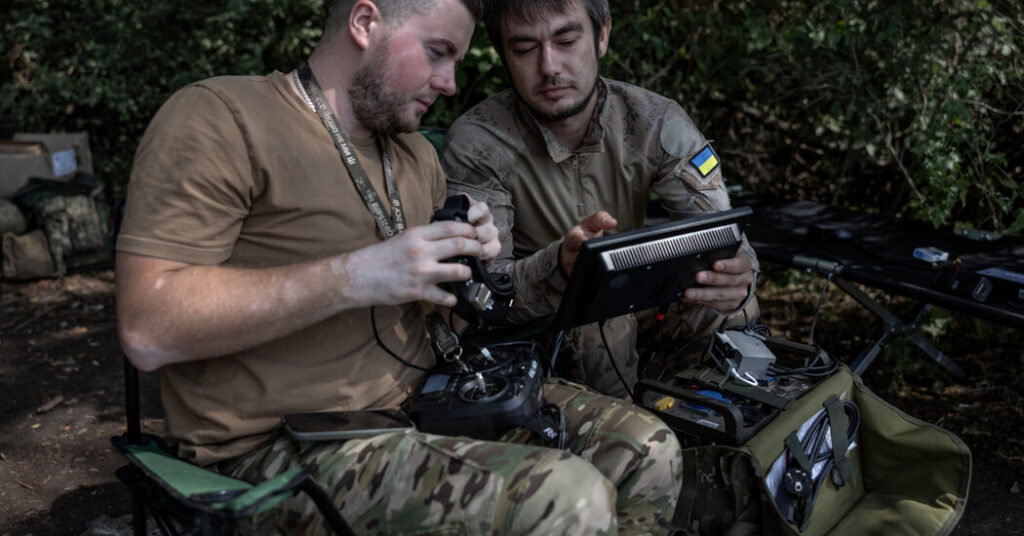
Before Russia’s full-scale invasion of Ukraine in 2022, Lee delivered parcels in Taiwan for a living, hung out with friends or played video games after work. He knew of Ukraine only from S.T.A.L.K.E.R., a game set in the Chernobyl nuclear zone.
Now, he is serving in the Ukrainian Army on the battlefield and hoping that what he has learned about drone warfare can help not only Ukraine but, someday, his own homeland.
“The war will happen one day with China, and then my experience will be valuable,” Lee, 37, said in an interview at a coffee shop in Kyiv, Ukraine’s capital, while on leave from the front. He asked to be identified by only his first name, in keeping with military protocol.
Lee is part of an emerging, informal network of ordinary citizens and defense companies building partnerships between Ukraine and Taiwan. Driven by the threat of conquest by much larger hostile neighbors, they are sharing lessons, resources and battle-tested technology.
Their efforts bypass the absence of official diplomatic or military relations between Ukraine and Taiwan, as well as sensitivities in both governments about upsetting China. The Ukrainian drone industry depends on China for most of its components, like motors and batteries. Taiwan, too, is deeply integrated into the Chinese economy.
Since 1992, Ukraine has adhered to the “One China” principle, which means it recognizes only the Chinese government in Beijing, not Taiwan. And to avoid antagonizing China, Taiwan does not want it to view it as going too far to aid Ukraine, given Beijing’s “no limits” partnership with Moscow.
Still, unofficial exchanges of military technology and expertise are occurring among executives of defense companies and volunteers like Lee. The two governments have also inched closer together as Taiwan has sent humanitarian and reconstruction aid to Ukraine, and Ukrainian lawmakers have visited Taipei, Taiwan’s capital.
Lee said he believed that Taiwan, as it tries to strengthen its defenses against any potential invasion by China, should adopt the inventive arsenal of flying, swimming and crawling robots that Ukraine has used to even the odds.
He said that when he travels home, friends he once served with in the Taiwanese Army, some of whom are still members, are overflowing with questions about drones on the Ukrainian battlefield.
They ask how a drone can be electronically jammed, or how to escape when one chases you, he said. In fact, little can be done if an exploding drone targets a soldier.
“Those questions are like baby questions — like asking how to eat,” he said.
Defense analysts and some retired Taiwanese defense officials have criticized Taiwan’s military over its sluggishness to innovate, including its failure to fully embrace the sort of asymmetric warfare that Ukraine has pioneered.
The Taiwanese government has also acknowledged obstacles to forming official defense connections with Kyiv.
“Ukraine’s experience in using drones in real combat environments is highly valuable,” said Tsou Yu-hsin, a deputy director general of the Industrial Development Administration in Taiwan’s Ministry of Economic Affairs. But wartime secrecy around drone technology, he said, made it difficult to study Ukraine’s techniques.
Yet one rank-and-file Ukrainian soldier who vacationed in Taiwan with his girlfriend was invited to speak to representatives of the Foreign Affairs and National Defense Committee in the Taiwanese Parliament.
The soldier, who pilots drones, said he spent hours last summer describing the war in Ukraine. He asked that his name be withheld because he had not been authorized to speak to the Taiwanese government or to The New York Times.
Ordinary Taiwanese are also trying to learn more. Tina Hu, 35, a project manager in Taipei, said she had read a civil defense handbook that mentioned drone safety based on Ukrainian experiences. She has found the location of a nearby bomb shelter and prepared a “go bag” with batteries, flashlights and food for each member of her family.
In the private sector, ties continue to grow. Taiwan has become what Ukrainian drone producers describe as a “gateway for Chinese parts.” Even after China tightened direct sales to Ukraine — a move that Ukrainian officials attributed to Beijing’s ties to Moscow — some components remained for sale in Taiwan, drone manufacturers said.
Taiwanese companies often route sales to Ukraine through Eastern Europe. Taiwan exported 70,372 drones to the Czech Republic and 31,711 to Poland in 2025, said Samara Duerr, a national security analyst at the Research Institute for Democracy, Society and Emerging Technology, a research organization in Taiwan backed by the Taiwanese government. Most ultimately wound up in Ukraine, she said, many through donations from charitable organizations to the Ukrainian Army.
The business connections go both ways. In Taiwan, international defense contractors market drone models to the military as battle-tested in Ukraine, but not sold directly by Ukrainian manufacturers. Taiwanese manufacturers have also sent drones to Ukraine for testing, said Gene Su, the general manager of Thunder Tiger, a major drone company in Taichung, a city in central Taiwan.
International defense contractors have asked Ukrainian engineers to devise specific designs tailored to Taiwan’s needs.
After Russia’s invasion of Ukraine, Oleksandr Mashchenko converted his successful wakeboard business into a maker of sea drones, sold under the brand name Strug. An industry contact later asked him to look into maritime drone systems to defend Taiwan against a Chinese invasion.
He told the contact that Ukraine could help. Taiwan needs defenses that extend well into the strait separating it from China. That, Mr. Mashchenko said, could involve underwater drones or surface drone platforms armed with interceptors. Ukraine has fielded similar systems in the Black Sea.
Soren Monroe-Anderson, the chief executive of an American drone maker, Neros, said his company was testing 100 drones in Taiwan that are based on designs developed in Ukraine. Neros has an office in Ukraine and is exploring opening production in Taiwan, he said.
“Our goal is to get capability developed in Ukraine to Taiwan and produce there in large quantities,” Mr. Monroe-Anderson said.
Lorenz Meier, the chief executive of Auterion, another U.S. defense technology firm with operations in Ukraine, signed a cooperation agreement last year with a Taiwanese research institution. The targeting software that his company codes is used extensively, and constantly refined, on the Ukrainian battlefield.
And in March, one of Ukraine’s largest defense start-ups, General Cherry, announced a partnership with an American company, Wilcox, that will produce General Cherry-designed drones in the United States. Wilcox sells its products in Taiwan.
Ukraine is eager to deepen partnerships around the world, and it recently signed security agreements with three Middle Eastern nations. But as the spread of Ukrainian-designed technology occurs beyond the control of Ukraine’s government, it has been a sore spot.
President Volodymyr Zelensky of Ukraine does not want Ukrainian-designed drones to be sold abroad merely as pieces of hardware. Instead, he is encouraging Ukrainian companies to offer subscriptions — to devices, software updates and the services of remote pilots in Ukraine. Such deals, Ukrainian leaders believe, would lead to more long-term security agreements with other countries.
He told journalists in March that he knew of at least 10 production facilities that had sprung up abroad where international defense companies and some Ukrainian firms were making Ukrainian-designed drones. A senior Ukrainian official and a defense industry representative, who spoke on the condition of anonymity to discuss a sensitive issue, said one such factory was in Taiwan.
Maria Varenikova covers Ukraine and its war with Russia.
The post Taiwan Could Learn From Ukraine. Informally, Connections Are Growing. appeared first on New York Times.