In 2022, La Nación, Costa Rica’s leading newspaper, broke several stories documenting a major sexual harassment investigation involving a presidential candidate, Rodrigo Chaves, who worked at the World Bank at the time.
Mr. Chaves was eventually elected as the country’s leader even though an internal investigation by the bank, where he held a senior position, led to his demotion.
As president, he has cozied up to Trump officials and has often used his position to frame the newspaper as an enemy of his administration. He berated its journalists and accused them of wanting to damage his government.
On Saturday, the U.S. State Department barred most of La Nación’s executives from traveling to the United States, the newspaper said in a statement. La Nación said the Trump administration had revoked the U.S. visas of five of its seven board members without an official explanation.
The newspaper said the move was “unprecedented.” The visa decision appeared to be part of a larger strategy by the White House to punish its critics and reward its allies, analysts said.
“In the absence of any explanation for this decision or objective reasons to support it, only one conclusion can be drawn: Its purpose has been to punish La Nación’s editorial stance,” the newspaper said in an editorial on Monday.
“Applying such a measure to nearly the entire board of a media outlet is unprecedented in our history,” it added. “In fact, we are not aware of any similar cases in other democratic countries.”
The State Department did not immediately respond to a request for comment.
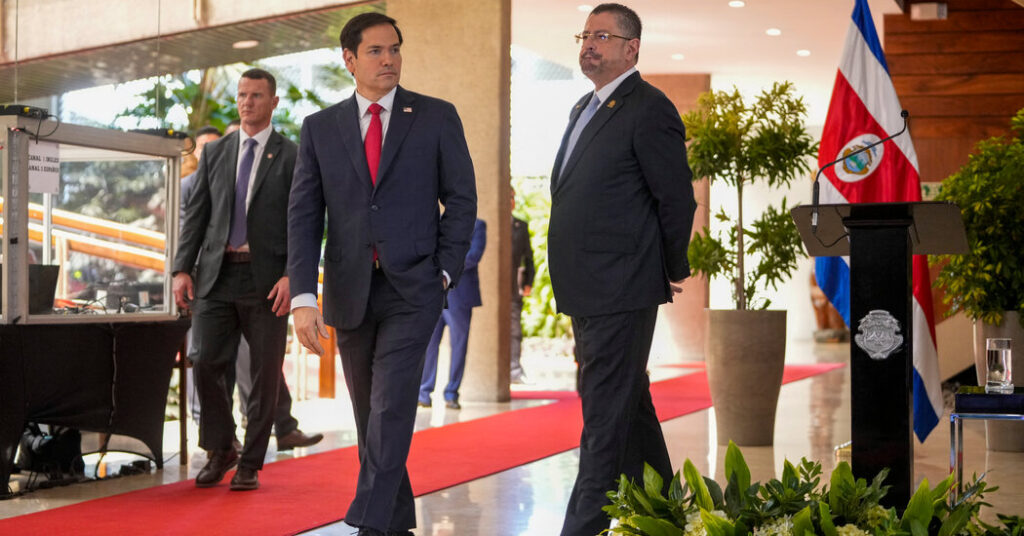
La Nación’s board members are the latest in a long line of people in Costa Rica whose U.S. visas have been revoked. It started shortly after Secretary of State Marco Rubio visited the Central American country last year. He showered Mr. Chaves with praise at a news conference and called Costa Rica “a model for what we want to see other countries in the region become and, frankly, the world.”
Mr. Rubio celebrated Costa Rica’s decision to ban Chinese 5G vendors, such as Huawei — a decree that Mr. Chaves signed in 2023 — and said that Chinese companies were a threat to the security of the region.
“We’re going to try to work in cooperation with you,” Mr. Rubio told Mr. Chaves then, “to impose costs on those within the country who use their positions of authority to undermine the interests of the people of Costa Rica.”
Trump Administration: Live Updates
Updated
- A judge slams the Trump administration for a ‘serious breakdown’ in legal ethics.
- A gunman exchanged fire with Secret Service agents near the Washington Monument.
- A judge questions a jail’s treatment of the suspect in the press gala shooting.
Two weeks later, the State Department revoked the U.S. visas of two opposition lawmakers who were vocal critics of Mr. Chaves’s 5G decree. Then it yanked the visa of Óscar Arias — a two-time president of Costa Rica and Nobel Peace Prize winner who, during his second term, broke diplomatic ties with Taiwan and partnered with China. It also pulled the U.S. visa of his brother, Rodrigo Arias, the president of the legislative assembly, who had favored trade with China.
In total, U.S. officials have canceled the visas of at least 15 Costa Rican officials and citizens, including former legislators and magistrates, “reportedly due to unspecified ties to China,” according to a report from the U.S.-based Congressional Research Service.
But analysts said that the latest targets at La Nación, including the board’s president, Pedro Abreu, signaled a broader pattern of punishing those who had criticized or scrutinized Mr. Chaves, who has sought to dismantle some of the country’s democratic checks and balances.
“It is extremely serious that the United States is using its immigration policy to punish political opponents” in Costa Rica, said Felipe Alpízar, the coordinator of the observatory on U.S. policy at the University of Costa Rica. The list includes people, he added, who do not represent “a risk to the United States at all.”
A spokesman for Mr. Chaves, 64, did not immediately respond to request for comment.
Revoking the visas of journalists who have exposed irregularities and possible acts of corruption in the Costa Rican government also goes against the United States’ previous efforts to promote democracy and a free press in the region, raising suspicions that the revocations could be the result of private deals between Mr. Chaves and the Trump administration.
“The only person who benefits from intimidating the press in Costa Rica is the president of Costa Rica himself,” Mauricio Herrera, a former Costa Rican communications minister, said in an interview.
All the members of La Nación’s board who had their visas revoked are Costa Rican nationals, Mr. Abreu, the board’s president, said in an interview, and several have personal, family, academic or professional ties to the United States. The only two members who were not affected, he added, hold passports from countries that do not require a traditional visa to enter the United States.
“This situation will not change our editorial line or our commitment to freedom of the press,” Mr. Abreu said.
Mr. Chaves, whose term ends on Friday, and his handpicked successor, Laura Fernández, a minister in his government who was elected this year, have offered a series of major concessions to the United States. The latest occurred in March, when Costa Rica agreed to take up to 25 foreign-born deportees a week from the United States — even though the country was severely criticized last year for temporarily confining 200 U.S. deportees in a former pencil factory.
Last year, two days after Mr. Trump took office, Mr. Chaves hinted at the kind of relationship he was hoping for with the United States.
“We understand this will be a relationship focused more on specific, transactional points rather than altruistic themes like democracy and so on,” he said at a news conference. “We’ll dance to whatever tune they play.”
David Bolaños contributed reporting from San José, Costa Rica.
Emiliano Rodríguez Mega is a reporter and researcher for The Times based in Mexico City, covering Mexico, Central America and the Caribbean.
The post U.S. Revokes Visas of Board Members at Costa Rica’s Top Watchdog Newspaper appeared first on New York Times.