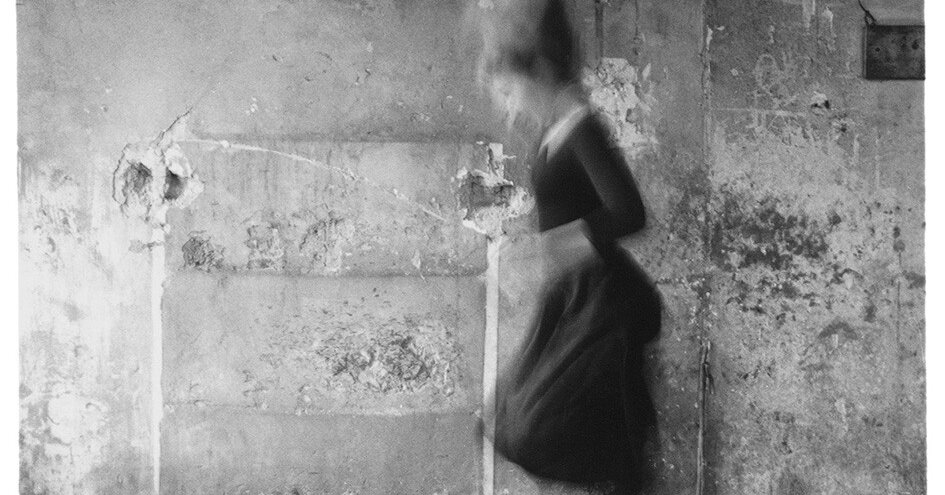
When the American photographer Francesca Woodman arrived at Rhode Island School of Design, in fall 1975, she was a voluble 17-year-old with a penchant for vintage dresses and poufy updos, and an established art practice. She died by suicide less than six years later, on Jan. 19, 1981. But not before creating a huge, influential body of work.
In essays in the 2006 monograph Phaidon Books published on her life and work, her friend Betsy Berne and her father, George Woodman, remembered that Francesca Woodman always carried what appeared to be her entire world with her in one or several large bags. Old ledgers and antique journals she repurposed into sketchbooks and journals. She loved to shop. “Today I came home from Newport seething with ideas,” she wrote in what archivists now refer to as Notebook III (from August 1975 to Dec. 31, 1975), “and a new hat.”
Woodman started working with photography in 1972, when her father gave her a small reflex camera. Among the early works she made at RISD is one black-and-white image of a large shell on a table, in which everything hovers just out of focus. Shot from a floating, slightly off-kilter viewpoint, the photo depicts a pair of disembodied hands advancing into the frame, proffering a piece of broken mirror. On one print of this image, Woodman wrote, in her characteristic, angular writing: “But lately I find a sliver of mirror is simply to slice an eye lid.”
This arresting phrase is the title of a show of Woodman’s work on view at Gagosian gallery in Rome (through July 31). With nearly 50 works, 15 of which have never been exhibited, it is an investigation of her connections with Surrealist literature and thought. This will be at least the 63rd posthumous solo show of her work since 1986, when the art historian Rosalind Krauss and Ann Gabhart, then the director of the Wellesley College Museum, co-curated the first.
For an artist “with a mere decade of a career,” as the Art Institute of Chicago’s photography curator, Matthew S. Witkovsky put it by phone, she attracts ever-intensifying attention. “It’s incredible, really,” he added. To understand why, The Times spoke to seven art-world insiders about Woodman’s influence.
She was exposed to the work of the Surrealists in 1977-78, when she spent a year in Rome as an exchange student. She hung out at the Libreria Maldoror, a countercultural gallery-bookstore specializing in Dada, Surrealism and Futurism, and made friends with local artists.
In a recent interview, Lissa McClure, the executive director of the Woodman Family Foundation, said she had long assumed that the titular shard of glass slicing an eye was a reference to Luis Buñuel’s 1929 silent Surrealist film “Un Chien Andalou.” After all, the art historian Chris Townsend devoted 10 pages of his essay on Woodman’s work for the Phaidon monograph to her interest in André Breton, Man Ray and other early Surrealists.
“But it turns out,” McClure said, “it is actually a reference to ‘The Snow Queen’ by Hans Christian Andersen that she read when she took a fairy tale class her freshman year at RISD.”
In Andersen’s tale, a hobgoblin makes a magical mirror that distorts the appearance of everything that it reflects. When it shatters into minuscule pieces, some pierce people’s hearts, leaving them cold to the world. Others pierce their eyes, forever changing their perception. Only the tears of a loved one can dislodge the shards.
Woodman’s RISD transcripts show she attended “The Fairy Tale” in 1976. And in a notebook entry from that year, she wrote, in enigmatic prose (the family foundation’s policy is to reproduce her writing exactly as it appeared, mistakes and all): “The morning is wiser than the evening say the Russian fairytales. I write her at night all this prattlings in my pocket a Sliver of mirror to slice an eyelid.”
From the outset, Woodman’s work has stopped viewers in their tracks with its strangeness and allegorical world building.
Artists and art historians cite her symbolic use of objects (eggs, eels, melons, garters) and her mesmerizing pictures of naked bodies in disused rooms, appearing to disappear behind torn pieces of wallpaper, or to take flight, with only their feet in focus. The photographer Tyler Mitchell said, in an interview, that he took inspiration from Woodman’s intentionality and playfulness.
Mostly, as Krauss noted in her 1999 book, “Bachelors,” it is Woodman’s utter dedication to her studio practice, her seriousness and her formal problem solving that lend her work such potency. In a recent interview, the photographer Alice Zoo said that as a young artist who had been schooled in social documentation, she found the way Woodman used photography to speak to “the numinous or the paranormal or the mythic” completely revelatory.
“I hadn’t seen that done before, and I think it just expanded what I felt was possible in photography,” she said.
Zoo has contributed an essay to “23 Devotions for Francesca Woodman,” a forthcoming book on the photographer from Saint Lucy Books. In a recent interview, Mark Alice Durant, an artist and writer who founded the small art press, explained that this project, scheduled for publication in 2027, was not reverential or nostalgic, but was rooted, instead, in respect for the artist’s lineage.
“I think that she, in her short life, did some extraordinary things,” Durant said, “explored some really beautiful, terrifying, moving, important, you know, sacred spaces.”
That there are still works to discover from a career that spanned less than a decade speaks to Woodman’s prolific output. It also highlights the foresight with which her parents shepherded her work after she died.
Given that Woodman died at just 22, and that she frequently photographed herself and explored, with startling intensity, early womanhood, sexuality, representation and erasure, her work has often been read through the lens of her untimely death, a profound and private familial tragedy. The actions her mother, the ceramist Betty Woodman, and father, George, who was also an artist, nonetheless took underscore how keenly they understood the enormous import and power of the work in its own right and the need to protect her legacy.
In the interview, McClure said the pair started the family foundation in 1994.
“Unbeknownst to many people, they set aside much of Francesca’s work, her lifetime prints,” McClure said. “So the best prints of everything, they set aside; if there was only one print of something, it was set aside.”
As a result, for a long time, the public largely only knew the 100-plus works George had suggested for inclusion in a 1998 exhibition of Woodman’s work at the Fondation Cartier in Paris, which then appeared in the show’s widely distributed catalog. But McClure said that was only a fraction of Woodman’s total output, which includes photographic prints, the monumental “Blueprint for a Temple” collages, diazotypes and seven artist books.
This careful dissemination means that instead of Woodman’s works being quickly sold off to private buyers, as sometimes happens with estate inheritances, her photographs are being acquired by museums. In 2025, the Art Institute of Chicago bought 30 of Woodman’s works, including gelatin silver prints, a large-scale diazotype from the “Caryatid” series and two artist’s books — a boon for scholarly research on Woodman’s oeuvre.
The family foundation became actively operational in late 2020, after Woodman’s parents had died. Researchers now have access to much more of Woodman’s own voice, via her personal correspondence and notebooks.
In a recent interview, the curator Magdalene Keaney noted the “fantastic sense of humor” that comes through in Woodman’s writing and the way she is constantly working out ideas. “She also often uses language in a really interesting and unconventional way,” she said.
Woodman herself described her idiosyncratic spelling and madeup words as “Steinwriting,” a nod to Gertrude Stein.
“This evening, I am not so pleased,” she writes in one 1970s notebook, bemoaning with robust self-deprecation and impatience her own romanticism. “I think that my effort to do away with this attitude in my work has had strange effects on my life. Photography is too connected with life. I take pictures of reality as filtered through my mind.”
As the works in this show demonstrate, that mind was a universe all its own.
The post A Show in Rome Sheds New Light on Francesca Woodman’s Haunting Images appeared first on New York Times.