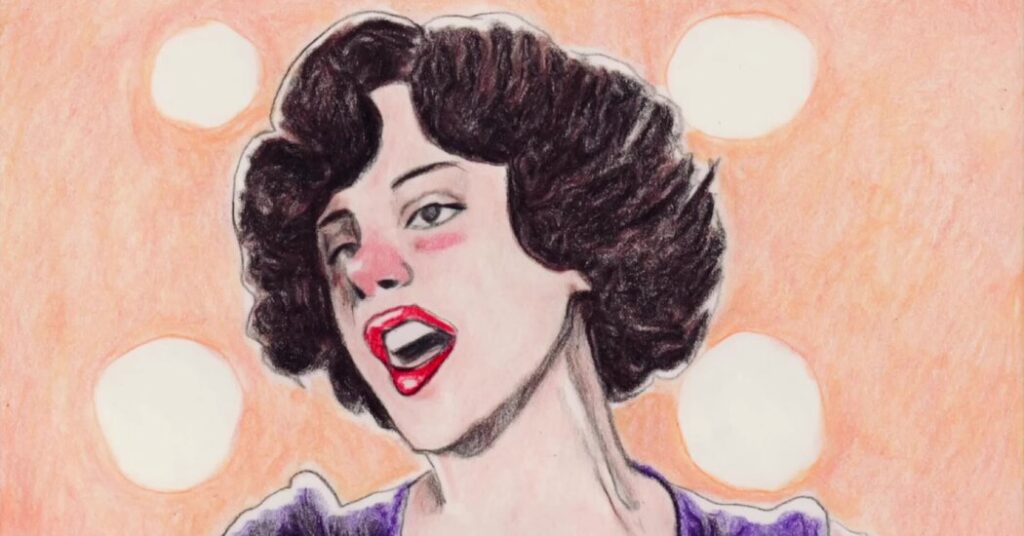
They are the big mouths of musical theater. The ones with their dental work on display. The ones who look as if they’re eating an invisible apple whole.
They sing the most dramatic songs, starting low and soft to win your confidence. But the breathy pianissimo is just preparation for the long climb from sorrow to exaltation, found only at the top of their range.
They are the belters, though many don’t like the term. Others don’t like the sound. Too loud, too high, too intense, they say — which, oddly, is exactly what the rest of us love. Belters tell a part of our story no one else can tell.
That story is largely American. Women like Ethel Waters and Sophie Tucker, assisted by the classic songwriters whose work they sang, took the dainty European operetta sound of early Broadway on a tour of synagogues, factories and juke joints, dragging it by its petticoats in new directions. By the 1940s, Ethel Merman, a former stenographer for the B-K Booster Vacuum Brake Company in Queens, could be the queen of musicals, the five-alarm voice in a crowded theater.
Now there are six-alarm voices. (Merman topped out around a C; Idina Menzel belts an F in “Defying Gravity.”) Now, too, we acknowledge the male belting voice. And a debt to the Black singers who found the depth in a joyful noise.
To celebrate and explain the thrill of that sound, we assembled a chorus of 15 people who love the belt, including Lea Michele, Jennifer Hudson, Adam Lambert, Christine Ebersole and other stars and experts. We asked them to name a performer who might convert agnostics into fans, and to provide a Broadway or Broadway-adjacent song as evidence. Naturally, their testimony is dialed to the max: as loud and intense as belting itself. — Jesse Green
Barbra Streisand
‘My Man,’ from ‘Funny Girl’
“My Man” was a song that the actual Fanny Brice recorded, and it was a very depressing and dramatic song, but what Barbra did with it is she turned it into one of the greatest belter songs of all time. It’s not from the Broadway show — it was in the film. But fun fact: At her closing night on Broadway, she sang “My Man” after her curtain call, and I had to do the exact same thing after we did our bows at our final performance, and it was probably the greatest moment of my life. Fanny Brice walks onto the stage, and she’s all alone, and she dedicates this song to the love for this man that will in some ways make her feel more alive than performing ever could, and not only is she able to just stand still, with her feet planted in the ground — which is something we don’t see very often anymore — but she’s able to belt and give the most pristine level of vocal ability that you have ever heard while crying at the exact same time. That is one of the greatest performances I have ever seen in my entire life and I have since tried to recreate it many many times.” — LEA MICHELE, singer and actor
 Listen on Spotify, Apple Music and YouTube
Ethel Merman
‘I Got Rhythm,’ from ‘Girl Crazy’
To find out how Broadway fell in love with belting, you’ve got to go back to the brassy broad who started it all: Ethel Merman. Voice like a trumpet, nerves like steel hawsers and the lung capacity of an Atlantic steamer, Merman made her Broadway debut in 1930 as the second female lead in “Girl Crazy,” which had songs by George and Ira Gershwin. The one that would become a signature, “I Got Rhythm,” starts out jaunty and tooting like a train whistle, and then shifts into taking up real space. In the second verse, Merman holds a C — somehow getting more powerful the more she exerts herself — as the band executes the melody under her. “I just stand up and holler and hope my voice holds out,” Merman said, and somehow it always, always did. Every belter who followed was blasting away in her nearly unfollowable footsteps. — HELEN SHAW, New York Times chief theater critic
Listen on Spotify, Apple Music and YouTube
Jennifer Holliday
‘And I Am Telling You I’m Not Going,’ from ‘Dreamgirls’
I was introduced to “Dreamgirls” through Jennifer Holliday’s voice. “And I Am Telling You” (by Henry Krieger and Tom Eyen) is Effie’s battle cry: her story, her pain, which so many can relate to. It’s earth-shattering. For me, seeing it via video, I could only imagine what theatergoers felt like while watching her. I wish I could be transported back in time, but 1981 was the year I was born, so I wasn’t able to see her do it live. Her voice is like thunder — it has a roar to it, it has the belly in it. It’s the type of voice you want to hear in theaters and arenas and stadiums, that can fill the entire space and probably shatter it too. By the time it was time for me to play the role in the movie, it was beyond intimidating, because there was absolutely nothing left. I remember saying, what am I supposed to do, stand on my head and sing it? — JENNIFER HUDSON, singer, actor and talk show host
Listen on Spotify, Apple Music and YouTube
Idina Menzel
‘Defying Gravity,’ from ‘Wicked’
The thing that is so thrilling about Idina’s voice, especially in “Defying Gravity,” is that as she’s climbing higher and higher, vocally and literally, you think: Is she gonna make it? Is she gonna make it? And she makes it! But that doesn’t happen without amazing technique. After our little moment together in that song, I would go to the side of the stage and watch her sing the rest of it. I could see how she breathes from her back, sending the sound around her like an inner tube. Also, by keeping the larynx down and thrusting her tongue forward a little bit, she forces the sound through an opening only about an inch wide, which resonates in the dome of her mouth and comes out huge. Then there’s her God-given shimmer — and something else. She’s an original. You can imitate her sound but not what comes with it. That’s because she’s not just singing Stephen Schwartz’s music but also living his lyrics: “Tell them how I am defying gravity / I’m flying high, defying gravity!” And her voice does exactly that. She’s releasing the hounds, and it’s thrillifying, if I may, because it’s exactly the same technique as in the very quiet, unforced “I’m Not That Girl,” earlier in the act. I don’t even call it belting. I call it “one voice.” — KRISTIN CHENOWETH, singer and actor
Listen on Spotify, Apple Music and YouTube
Joshua Henry
‘Wheels of a Dream,’ from ‘Ragtime’
What does hope sound like? What does hope feel like? “I see his face,” Joshua Henry sings softly, his voice quivering with wonder over his baby son at the start of “Wheels of a Dream” from “Ragtime.” It’s an anthem (by Stephen Flaherty and Lynn Ahrens) that quickly becomes about the face of America, too — a just and equitable America that Henry’s Coalhouse Walker Jr. imagines for Black men and families someday. Henry’s confident baritone grows in power as shares his hopes with the son’s mother, Sarah (Nichelle Lewis). In those minutes, Henry’s voice is so certain, so convincing, that it makes us forget the unlikeliness of his dream. Henry’s belt is essential here: Coalhouse’s voice needs to soar so high that he can convince even himself of an America that is not yet true. He sweeps us away with the promise of possibility. “He’ll travel with head held high / Just as far as his heart can go,” Henry booms in the last seconds. That’s what hope sounds like. — PATRICK HEALY, Times assistant managing editor and former theater reporter
Listen on Spotify, Apple Music and YouTube
Patti LuPone
‘Forever Beautiful,’ from ‘War Paint’
My nightly ritual as a cast member of the 2017 Broadway production of “War Paint” was to watch Patti LuPone perform her 11 o’clock number, “Forever Beautiful,” as I waited backstage for our final scene together. I loved watching Patti, as the cosmetics magnate Helena Rubinstein, sing this full-spectrum moment, because I got to witness yet another thrilling performance by the greatest belter in the history of musical theater.
Night after night as she savored Michael Korie’s lyrics about the solace and eternal nature of art in the face of earthly abandonment, set to Scott Frankel’s cinematic music, she started low and angular, then ultimately soared to the top of the belfry for the whole town to hear. I marveled at her vocal strength and fortitude, in awe of how she would build this song to a climax, without a waver of intention or passion. At the song’s finish, I was always left in shivering goose bumps. If I ever imagined going on in her place, and singing that high-wire song, this soprano could only resort to mixing the note, a reasonable facsimile that would never achieve the authentic sound of a true belter. Ah, maybe next life.
Toward the end of the run, which came earlier than planned — Patti needed a hip replacement — it was upsetting to see her offstage before the final scene, barely able to walk. She was in a tremendous amount of pain, her face an agonized grimace, yet when she made her entrance, by sheer force of her will, she commanded the pain to vanish without a trace while she delivered every note and every word at full throttle, full capacity and full command of her gifts, belting and otherwise. — CHRISTINE EBERSOLE, singer and actor
Listen on Spotify, Apple Music and YouTube
Lena Horne
‘Stormy Weather,’ from ‘The Lady and Her Music’
Debuted by Ethel Waters at the Cotton Club in 1933, “Stormy Weather” was already a classic when Lena Horne recorded her first version of it in 1941. She would continue to record it over the years, revising her interpretation as life revised her. The lyric by Ted Koehler speaks of a faithless lover, but the moaning music by Harold Arlen hints at something bigger, which Horne eventually identified for herself as the heartbreak of racism. By the time she starred in “The Lady and Her Music,” her 1981 one-woman Broadway show, she had to sing it twice during each performance to reveal all she had mined from it. First, in Act I, it was a sad but standard torch song; near the end of Act II, her voice rising higher and burning brighter, it was a wildfire. In the process, a meek complaint became a shattering indictment: America was the faithless lover, and yet Horne would emerge triumphant. — JESSE GREEN, Times culture correspondent
Listen on Spotify, Apple Music and YouTube
Eydie Gormé
‘If He Walked Into My Life,’ from ‘Mame’
Eydie Gormé remains, for us, the gold standard of Broadway belting. Just go to YouTube and watch her impeccable “Ed Sullivan Show” performance of Jerry Herman’s “If He Walked Into My Life” from “Mame” to hear her thrilling voice in full command. Or Burton Lane and Alan Jay Lerner’s “What Did I Have That I Don’t Have” from “On a Clear Day You Can See Forever.” For Gormé, belting is never merely about “money notes.” It becomes emotional storytelling at white heat. Add to that her wit, her perfect diction and that irresistible physicality — her whole body seeming to pulse with pure show business — and you have a songwriter’s dream.
As songwriters, we also marvel at how the lyrics are so exquisitely tailored to the very specific dramatic circumstances of the shows — an aunt and her nephew in one case, reincarnation in the other — yet somehow also emerge as stand-alone torch songs that Gormé transforms into crushingly personal confessions of heartbreak despite her famously happy 56-year marriage to the singer Steve Lawrence.
In 1968, when 13-year-old Scott was given the choice of seeing the groundbreaking “Hair” or the fourth-wall-breaking “Golden Rainbow” starring Eydie and Steve, you can guess which he chose. Decades later, after seeing “Hairspray,” they sent a note saying it was as if we’d written the song “Timeless to Me” for them. Which we had.
We have admired and even worked with some of the all-time greats as they cooked up a hearty buffet of belting, but there is only one true Gormé. — MARC SHAIMAN and SCOTT WITTMAN, songwriters
Listen on Spotify, Apple Music and YouTube
Cynthia Erivo
‘I’m Here,’ from ‘The Color Purple’
Watching Cynthia Erivo perform ‘I’m Here’ from ‘The Color Purple’ (by Brenda Russell, Allee Willis and Stephen Bray) is one of those rare moments where time just stops, something she does every single time she sings. I had the pleasure of seeing her in the musical on Broadway. At the time I wasn’t familiar with her work, but I remember being absolutely floored by her grounded technical control, while still remaining brilliantly fluid in her storytelling. I left the theater that night knowing we would all be hearing her name more and more. The truth she brings to her performances is beyond just vocals; it’s her soul on full display. — ADAM LAMBERT, singer and songwriter
Listen on Spotify, Apple Music and YouTube
Susan Johnson
‘Ooh! My Feet!’ from ‘The Most Happy Fella’
This is the opening number of the show, and it takes place when a restaurant is closing and the sidekick character, Cleo, is exhausted from being a waitress all day. As they’re cleaning up all around her, she sings this Frank Loesser song. When I was a kid, my parents would play records, and this song just got into my head at a very young age, and I really became obsessed with it. In terms of belting, it set the stage for the kind of voices I’ve loved all my life. It’s loud, first of all. It just has an incredible tone. It’s not a high belt, but it’s a very bright belt, and it’s thrilling. It just gives me endorphins. The song itself has this really cool dissonance — the bass part sounds like you’re clomping around and everything hurts. Johnson has a really fast vibrato, and every time she sustains a note, she lets the vibrato rip. Right at the end, when she sings “doin’ my blue plate special ballet,” she puts vibrato on the second syllable of the word “special,” and I used to pick up the needle and put it back just to hear that spin, because it’s so exciting and joyous and buoyant. Johnson never really had a hit show, but she set the stage for the type of belting that we all became obsessed with. She laid the groundwork. — SETH RUDETSKY, SiriusXM Broadway host
Listen on Spotify, Apple Music and YouTube
Joaquina Kalukango
‘Let It Burn,’ from ‘Paradise Square’
The Broadway musical thrives on the extraordinary, almost superhuman ability to create deeply passionate and visceral moments. Joaquina Kalukango’s performance of “Let it Burn” from “Paradise Square” (music by Jason Howard; lyrics by Nathan Tysen and Masi Asare) does just that, testing the limits of her vocal and emotional range. To create the catharsis at the end of the show’s tragic story about the Civil War draft riots that pitted Black Americans against their Irish American neighbors, she digs deep into her vocalism to take what many will call her belt voice to almost unthinkable heights.
I don’t use that term though. “Belting” is really just an active, powerful chest voice carefully coordinated with the cushion of head voice. Done right, it allows the singer to sing very high with full richness but without stripping the gears by adding unwanted and unnecessary volume. It’s what Pavarotti described as “the educated scream.”
Kalukango does it right, regulating intensities throughout her range with complete control. You can hear that in the song’s quiet opening passages and in some of the burnished, less frantic moments throughout. Hers is a complete voice but, more than that, a complete performance. Opera calls it chiaroscuro. I call it excitement balanced with sympathy and deeply anchored pain. — ARTHUR LEVY, voice teacher
Listen on YouTube
Megan Hilty
‘They Just Keep Moving the Line,’ from ‘Smash’
I’ve been a fan of Megan for a long time — her instrument is so brilliant. To be able to do a legit soprano and then go directly into a belt is so impressive, and her sound quality is just so good. “They Just Keep Moving the Line,” by Marc Shaiman and Scott Wittman, is this plea of a song — no matter what you do, you can do everything right, and somehow, they’re going to move the line further and further away from you, just to keep you from succeeding. You can feel the emotion that she brought to it, and her voice quality in singing such a brassy number, with the horns, and still keeping up with the instrumentation of it, and cutting through, her voice was palpable, and that was a testament to her prowess as a singer. — ALEX NEWELL, singer and actor
Listen on Spotify, Apple Music and YouTube
Lillias White
‘The Oldest Profession,’ from ‘The Life’
Lillias White kicks off “The Oldest Profession,” from the 1997 musical “The Life” by drawling out the lines “I’m worn out and weary / I ain’t no machine / My head hurts, my feet hurts / And ev’rything in between.” The lyrics (by Ira Gasman) continue in the same confessional vein, but White’s rendition of Cy Coleman’s bluesy tune lets us hear the indomitable life force in Sonja, the prostitute she portrayed in the show. Perfectly illustrating the idea that a great belt is the earned end point of a song-length journey, White drops hints that she’s holding back: Words sprout extra syllables, notes are pulled and stretched like warm taffy, an occasional frisky trot on a lyric suggests the final runs to come. After several minutes of a confident buildup — there is never any doubt that a big payoff is coming — White finally brings the song home. The twist: Sonja is still singing that she’s tired, but with a vibrant energy that feels like a force field vibrating around her. This is a woman who may be down, but who will never be out. — ELISABETH VINCENTELLI, Times theater writer
Listen on Spotify, Apple Music and YouTube
Marisha Wallace
‘Maybe This Time,’ from ‘Cabaret’
The London musical theater star Marisha Wallace has a belt that could blow the walls off, and when she performed last year in Rebecca Frecknall’s revival of Kander and Ebb’s “Cabaret” — in the West End and on Broadway — so did her Sally Bowles. A lost soul of a nightclub singer, Sally finds a haven in the boardinghouse room she shares with the American novelist Clifford Bradshaw, whom she would love to love her madly. When she discovers that she’s pregnant, he proposes a future in which baby makes three.
“Maybe This Time” is Sally pondering that offer. A slinky number about her soul-deep yearning to have at last a man who stays, it is not necessarily a belting song. But in this concert version, recorded during Wallace’s London run in “Cabaret,” quiet regret and tentative hope gather force and sultriness until the sheer might of emotion bursts, undammed. — LAURA COLLINS-HUGHES, Times theater writer
Listen on Spotify, Apple Music and YouTube
Michael Paulson and Jesse Green interviewed the contributing artists.
The post Streisand, LuPone, Holliday, Menzel: Broadway’s Biggest Voices appeared first on New York Times.