The sound of a mighty tree falling fills the air before the curtain rises on Akram Khan’s “Lady Macbeth” for the Royal Danish Ballet. It suggests the end of an old order, the demise of empire, the implacability of the natural world.
All of these are dominant themes in Kahn’s new full-length ballet, which comes 10 years after the success of his “Giselle” for English National Ballet. That commission was a gamble, since Khan, known for his fusion of Indian Kathak and contemporary dance techniques, had never created a full-length piece for a ballet company.
It paid off. “Giselle” became a calling card for English National Ballet and toured internationally. So “Lady Macbeth,” commissioned by the Royal Danish Ballet’s former director Nikolaj Hubbe, is another significant premiere for the company in a season that has already boasted Alexei Ratmansky’s magisterial new “Art of the Fugue.” Both show the company’s capacity to move outside of its distinctive style and tradition, forged by August Bournonville in the 19th-century.
The characteristics of that style are fleet, fluid footwork, airy bounding leaps and an ebullient, sweet-natured charm. Whereas Ratmansky alluded to that heritage, Khan draws from another 19th-century ballet tradition: the Romantic fascination with the gothic and the supernatural.
For “Macbeth,” he has brought back two important members of the “Giselle” team: the composer Vincenzo Lamagna and the set and costume designer Tim Yip, whose magnificently huge, root-dangling tree descends slowly over the stage during the course of the ballet. (The dark-hued, subtly atmospheric lighting is by Michael Hulls and Ryan Joseph Stafford.)
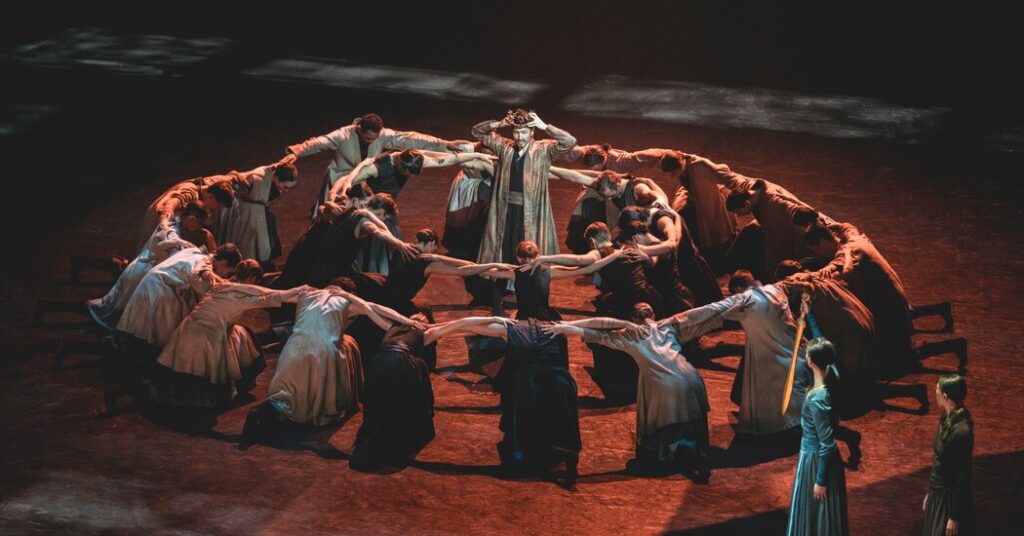
From the outset, it is clear that this won’t be a straightforward version of Shakespeare’s “Macbeth.” (Kahn’s version follows a “Lady Macbeth” by Helen Pickett and James Bonas for Dutch National Ballet last year that seems to have taken a more traditional approach.) Rather than beginning with the witches’s prophecy that propels Macbeth to kill King Duncan, Khan opens with concentric circles of dancers, immobile and silhouetted on a darkened stage, as Lady Macbeth (Astrid Elbo) and Macbeth (Sebastian Pico Haynes) approach each other from beyond the circle.
A pas de deux, set to slow piano music, is full of whirling turns and supported falls, suggesting their love and mutual dependence. It ends when Macbeth touches her stomach hopefully and she shakes her head. As he and the surrounding ensemble back away, a spotlighted female figure holds out her arms to Lady Macbeth.
This is Lady Macduff (Emma Riis-Kofoed), who is also confusingly called the first seer, the name that Khan gives the witches, who are soon the subjects of a murderous hunt by the king and his soldiers. This is an allusion (we learn from the program) to the witch hunts carried out by King James I in Shakespeare’s time.
It is Lady Macbeth’s solidarity with Lady Macduff and the seers — a black-garbed, longhaired group who have much in common with the Wilis in Khan’s “Giselle” — that is the emotional core of the ballet. Her horror at the killing of the seers, Khan suggests, not naked ambition, motivates her desire for Duncan’s murder. Later, her revulsion at her husband’s actions and her mental collapse come not from blood-on-her-hands guilt, but from her realization that Macbeth will continue to rule through bloodshed and war.
This transformation of Lady Macbeth from catalyzing villain to pure-intentioned heroine flattens the character and sits uneasily within the Shakespearean narrative that Khan partially adheres to. Elbo is a beautiful dancer, but she isn’t given quite enough to do — she doesn’t get a significant solo, nor do the Macbeths have a dramatic, central pas de deux that might tell us more about their relationship or the conflicting forces at play. As a result, it’s hard to care about their unraveling partnership or her tragic losses.
Riis-Kofoed’s overwrought Lady Macduff feels more fully at the center of an emotional storm, a kind of Cassandra who cannot bear to live out her social role at court while bearing witness to the fate of the seers.
The men remain largely unfocused: Macbeth, beautifully danced by Pico-Haynes, has not much more to do, emotionally speaking, than look triumphant or desperate. Duncan, Macduff and Banquo are similarly unidimensional.
The real core and strength of this “Lady Macbeth” is the ensemble choreography, where Khan’s fusion of ballet’s extended lines, folk dance earthiness, Kathak’s stamping, whirling turns and the low-to-the-ground weightedness of contemporary dance are blended to brilliant theatrical and visual effect.
The interwoven, gliding movement of the seers, the thronging formations of warriors and the circling dances of the courtiers evoke the larger forces that Khan is concerned with: masculine versus feminine, social order set against the natural world, the warlike opposed to the spiritual.
Khan’s ballet is less an alternative version of “Macbeth” than a meditation on some of its themes. But even those familiar with the play might find Khan’s relationship to it puzzling without the program notes. Focusing on the redemptive virtues of the feminine connection to nature, Khan leaves us without the deeply human drama that lets us feel the story as a tragedy.
The post Review: Out, Damned Patriarchy! A Revisionist Ballet ‘Macbeth’ appeared first on New York Times.