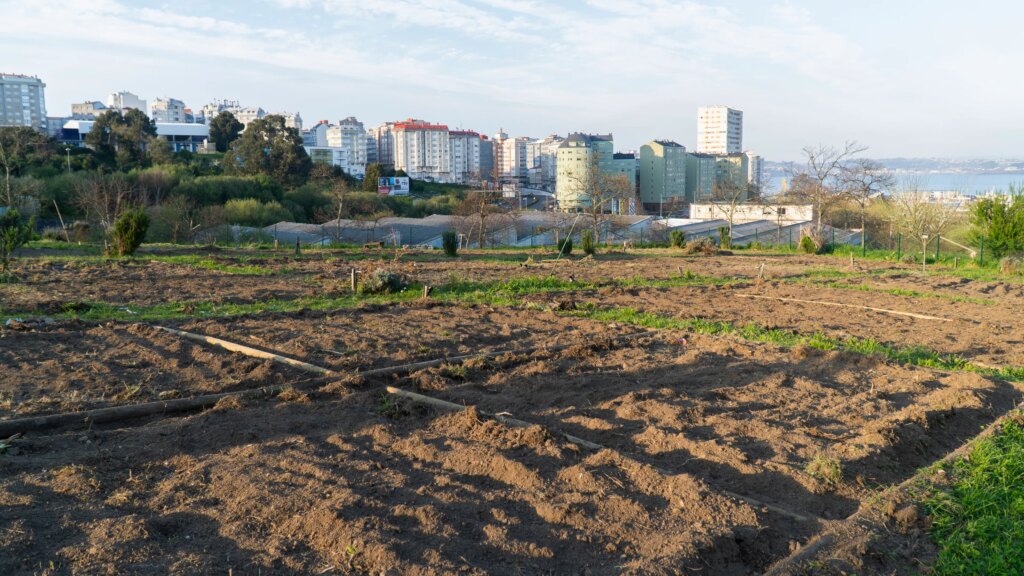
Most of the time, an urban rooftop is not a pretty place—a tarpaper or concrete griddle in summer, a windswept waste in winter. But if a new study in the journal Sustainable Cities and Society is correct, city roofs—along with vacant lots and urban greenspaces—could become something else entirely: farms. Deployed and reclaimed just right, the researchers found, urban gardens could meet up to 28% of the fruit and vegetable demands of 190 million people across the continent of Europe.
The study, led by Stepan Svintsov, a researcher at the Leibniz Institute of Ecological Urban and Regional Development in Dresden, Germany, employed a surveying and modeling program known as geographical information systems (GIS) to catalogue available space on rooftops and the ground in 840 cities across 30 European countries. The smallest city in terms of population was Melun, France, with 9,000 people; the largest was Paris, with 7 million. The smallest city in terms of geographical reach was Mislata, Spain, at 0.2 sq. km; the largest was Paris again, at 100 sq. km.
Not every potential spot that appeared on an urban map was a good candidate for agriculture. The researchers do not envision using high-tech systems such as vertical-farming or hydroponics to grow crops. Rather their goal was to focus on what’s easiest for most people: old-school, low-tech, soil-based farming. That makes for a low entry bar, but also presents some of the same challenges that have to be controlled on ordinary farms—including erosion and soil and nutrient runoff. For that reason, they limited their roof selection to those that were sloped at no more than 2°.
“We need to level off the rooftop,” says Prajal Pradhan, associate professor in the faculty of science and engineering at the University of Groningen in The Netherlands, and a co-author of the study. “That’s why we use the two-degree rule.”
Not every region in Europe is created equal either. In the southern tier of the continent, water scarcity and high evaporation rates limit urban farming. In the north, lower temperatures and reduced daylight shorten growing seasons. In central and western Europe, high population density and competing use for land are local limiters.
Taking all of those x-factors into consideration, the researchers concluded that from 4,500 to 7,500 sq. km. of urban land and rooftops could be used for cultivation—the equivalent of up two two islands the size of Mallorca. Overall, up to 9% of the average city’s footprint could support rooftop farming and 7.2% could support ground cultivation.
That spells a lot of fruits and vegetables—from 11.8 million to 19.8 million tons annually. Different cities would benefit in different ways from this bounty. Berlin, for example, could have up to 45% of its produce needs met by growing within the city limits. Cerdanyola del Vallè, near Barcelona, would actually run a harvest surplus—growing enough to meet 140% of its annual needs. Scaled up outside of Europe to the world at large, the researchers cite another group’s study showing that urban farming could provide from 5% to 10% of the planet’s fruit and vegetable needs.
Urban cultivation does more than fill grocery shelves and farmers’ markets—it also reduces greenhouse gas output, eliminating the carbon load produced by shipping fruits and vegetables across a continent or ocean. “Let’s say you have a tomato that is produced in Spain and transported to Germany,” says Pradhan. “Compare that to a tomato produced within Berlin.”
The so-called “last mile problem”—the distance consumers have to travel from their homes to the grocery stores to buy their produce—could also be eliminated or reduced. When crops are being grown directly overhead or in adjacent lots, there’s no travel involved at all. All of this contributes to achieving what is known as the 15-minute city ideal: designing urban spaces so that residents are nowhere more than a one-km, 15-minute walk or bicycle trip from all of their basic needs.
There are other knock-on benefits of urban farming—not least reducing urban temperatures. In summer, brick, concrete, and asphalt cities are nothing short of heat sinks, baking in the high sun during the day and radiating heat back out at night. Carpeting rooftops and empty lots with vegetation combats this, producing an overall cooling effect. Pradhan cites studies showing that residences in the vicinity of an urban garden do experience lower summertime temperatures than those farther away.
Transforming underused city space into farm space is not a perfect solution. The researchers concede that growing crops within urban centers could expose the food to heavy metals like lead, zinc, cadmium, and nickel, carried in runoff from cars, factories, and aging buildings. What’s more, every hectare (2.5 acres) of urban land that’s given over to farming is one less hectare of greenspace available for recreation—a critical feature for any livable city.
Still, the researchers conclude, the fruits—both literal and otherwise—of urban farming easily outweigh the downsides, contributing not only to better provisioned residents, but happier ones too.
“There are a lot of [benefits] related to mental health,” Pradhan says. “It’s not only about biodiversity, it’s not only about environment, it’s not only about food, it’s also about a way of healthy living. This is all part of a healthy lifestyle.”
The post City Farming Could Supply Nearly 30% of Europe’s Fruit and Vegetable Needs, Study Finds appeared first on TIME.