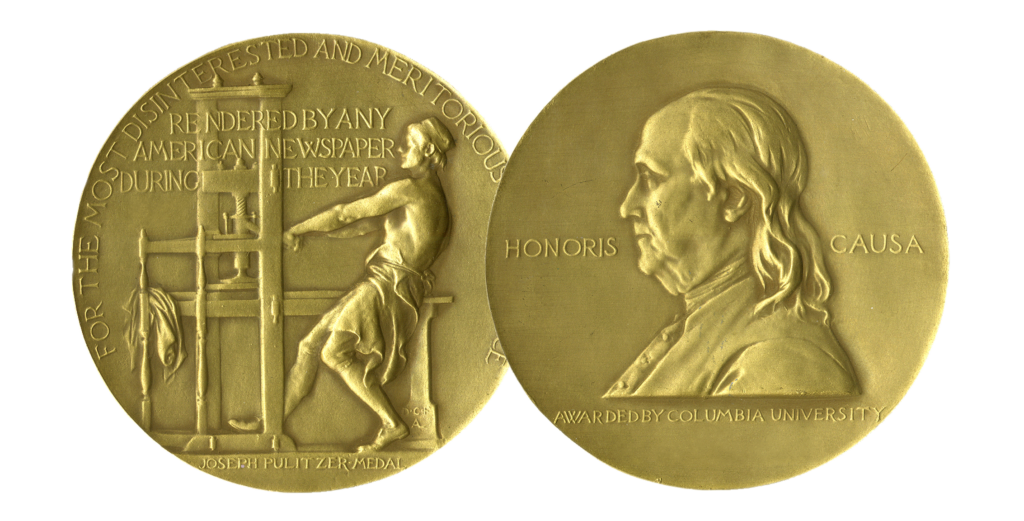
The Washington Post on Monday won the Pulitzer Prize for public service for its coverage of President Donald Trump’s far-reaching efforts in his second term to shrink the federal workforce and overhaul government through the Elon Musk-led U.S. DOGE Service.
The Post also won the Pulitzer Prize for feature photography for work by former staff photographer Jahi Chikwendiu documenting the struggle of a young couple coping with a terminal cancer diagnosis even as they awaited the birth of their daughter.
The stories that won the public service prize, widely considered the top honor in American journalism, prominently featured staff writer Hannah Natanson’s reporting that chronicled how federal workers’ lives were upended last year. In an essay, she recalled being the newspaper’s “federal government whisperer,” a role she described as all-consuming, involving interactions with more than 1,000 sensitive government sources.
On Jan. 14, FBI agents executed a search warrant at Natanson’s home in Virginia, seizing equipment while subpoenaing The Post that same day. Natanson wasn’t the target, the government said, but it alleged that the raid was necessary in an investigation into a federal contractor accused of illegally retaining classified government materials. The Post is in court litigating Natanson’s case, attempting to retrieve her electronic devices and arguing that the government’s actions amounted to an unprecedented overreach that could chill journalists’ ability to do their jobs in the future.
In its citation, the Pulitzer jurors said they recognized The Post for “piercing the veil of secrecy around the Trump administration’s chaotic overhaul of federal agencies and chronicling in rich detail the human impacts of the cuts and the consequences for the country.”
The public service prize is awarded to The Post as an institution. Meryl Kornfield and former Post staff writer Jeff Stein also heavily contributed to the package, which drew from journalists’ work across the newsroom.
Trump’s effort to downsize the federal government ricocheted through official Washington power corridors, as well as D.C.’s neighborhoods and suburbs. D.C.’s unemployment rate is climbing steadily and has recently hit peaks not seen since the pandemic. It has also caused widespread emotional fallout, as Natanson and Post investigative reporter William Wan captured in their piece on the deteriorating mental health of many federal workers. The federal workforce cuts disrupted everyday operations across the country, from Social Security offices to national parks, and stalled international food assistance and other forms of U.S. aid overseas.
The coverage also revealed the extent to which Silicon Valley entrepreneurs allied with the president have reshaped Washington, especially Musk’s efforts to transform Washington through DOGE.
The award was one of two Pulitzers that The Post took home on Monday.
Chikwendiu, a former staff photographer, won for photographs taken for two stories about a young couple, Tanner and Shay Martin, who struggled with Tanner’s terminal colon cancer while Shay carried their daughter, AmyLou. The couple let Chikwendiu, along with reporter Ariana Eunjung Cha and video journalist Drea Cornejo, spend months documenting their lives in Utah. Data journalist Dan Keating analyzed trends in rising cancer rates among young Americans.
In a follow-up story, Chikwendiu photographed Tanner’s funeral less than six weeks after the couple’s baby was born. In their citation, the jurors honored Chikwendiu for “a heart-wrenching and achingly beautiful photo essay on a young family welcoming the birth of their first child as the father is slowly dying from cancer.”
The Pulitzer wins, which recognize work published in 2025, come amid a turbulent season for The Post, which saw hundreds of journalists depart its newsroom in the past year — first through buyouts in the summer and then layoffs in February. Publisher and CEO William Lewis resigned in the aftermath of the layoffs, and chief financial officer Jeff D’Onofrio stepped in as acting publisher and CEO.
Matt Murray, The Post’s executive editor, said in an interview Monday that the wins are a testament to the newsroom’s hard work.
“As difficult as some of what we’ve been through is and as challenging as the moment can be to navigate, we all want a thriving and growing Washington Post in what is a very difficult industry, because this kind of work is so important,” Murray said. “I hope people who have opinions about The Post or thoughts about The Post have the opportunity to revisit it and look at the work that we’re really doing every day.”
Natanson, he said, was central to energizing the coverage honored for public service.
“Hannah just got to work. She became, through the virtue of her work, a superstar for The Post and brought a lot of other people onto that same train,” he said. “It was the kind of ambition and reinvention and enterprise that has often made The Post continue to hum. And, you know, a star was born.”
Murray said he hopes the honor brings renewed attention to Natanson’s legal case.
“If the award helps bring a larger awareness of this press fight, and the load that Hannah is carrying for all journalists right now, that’s a good thing and I’m really happy about that,” he said.
Considered the year’s top awards in journalism, the Pulitzer Prizes are administered by Columbia University’s journalism school and have recognized exceptional work since 1917. The Post last won the public service prize in 2022 for its coverage of the insurrection at the U.S. Capitol on Jan. 6, 2021. The Post was a finalist for the award in 2024 for its reporting on the AR-15 semiautomatic rifle.
The Post was honored alongside two finalists for public service: the Wall Street Journal’s coverage of financier and convicted sex offender Jeffrey Epstein and the Chicago Tribune’s coverage of immigration raids in the city. The Pulitzer board moved the Chicago Tribune’s entry and awarded it the prize for local reporting.
The Post was also a finalist in the national reporting category for its coverage of immigration and U.S. Immigration and Customs Enforcement. The coverage focused on the Trump administration’s mass deportation campaign and featured articles written by reporters across the newsroom. The jurors, in their citation, praised The Post for “reporting that tracked the impact of the Trump administration’s mass deportation campaign, following it from a Chicago park to the White House, a tent encampment in Texas and a Salvadoran prison.”
The Pulitzer jurors honored a wide array of newsrooms in its annual awards. The New York Times took home three awards: the investigative reporting award for reporting on Trump’s alleged conflicts of interests while in office; columnist M. Gessen won the opinion writing prize for essays on authoritarian regimes; and photojournalist Saher Alghorra won the breaking news photography award for documenting devastation and starvation in Gaza.
The Post and Reuters won two awards each. Reuters’s reporters Jeff Horwitz and Engen Tham won the beat reporting prize for reporting on how Meta allegedly served scams and AI-generated content to users, including children. It also won the national reporting award for reporting on the Trump administration’s expansion of power and its targeting of political foes.
The Minnesota Star Tribune won the breaking news award for covering a shooting at a Catholic school mass that left two children dead and 17 wounded.
The San Francisco Chronicle’s Susie Neilson, Megan Fan Munce and Sara DiNatale won the explanatory award for a series on insurance companies allegedly using algorithmic tools that undervalued their properties lost to forest fires.
The prize for local reporting went to Dave Altimari and Ginny Monk of the Connecticut Mirror, and Sophie Chou and Haru Coryne of ProPublica for a series on controversial towing laws. The prize was jointly awarded to the Chicago Tribune for its reporting on the Trump administration’s immigration sweeps.
The Associated Press’s Dake Kang, Garance Burke, Byron Tau, Aniruddha Ghosal and Yael Grauer won the international reporting award for reporting on mass surveillance.
Aaron Parsley of Texas Monthly won the feature writing award for a first-person story about the Central Texas floods. The criticism prize went to Mark Lamster of the Dallas Morning News for his architecture criticism.
Anand RK and Suparna Sharma, and Natalie Obiko Pearson of Bloomberg won the illustrated reporting prize for a story on digital scams and surveillance in India.
The staff of the podcast “Pablo Torre Finds Out” won the audio reporting prize for its investigation of how the Los Angeles Clippers allegedly evaded the NBA’s salary cap.
Miami Herald reporter Julie K. Brown received a special citation from the Pulitzer jurors for what it called “groundbreaking reporting” in 2017 and 2018 that exposed Jeffrey Epstein’s abuse of young women and the powerful people who enabled him. Brown was not honored by the Pulitzers at the time of her reporting.
In a video message shared ahead of the ceremony, Chikwendiu spoke of his first encounter with Tanner Martin and how it evoked his own visits to his ailing mother.
“I remember how when I first hugged him, I hugged him in a way that I would hug my mother, remembering how her cancerous body in her last days felt pain at every touch,” he said. “So when I went to hug Tanner, squeezing and tensing myself around him, but not squeezing into him, but just tensing around him so they could feel the intensity of my hug without feeling the pain of it.”
Chikwendiu said he was pleased to represent the Martins — and their story — in accepting the award. “ I accept being that conduit and it being recognized and going down in the halls of history as being a Pulitzer Prize-winning work,” he said.
Christine Armario, The Post’s immigration editor, recalled a moment from Trump’s second inauguration that signaled a year of intense coverage, stories she called “revelatory, distinct and urgent” in an interview Monday. Arelis R. Hernández, a Post reporter, was stationed on a border bridge alongside migrants lining up to enter the United States, many of whom had secured hard-to-obtain appointments through U.S. Customs and Border Protection. But within minutes of Trump’s swearing-in, those appointments were canceled.
“Arelis captured one woman wailing when she learned that she wouldn’t be allowed in,” Armario said. “Her name was Margelis Tinoco, and she had embarked on a months-long journey from Colombia, fleeing armed guerrillas after her son’s murder.”
That kicked off months of reporting, during which staffers from the newsroom went to nearly every city where the U.S. had launched enforcement operations.
“We did all of this while being continually castigated by the administration,” Armario said. “For me, this coverage is a testament to what we are as an institution and what is immovable no matter what odds or obstacles we may be facing. This is a newsroom that is defined by its people.”
Chikwendiu — a Post staffer since 2001 — left The Post in the summer of 2025 after taking a buyout offer. The Post laid off all of its remaining staff photographers in February.
Murray in an interview said that despite the layoffs, there is a “strong future for photography” at The Post and promised a rebooted visual journalism team.
“Much journalism is visual,” Murray said. “We wanted to change some of the way that we approach it with changing times and changing reader habits. The future of visuals will be bigger and greater at The Post as we build that out.”
The post Washington Post wins public service Pulitzer for DOGE, federal workforce coverage appeared first on Washington Post.