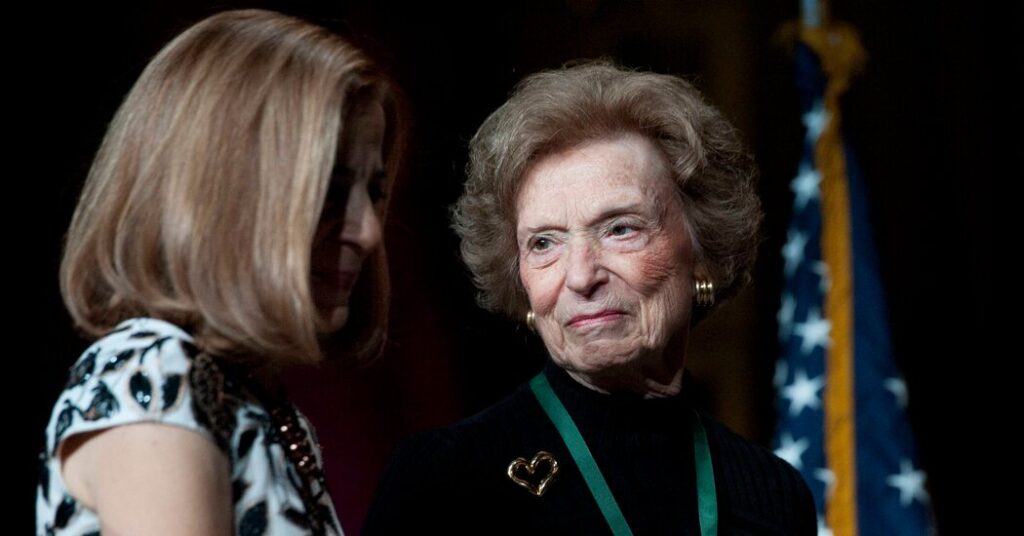
Doris Fisher, who along with her husband, Don, founded the Gap retail empire in 1969, remaking the apparel industry and helping to change the way Americans dress, died in San Francisco on Saturday. She was 94.
Her death was confirmed by a spokesman for the Gap.
Starting with a store on Ocean Avenue in San Francisco that sold bluejeans and record albums, the Fishers built the Gap Inc. into a $16 billion global retail brand. They capitalized on the emergence of new style trends — in particular, the popularity of jeans, khakis, T-shirts and other casual items — and opened outlets in nearly every urban retail district and suburban shopping mall in the country, selling those goods at moderate prices.
Ms. Fisher was the company’s fashion merchandiser for nearly 40 years and, as a corporate director, was active in the company’s remarkable growth. She and her husband considered themselves equal partners: He ran the business, while she focused on the merchandise. She also came up with the company’s name, a reference to the “generation gap” and the young consumers they hoped to attract. Mr. Fisher died in 2009.
The Fishers’ retail philosophy was to make shopping easy by keeping sizes well organized and stores well stocked, with pants and shirts piled high on shelves and tables, and dressing rooms abundant. When the company decided to manufacture its own line of clothing in 1972, Ms. Fisher was an essential voice in creating the style and look of the brand.
“My dad relied on her a lot for her sense of style and taste,” her eldest son, Robert J. Fisher, a company director and former chairman, said in an interview for this obituary in 2015.
She was also, he said, the keeper of the company’s values: “She was the spiritual leader of our corporate social responsibility.”
He added that she had insisted that no ethical corners be cut. “From the start,” he said, “it was important to her that we treat everybody fairly.”
A billionaire who eschewed an ostentatious lifestyle — she drove an older model Buick Roadmaster station wagon and often wore 10-year-old outfits — Ms. Fisher, like her husband, was an avid collector of modern art and was devoted to education reform.
The Fishers donated millions to Teach for America and founded the Knowledge Is Power Program Foundation, which supports a network of public charter schools preparing students in underserved communities for college.
“She got more satisfaction sitting with school kids than anything else she did,” Mr. Fisher, her son, said.
Under the Fishers, the Gap grew quickly and then slowed in the 1980s, as fashion tastes shifted. Bringing in the retail guru Millard Drexler in 1983 reinvigorated the company and led to meteoric growth. Under Mr. Drexler, whom The New York Times called the King of Retail, the Gap expanded its brand with Baby Gap and Gap Kids stores and the acquisition of Banana Republic.
Mr. Drexler also created Old Navy, a less expensive retail outlet. The Gap’s stock soared.
After 20 years, however, Mr. Drexler’s golden touch faded. The Gap struggled, and a tempestuous relationship with Mr. Fisher led to Mr. Drexler’s departure in 2002. (Mr. Drexler cashed out his stake in the Gap for about $350 million, according to The Wall Street Journal.)
Despite the company’s roller-coaster fortunes, Ms. Fisher remained a steadfast presence as a director and, later, an honorary director.
Chip Adams, a venture capitalist and longtime family friend, said in an interview for this obituary that Ms. Fisher was closely involved with even rank-and-file employees.
“She had strong, informed points of view about how to serve customers and how things ought to be done,” Mr. Adams said.
Doris Lee Feigenbaum was born on Aug. 23, 1931, in San Francisco, to B.J. and Dorothy (Bamberger) Feigenbaum. Her father was a prominent lawyer and a close friend of Earl Warren, who would later become the governor of California and Chief Justice of the United States.
She attended the Katherine Delmar Burke School for girls in San Francisco and earned an economics degree from Stanford University in 1953. (She would serve on Stanford’s board of trustees from 1992 to 2002.) Her family was close to her future husband’s family, and the couple knew each for years before marrying in July 1953.
Ms. Fisher is survived by three sons, Robert Fisher, William S. Fisher and John J. Fisher; 10 grandchildren; and 13 great-grandchildren.
The Fishers were a fixture on San Francisco’s social and philanthropic scenes. “They are a family that made a real difference in San Francisco,” Charlotte Mailliard Shultz, a former city official and a longtime friend, said in an interview for this obituary.
When the Gap went public in 1973, the Fishers used their newfound wealth to become art collectors. They had dabbled in acquiring prints to cover the white walls of the Gap’s headquarters and stores, but now they had the means to buy paintings by eminences like Andy Warhol, Roy Lichtenstein, Chuck Close and Ellsworth Kelly.
The Doris and Donald Fisher Collection grew to include more than 1,100 works by 185 artists, and the Fishers eventually agreed to display their collection permanently at the San Francisco Museum of Modern Art. (The Fishers donated $250 million toward the museum’s new building, which opened in 2016.)
“They invested in new artists,” Mayo Shattuck, a friend and board member at the Gap, said of the Fishers. “And the beauty of their collection was that they found these artists when they were young and alive.”
Ash Wu contributed reporting.
The post Doris Fisher, Co-Founder of the Gap, Dies at 94 appeared first on New York Times.