Marina Abramovic was a teenager when she saw Venice for the first time. After a long train ride from Belgrade — then the capital of Yugoslavia — with her mother, she was so entranced by the city that she burst into tears.
It was “so in contrast with the Communism and grayness of where I came from,” said Abramovic in a phone interview. The Serbian American performance artist recalled the “fairy tale” vision of the Grand Canal, the buildings immersed in water, the gondolas and “all the flavor and exuberance of Italy.”
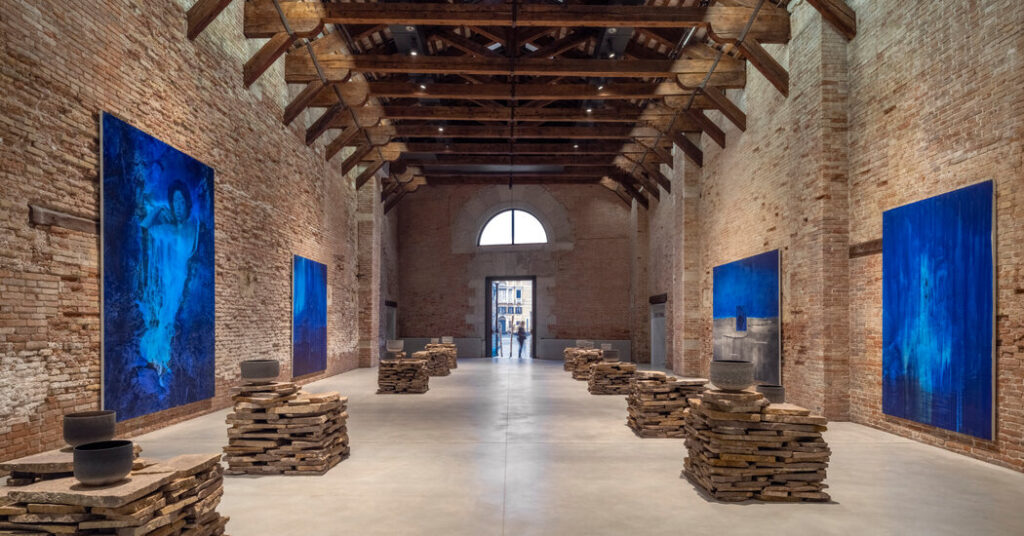
Venice has certainly returned her affections. In 1997, Abramovic became the first woman to win the Golden Lion for best artist, the Venice Art Biennale’s highest accolade. And this year, Abramovic (who turns 80 in November) is the first living female artist to get a solo exhibition at the Gallerie dell’Accademia. Some of her works will be displayed among the museum’s permanent collections of Renaissance art.
Abramovic is one of a number of international (and, often, American) art stars with exhibitions running alongside the Venice Art Biennale (Saturday to Nov. 22).
The artist said she was “humbled” to exhibit next to masterpieces that she first discovered as a student in reproductions and textbooks, and to “be there with these works, by myself,” during the installation period.
The show features re-enactments, projections and images of her past performances, as well as a set of interactive elements: stone beds and crystal-embedded structures, on which audience members can lie, sit or stand.
They are also invited to interact with “Imponderabilia” — to walk through a narrow passageway between a naked man and woman standing on either side.
Asked if Venetians might squirm at nudity in the museum, Abramovic said she originally performed the work in Bologna, Italy, in 1977 — together with her partner at the time, Frank Uwe Laysiepen, or Ulay — and the audience was “very comfortable” with it.
Ulay also starred in the 1983 performance “Pietà (with Ulay),” in which he posed as the dead Christ in Abramovic’s arms. The image of that performance is now on display at the Accademia next to Titian’s large and unfinished oil painting “Pietà” (c. 1575-76) — a juxtaposition that Abramovic described as “incredibly scary.” (She also noted that her 1983 “Pietà” prefigured Ulay’s death in 2020.)
Besides Abramovic, other American artists — including the painter and multimedia artist Lorna Simpson; the video artist and cinematographer Arthur Jafa; and the conceptual and pop artist Richard Prince — also have shows in stately premises on the Grand Canal. And the 1930s London gallery of the collector and gallerist Peggy Guggenheim is the focus of a stand-alone exhibition.
By night, the spectacle will be in the skies above.
Through May 11 — coinciding with the Biennale’s preview days and opening — everyone in Venice can see a work by the British light artist Chris Levine (famous for his 2008 portrait of Queen Elizabeth II with her eyes closed).
In that work, titled “Higher Power,” a green, circular halo will be projected into the night sky using a repurposed military-grade laser system. According to Levine, it will be visible from space.
“In these darkened days that we’re going through right now,” he said in an interview, “my humble contribution to the big picture is by making light.”
Lorna Simpson
A short walk from the Accademia is Lorna Simpson’s solo show at the Punta della Dogana — Venice’s former customs house, now a contemporary-art space founded by the billionaire French collector François Pinault.
For Simpson, who in 2025 had a well-reviewed show at the Metropolitan Museum of Art in New York, Venice is familiar territory. Her “Three Figures” (2014) was in the 2015 Venice Biennale’s central exhibition (curated by Okwui Enwezor); it’s a large ink-and-screen-print painting showing civil rights protesters being sprayed with a fire hose. It also marks Simpson’s transition from photography and multimedia work to painting — and is on view at the Dogana.
Simpson said the work came about when a collector hosted her for a few weeks in a separate house and garage space converted into a studio, and left her alone to work. This was in Sonoma, in Northern California — a place where, if you ventured out in nature, there were “rattlesnakes all over the place” — so Simpson stayed close to home and “procrastinated” for the first week or two.
One night, there was an earthquake that Simpson likened to “a jolt: the power goes out, the city is shut down, everyone is checking structures to make sure that they’re sound.” That quake somehow led her to dare to experiment.
“Some of that freeness about just jumping in like that had to do with this multilayered experience of being away and embarking on new work,” she said.
Simpson noted that “Three Figures” was “very relevant to now,” because it was “a kind of premonition of all the backlash against the Obama era,” referring to the presidency of Barack Obama.
She explained that, in general, she was drawn to images with “a kind of edge,” and with a certain “instability in the reality that’s being presented.”
Also showing at the Dogana exhibition (a partnership with the Met) are Simpson’s Arctic panoramas — paintings based on photographs and archives of historic expeditions — and a group of paintings of towering female figures.
Peggy Guggenheim in London
On the way back to the Accademia is the Peggy Guggenheim Collection, an unfinished 18th-century palazzo on the Grand Canal where the American collector and gallerist spent the last three decades of her life — because, as she said, once you see Venice, “there is nothing left over in your heart for anyone else.”
In 1938, Guggenheim opened a gallery in a former pawn brokerage on Cork Street in London, behind the Royal Academy of Arts. The gallery, Guggenheim Jeune, stayed open for 18 months, and is the subject of a Venice show.
“It was not just a blip,” but “really the central part of everything there was to come,” said Pilar Ordovas, an art gallerist in London who presented an exhibition on Guggenheim Jeune in 2019.
Had World War II not broken out, she added, Peggy Guggenheim’s museum “would have ended up being in London and not in Venice.”
Works were hard to sell, so Guggenheim often bought a painting or sculpture from each exhibition as a favor to the artist. That’s how her collection was born, said the show’s curator Grazina Subelyte. She was “not afraid to take risks, and not afraid of other people’s opinion,” and made it “her duty to help these artists gain visibility,” she added.
Guggenheim was one of the first people to introduce abstract and Surrealist art in Britain, exhibiting the painter Yves Tanguy and the sculptor Jean Arp. She also staged Britain’s first solo exhibition of Wassily Kandinsky: 38 paintings, ranging from early landscapes to abstracts. According to Subelyte, Guggenheim and her sister offered four of the works as gifts to Tate Gallery; Tate turned down three of them for being too avant-garde, and kept one.
She also put on a show of drawings and paintings by children — one of her largest shows ever, with some 120 works by her own son and daughter, by the grandchild of James Joyce, and by a boy named Lucian Freud (the grandson of Sigmund Freud), who would go on to become a prominent British painter.
Many of the works displayed at Guggenheim Jeune are on show in Venice, including Arp’s “Head and Shell” (c. 1933), the first artwork that Peggy Guggenheim collected; Kandinsky’s “Dominant Curve” (1936); and Tanguy’s “The Ribbon of Excess” (1932), which was in the 2019 Ordovas Gallery show.
Arthur Jafa, Richard Prince
In a palazzo further along the Grand Canal is an exhibition curated by Nancy Spector, the former artistic director and chief curator of the Solomon R. Guggenheim Museum in New York (founded by Peggy’s uncle). Titled “Helter Skelter,” it pairs up Arthur Jafa and Richard Prince.
Both artists work with imagery taken from comic books, posters, album covers, movies, celebrity memorabilia and videos. They are, as Spector writes in the catalog, “image scavengers” who “dip into the overflowing reservoir of visual culture” and deliver “an unflinching exposé on America.”
Still, the two artists seem at first to be an unlikely tandem. Prince is often associated with white masculinity and depictions of women as nurses and poster girls. Jafa is known for his stark representations of African American life.
Spector acknowledged that the two had distinct histories and personalities: “I don’t think anyone would confuse a Richard Prince for an Arthur Jafa.” Yet she said they were both “very nuanced thinkers” whose art highlights the complex realities of the present-day United States.
Both artists “find beauty in the downtrodden, in the overlooked, in the underbelly of this country in which we live, where there’s increasing economic disparity,” she added.
The exhibition points out uncanny parallels in their works. Prince’s 2006 steel-and-rubber installation “Folk Songs” and Jafa’s “Big Wheel II” (2018), which both reference America’s car culture, occupy the ground floor and courtyard of the Fondazione Prada in Venice.
Elsewhere, celebrity culture is examined in Prince’s “Publicities” (begun in 1999), a series of autographed head shots of celebrities, and in Jafa’s portrayals of music, sports and social media stars.
The post Venice Showcases an Array of Global Art Stars During the Biennale appeared first on New York Times.