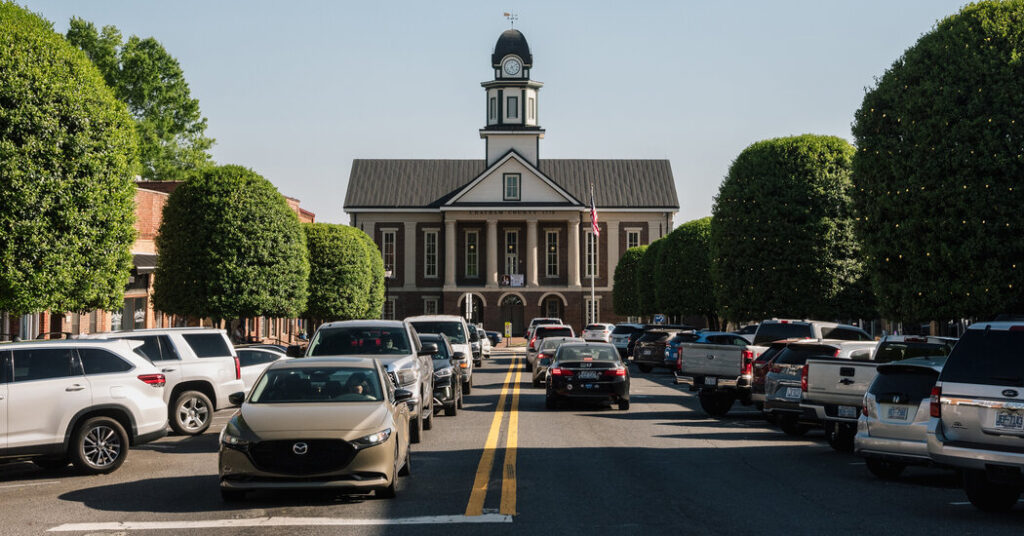
On a recent chilly afternoon, the tiny downtown of Pittsboro, N.C., was full of life. The soda shop, wine bar and barbershop were all crowded, and dozens of fliers on bulletin boards advertised upcoming concerts and events.
At the counter of a packed restaurant, Virlie’s Grill, Robert Parks was eating a rib-eye sandwich while watching a television tuned to Fox News. “It’s a very nice community here — I don’t want this to change,” said Mr. Parks, who grew up in Pittsboro and works as a paint contractor. “I’m all for progress,” he said. “I just want it to be done in a responsible way.”
Mr. Parks, 74, was referring to Chatham Park, a master-planned community that is expected to help expand Pittsboro, about 35 miles from Raleigh, to more than 60,000 people in the next two decades from its current population of about 5,000. The plan is to build over 22,000 homes, 22 million square feet of commercial space — including schools, clinics and stores — and a network of roads connecting it all.
Since Chatham Park’s first houses in Pittsboro went on the market six years ago, the town’s average home prices have risen steeply, to roughly $550,000 from $360,000 in 2020, and larger, more expensive houses are on the horizon.
As the nation faces a growing shortage of housing, master-planned communities have been popping up all over the country as a potential solution. These neighborhoods are more like sprawling towns, where a single company builds the homes, streets, shopping centers, offices and other structures. But the towns typically come together so quickly that the people living nearby are left grappling with the implications of that growth.
In Pittsboro, many residents are concerned: Can their town’s unique characteristics survive that much growth and change?
It’s not just lifelong residents who are wary. Allen Wilson, who arrived four years ago from West Virginia, remembers a discussion among new residents over the possible construction of a hospital, which the town doesn’t have. Several people opposed it, thinking it could bring traffic. “One person said: ‘I moved here because of the dark skies. This will lessen that experience,’” Mr. Wilson recalled.
Pittsboro is a prime location for a master-planned community, which works best when it’s built on the edge of a major metropolitan area. The town is part of the Research Triangle region, an area that includes three major research universities in Raleigh, Durham and Chapel Hill. Since 2010, roughly 500,000 people have moved to the region, turning small municipalities like Pittsboro into growing developments that have gradually merged with Raleigh’s sprawl.
Chatham Park’s developer, Preston Development Company, is behind much of the area’s change. In the 1990s, it created a master-planned community in Cary — a town near Raleigh whose name has become synonymous locally with suburbanization — and the population there doubled that decade. Preston has since built neighborhoods all over the region.
In the early 2000s, Preston’s founders, Tim Smith and Julian Rawl, known as Bubba, predicted that the Research Triangle region would continue growing for at least another 50 years. They eyed Pittsboro, where land was still relatively cheap, as a place to bet big. They also persuaded the state’s richest person, James Goodnight, the founder of the data and artificial intelligence company SAS, to come on as a partner for their plans to transform the town.
“The main driver was looking at growth patterns in the region and predicting and planning based on land and resources available for growth,” a spokesperson for Preston said in an email.
Most people in Pittsboro learned about Chatham Park in 2013, when its master plan was approved by the town’s planning commission and eight-person planning department. Some local businesspeople welcomed the news, but for a number of residents, it was hard to accept that everything could change in a few decades. They worried their town could become bland and suburban — “the next Cary,” as some put it — and they fought the development with lawsuits.
Preston has so far built on 1,900 acres in Pittsboro, and in November, the town’s Board of Commissioners approved a proposal to allow the developer to build on 5,000 more acres without much additional authorization. Supportive commissioners say Preston’s existing construction plans are sufficient, but opponents worried about giving the developer what they viewed as carte blanche.
John Bonitz, one of the board’s most vocal members, worries that the development’s many single-family neighborhoods will increase sprawl and lead to more carbon emissions and worse traffic.
And unlike commercial development, residential growth requires significant public funding and can result in higher property taxes.
“We’re guaranteeing that taxes will have to increase to pay for police and fire, and to pay for the repair and replacement of miles of greenways, roads, sidewalks and parks,” Mr. Bonitz said. Higher tax bills, and a potential rise in housing costs, could price out some of the town’s current residents, he added. (After protracted negotiations, Preston agreed to make 7.5 percent of the new homes built affordably priced.)
Others worry about preserving the area’s natural setting. “We tried so hard to talk about the caliber of the trees we wanted to save all through this process,” said Cindy Perry, who was mayor when key negotiations were held. “But on the ground today, I can drive out and see a part of Chatham Park that’s undergoing new construction and it’s totally and completely clear cut” of tress, she said.
Many observers and officials believe the town was outmatched by the seasoned, well-funded company. But Randy Voller, who served as mayor when Chatham Park’s master plan was approved and later worked as a consultant for Preston, said that had locals not viewed the company with suspicion from the start, negotiations with the town might have been more fruitful.
“It’s very easy to be against what’s perceived as the Death Star,” Mr. Voller said. “It’s a lot harder to say, ‘How do we make this whole thing work for us?’”
Steven Richter, a professor in the community and regional planning program at East Carolina University, said that what was happening in Pittsboro was “so much better than the alternative,” which is that multiple companies carve up individual plots of land that might not connect well.
Instead, working with a single developer to plan something functional and cohesive is far preferable, said Mr. Richter, who studies growth in metropolitan regions across the United States.
But Preston has a history of selling parcels to other developers. In 2023, the developer sold land to Disney for Asteria, a 1,500-acre community that is the company’s second foray into residential development. That development, which is opening for sales in 2027, will include 4,000 single-family homes, townhouses and duplexes, with a particular emphasis on older adults.
Other developments are also planned for the area. In response to the mushrooming growth, Pittsboro said, it recently established a department to oversee planning and streamline development review, and plans to expand it.
The debates around growth were a big topic in the town’s elections for commissioner last fall. The commissioners who won campaigned on platforms that emphasized better management of Pittsboro’s growth.
Not all residents are resistant to growth. Some homeowners in Chatham Park welcome the new amenities like schools, veterinarians, sports facilities and restaurants, and are glad to see more young families in a town that has skewed older than the regional average.
Cameron Potvin and her family moved into Chatham Park a year and a half ago from downtown Raleigh in search of a quiet but walkable neighborhood. Ms. Potvin, 29, grew up in Cary, in the very first community Preston developed, and remembers fondly its welcoming spirit — as well as how the neighborhood wound up transforming the town.
She understands the challenges ahead for Pittsboro’s leaders. “They have a lot on their hands,” she said. “It’s about how to develop land to support the growing community without taking away from the existing community. There’s a balance to be had.”
The post A 22,000-Home Community Is Being Built in a 5,000-Person Town appeared first on New York Times.