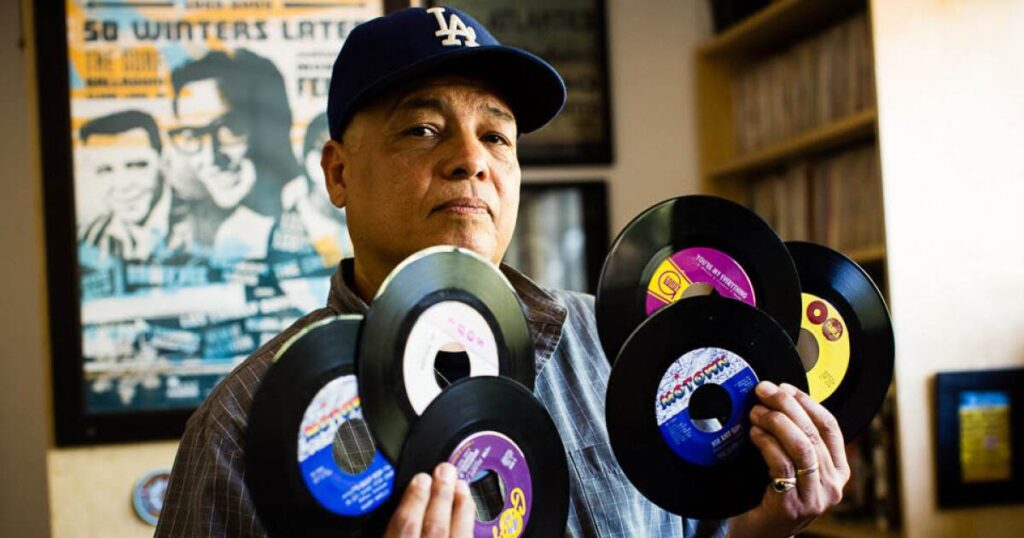
One day in December 2022, Ruben Molina — DJ, record collector, and community historian — received a call about a collection of 78rpm records in Azusa. What awaited him weren’t just slabs of fragile shellac, many scarred with scratches: “These were all from 1953-55, all early rhythm and blues, and the sleeves were tagged up with neighborhood and school club names,” he explained. These tags, left on fading labels and torn record sleeves, can be found on countless singles and albums from the era, informal markers of who people were and where they came from.
As Molina learned, the collection belonged to the late Julia Juarez, a member of the Rhythm-Aires, a trio of teenage Chicanas from Azusa who threw parties in the early ’50s. On one yellowed sleeve, he found a hand-drawn Rhythm-Aires logo, surrounded by a roll-call of friends nicknamed after their neighborhoods: “Kenny De Ontario,” “Victor De Pomona,” “Annie-Lara De Chino.” USC journalism professor and longtime record collector Oscar Garza describes these markings as “Chicano hieroglyphics… a reflection of the friends who shared the memories of that song or album.” Molina saw the records and their scrawls as street-level snapshots of Mexican American youth life: “stories from the bottom up,” as he describes. They directly inspired his latest book: “The Dreamy Side: Rhythm & Blues and Chicano Culture in 1950s Los Angeles.”
Across its 140-plus pages, the book traces a postwar landscape of Chicano youth culture through personal essays, interview testimonials, and over a hundred vintage photos, party ads, and scans of record labels and album covers, many with those tags. As with Molina’s previous books, including his groundbreaking “Chicano Soul: Recordings and History of an American Culture” (2007), The Dreamy Side” offers an alternate approach to local Chicano cultural history. University of Houston historian Dr. Alex LaRotta, who wrote the foreword to the second edition of “Chicano Soul” (2017), said Molina excels at telling “the people’s history of Chicano rock and soul music,” lauding how his work embodies “the importance of local knowledge and preservations of barrio memories.”
In “The Dreamy Side,” Molina chronicles the heady period between the end of the pachuco era of zoot suits and jazz parties in the 1940s, up to the late-1950s emergence of Chicano rock ’n’ roll stars like Ritchie Valens and Thee Midniters. Dr. Michelle Habell-Pallán, a native of Downey and one of the curators/authors behind 2017’s “American Sabor” exhibition/book about Latino music in the U.S., says that while this generation’s “parents were listening to Mexican music, they were listening to rock ’n’ roll.” Then-teens like Julia Juarez and her friends came of age dancing to balladeers like Johnny Ace and honking sax players like Chuck Higgins while tuning into radio DJs like KRKD’s Dick “Huggy Boy” Hugg and KGFJ’s Ray Robinson. The book’s title nods to another famed DJ — Art Laboe — whose “Oldies But Goodies” compilations were split between the ballad-heavy “dreamy side” and dance-centric “jump side.”
As Molina writes, these records, mostly from Black vocal harmony and R&B artists, “played a pivotal role in shaping Chicano culture, particularly within the teen pachuco and cholo subcultures … songs that became rites of passage.” However, because the artists were not of Mexican descent, Chicano music histories often overlook or underplay this era. LaRotta lauds “The Dreamy Side” for “establishing a lost historical connection in Chicano culture,” and Molina wanted his new book to “fill the void,” insisting, “what they began in the ’50s, it stayed. It didn’t leave us.”
Centering community stories has been Molina’s approach to cultural history for decades. Born in El Paso, Molina was 5 when he and his family moved to Elysian Valley in 1958. “It was nice, a very mixed working‑class neighborhood…. There was always music around,” he recalled. “My mom was into Motown… my dad into the Mexican standards and jazz.” In the 1960s, Molina and his friends began calling their neighborhood “Frog Town” after the local fauna in the nearby L.A. River. These memories became the basis for his neighborhood history, “Down By the River: Elysian Valley and the Age of Frog Town” (2024). Molina directly traced his fascination with soul music and similar “oldies” to a youth spent in and around Frog Town, “sitting on the curb while the older homeboys kicked back with their trunk open, listening to whatever they had on an eight-track player.”
When he was in his early 50s, after decades of collecting records and researching musical histories, Molina self-published his first book, “The Old Barrio Guide to Lowrider Soul” (2002), a comprehensive yet focused compendium of what he described as “romantic grinders” and “mournful tearjerkers … long forgotten by the general public [that] have become a mainstay in the barrio, handed down like valuable family heirlooms.” As with his later books, “The Old Barrio Guide” made it clear that most of the oldies beloved in his community came from African American artists. He recalled when a trio of women asked to return their copies of “The Old Barrio Guide,” explaining, “We thought this book was about Chicano music,” to which Molina replied, “Are you trying to tell me that you thought Barbara Mason and Billy Stewart were Chicano? I want you to understand that what we enjoy is Black music.”
In “The Dreamy Side,” Molina traces the roots of these cross-cultural musical obsessions to the early R&B scene in Los Angeles. Drawing from personal interviews with Mexican American elders, Molina recounts how teens from Maravilla, La Puente, Clover, and other barrios crisscrossed town to shop at Dolphins of Hollywood in South Central or Flash Records downtown when they weren’t flocking to concerts thrown by Art Laboe at El Monte Legion Stadium or Gene Norman at the Shrine Auditorium. He writes of how this generation “found joy in music that was … portrayed as improper and immoral by highbrow elites.” However, they weren’t just passively consuming this music, they also left their marks on it, quite literally.
Inspired by the tags left by Azusa’s Julia Juarez and her friends, Molina sent over two dozen seven-inch record sleeves to friends to use as blank canvases. The super-sized “Plaquiasos” (“markings”) chapter ending the book features 60 scans combining original, tagged-up records Molina has come across over the years plus all his commissioned versions. The latter includes Julian Mendoza’s shout-out to the Harbor Area with cities like Lomita and Carson written in stylized block letters while Lionzo Perez celebrates Frog Town with names of friends — ”Fausto,” “Sleepy” — plus a hand-drawn frog peering above the edge of the 45 sleeve. Among the vintage examples is a copy of the Orlons’ birthday dedication, “Mr. Twenty-One,” with “LA SAD GIRL – PUENTE 13” written on its baby blue label while a faded 78 sleeve for the Hollywood Flames’ “Crazy” bears the names and neighborhood of East Clover’s Louie Berrera and Jimmy Alcala, complete with sketched-in three- and four-leaf clovers.
For Molina, “Each record serves as a vessel for memories, emotions, and experiences — preserving stories that might otherwise fade with time.” What he found in the 78s that Juarez left behind was more than a record collection; they were miniature time capsules from a teenage world bound by friendship, community, and music. By documenting them — and inspiring new markings of his own — “The Dreamy Side” ensures this vibrant but overlooked chapter of Los Angeles history doesn’t trail off into silence.
The post This historian dug into old records and found a lost chapter of Chicano L.A. music culture appeared first on Los Angeles Times.