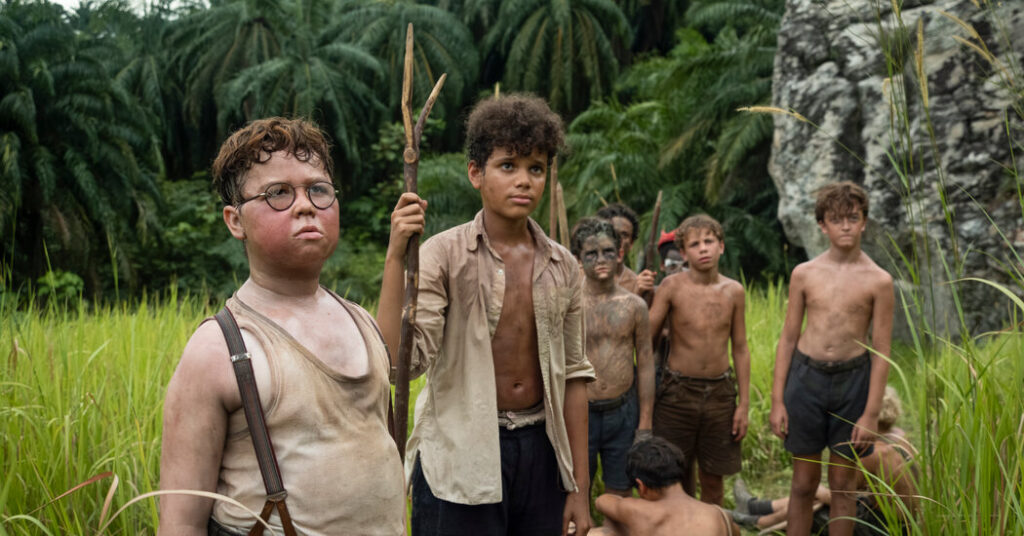
In the first episode of a new adaptation of “Lord of the Flies,” Jack, one of the older boys stranded on a deserted island after a plane crash, pushes the pilot’s dead body off a cliff. It’s just the first instance of the brutality that characterizes the classic William Golding story, and Jack justifies it to his peers by saying, “A better pilot — a better man — would not have made such a mistake.”
“Lord of the Flies,” which aired in Britain on the BBC in February and arrives on Netflix for U.S. audiences on Monday, is the latest in a recent string of television shows that address the question of what it means to be a man. It’s also the second written by Jack Thorne, who wrote 2025’s agenda-setting drama “Adolescence.”
The two stories have very different contexts: In “Adolescence,” about a 13-year-old boy suspected of killing a girl from his school in present-day England, the influence under examination comes from the online “manosphere,” while in “Lord of the Flies” it is that of expectations placed on men in 1950s society, particularly through the figures of the boys’ fathers. But “Lord of the Flies” still speaks to our current moment in its depiction of how young boys are susceptible to the influence of others.
This focus on masculinity in crisis is “tapping into quite a visceral fear of male violence,” Nick Isles, director at Britain’s Center for Policy Research on Men and Boys, said in an interview. “I think there’s a sense in which boys are trouble,” he said, “rather than a recognition, which is part of what these programs are doing, that boys are in trouble.”
Thorne first tried to adapt “Lord of the Flies” 15 years ago for the British broadcaster Channel Four, but Golding’s estate denied him the rights. This time, Thorne was able to sell them on the idea of splitting the story into four episodes that each focuses on a different boy on the island.
One advantage of this approach is that it allows the production to handle Jack’s character with more nuance than as the one-dimensional villain he is often thought to be and to draw out the idea that all of these boys, like the boys in “Adolescence,” are in trouble because they are vulnerable to malign influences.
The two shows, both of which were shot in the summer of 2024, can be thought of as partner pieces, even given the notable differences.
Crucially, many of the cast and creatives involved in “Lord of the Flies” said, the context is important to parse the characters’ behavior. When Golding was writing in the 1950s, the specter of World War II loomed large. And the brutality of society as well as the concept of a stiff upper lip in the face of adversity is legible in the way his characters act.
Winston Sawyers, who plays Ralph, the morally upstanding foil to Jack, said in an interview that it was a notable contrast to the way that boys nowadays were encouraged to express a range of emotions. Back then, he said, “if you were a boy, I think you were just expected to be a man and fend for yourself.”
“Lord of the Flies” is suffused with what Thorne describes as the “smell” of the boys’ fathers — for better and worse. Although the fathers of the stranded children aren’t characters aside from in a few sparing flashback sequences, their presence in the minds of their sons is felt. One of the first pieces of information many of the boys share with one another, for instance, is what branch of the military their fathers serve in.
Marc Munden, who directed the series, said that Ralph’s father, whom we hear about from Ralph and see in flashbacks played by Rory Kinnear, is an example of the positive influence a father can have. Ralph “desires to do the right thing and go for election as leader as a result of his father’s influence,” Munden said.
By contrast, Jack’s desire to show strength and be a leader among the boys, which eventually results in the island’s society descending into savagery, stems from a lack of fatherly love. As Lox Pratt, who plays Jack, sees it, his character grew up mostly away from his family at boarding school and otherwise surrounded by men who “haven’t been on their game, and they’ve been off at war.”
“There was no love for Jack,” the actor added. “He never had anyone that he can go home and cry to.”
Giving Jack’s familial back story more space in the series was important to Thorne. “By building out complication, by having boys just talk about themselves, that felt like we would have a greater understanding of the context within which they are talking,” he said.
Thorne emphasized that “Lord of the Flies” was not about some kind of inherent toxicity in men and boys that makes them descend into barbarism outside the strictures of society. “I have a real problem with the thesis that some people have that ‘Lord of the Flies’ is a book about who we are at our essence,” he said.
“Lord of the Flies,” in this version, is about what makes some boys act in one way and others act in another. In Munden’s view, “I think there are boys that are capable of cruelty and brutality, and I think they’re boys that are capable of good and cooperation,”
The boys who act in the series agree. As Ike Talbut, who plays Simon, put it, “Golding chose to make it about boys because boys are suggestible, not because they’re evil.”
The post A ‘Lord of the Flies’ for the ‘Adolescence’ Era appeared first on New York Times.