James Kamau Ndungu told only a few friends that he was heading to Russia. He told them he had been promised a job as a day laborer there. He was 32, unemployed in Kenya and needed the work.
Last June, Mr. Kamau sent a photo to his friends from Istanbul Airport, saying he was in transit, one of the friends said. A few weeks later, he sent another photo. This time, he was wearing fatigues and holding a gun. In August, he wrote to say that he was in a trench in Ukraine. Things were bad. He asked for prayers.
It was the last anyone in Kenya heard from him.
A growing number of Africans are ending up on the front lines of Russia’s war with Ukraine. Some go there willingly as mercenaries, but many more are like Mr. Kamau, young men lured by the promise of ordinary civilian jobs — from bodyguards to line cooks — only to be forced into joining Russian forces in battle.
A string of fly-by-night companies have been set up across the continent to recruit the men. The companies often appear as travel agencies or job placement firms and advertise on WhatsApp or Telegram.
The New York Times interviewed several victims and recruiters. The interviews suggest that the recruiters do not work directly with the Defense Ministry in Moscow. Contracts seen by The Times were in Russian, meaning the Africans could not read them.
Formal jobs in Africa are scarce, making the promise of work overseas a powerful magnet. And Africa has the fastest growing youth population on the planet. Many young people are unemployed, making the continent a prime target for the false recruitment of unwitting soldiers.
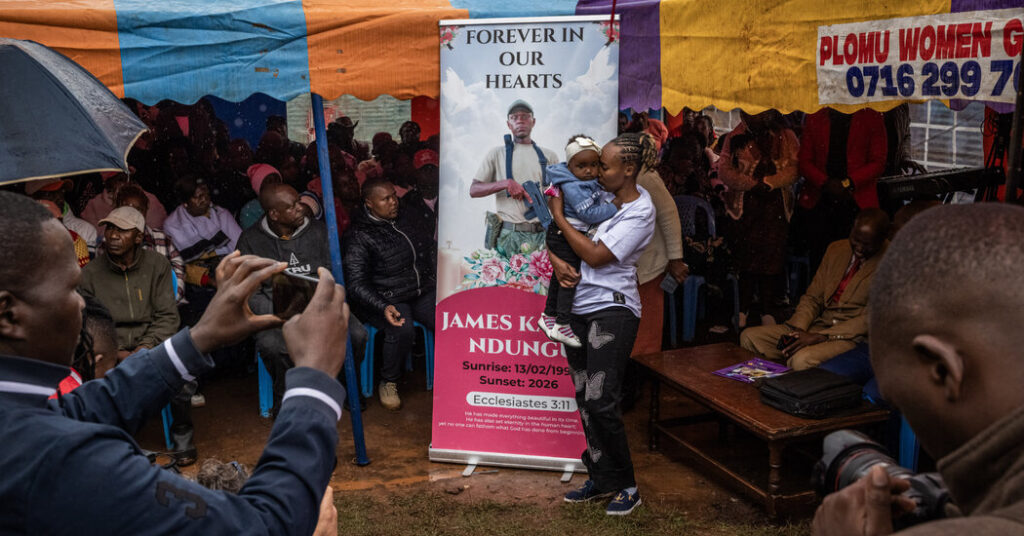
“Why has Russia taken my son?” Hannah Wambui Kamau wailed as she collapsed into the arms of relatives at Mr. Kamau’s memorial on a muddy hillside outside Nairobi in March.
It is unclear how many men have been falsely recruited from Africa, though the authorities in at least nine countries have reported cases. And in Kenya, the National Intelligence Service found that around 1,000 Kenyans had gone to Russia and ended up in Ukraine so far. Only 30 of them have returned alive. To curb the number of men being caught in the dragnet, the government said it had bolstered checks on young men leaving the country on international flights.
Okoiti Andrew Omtatah, a senator in Kenya, used a metaphor to describe the desperation created by the jobs crisis across Africa. “If a slave ship docked today in Mombasa with a banner saying, ‘Slaves required in the West,’” he said, referring to the coastal city in Kenya, “you would not have space on that ship.”
Russia’s foreign minister, Sergey V. Lavrov, acknowledged in March that foreigners were participating in what Moscow calls its special military operation in Ukraine but said that the government does not hire or recruit people to fight against their will. “Volunteers get there in full compliance with Russian legislation,” he said in Moscow at a news conference.
Asked whether any Africans had gone to Russia on the basis of a promise of civilian work only to find themselves pressed into military service, the Kremlin spokesman, Dmitri S. Peskov, told The Times last week through his press service, “We are unaware of any such cases.”
Ukraine’s ambassador to South Africa, Olexander Scherba, accused Russia of taking advantage of young Africans looking for work. “I’m just amazed at how devious and how inhumane and imperialist people can be toward Africans who just need money,” he said.
Kenya, Tanzania, Zambia, South Africa, Nigeria, Ghana, Togo, Botswana and Mali have all reported men being falsely recruited into the Russian Army. Prosecutors in Kenya charged a man in February with recruiting 22 Kenyans to Russia. The same month, President Cyril Ramaphosa of South Africa spoke by telephone with President Vladimir V. Putin of Russia about the recruitment of South Africans. A week later, 17 South Africans returned home from the front lines. Prosecutors are investigating a South African politician’s involvement in misleading the men.
Vincent Odhiambo Awiti said he was recruited last year by an agent he met on the street in central Nairobi, Kenya’s capital. The man told him he worked for the Global Faces Human Resources Agency and promised Mr. Awiti a job in a shop in Russia. He paid for him and four other men to fly to St. Petersburg on July 14, Mr. Awiti said.
“We ended up buying the idea because I didn’t have anything else to do,” he said. “We thought that it was a great opportunity.”
Mr. Awiti said he and the others were told to sign a contract to join the Russian military when they arrived. At first they refused, he said, but then he said they were told the only way to return to Kenya was to repay what had been spent to get them to Russia. None of the men had the money. They all signed the contract, he said.
The group was sent by train for four days of military training in a camp near the town of Shebekino, close to the frontline south of Belgorod, Russia, Mr. Awiti said. He encountered an Egyptian recruit there who told him that he and the others were “dead men walking.”
Mr. Awiti said he was sent into battle near the city of Vovchansk in Ukraine’s Kharkiv Province, the site of significant fighting last summer. His squad was instructed to cross two small rivers and a patch of open ground to get to a trench. His squad commander was killed before they reached the first river, he said.
“His head left his body,” Mr. Awiti recalled. “They call it the death zone.”
By the time he reached the second river, he said he was virtually alone. Unburied corpses littered the battlefield, and the dead floated on the river “like waterlilies.”
When he got to the trench, it reeked of death. The Russian soldiers who had taken shelter there beat him for abandoning his gun at one of the rivers. He was given another gun, and for the next 20 days he was forced to shoot at an unseen enemy, he said. He showed The Times photographs of what he said were maggots that infested his wounds.
Mr. Awiti said he escaped with a Russian deserter who shot himself in the leg so he could be designated an invalid. He said he watched in horror as the Russian closed his eyes, aimed at the fleshy part of his lower leg and pulled the trigger twice.
Mr. Awiti said he was treated in Belgorod for wounds to his hand and hip from a drone attack and then shipped to a military hospital in Moscow. Doctors told him he would be sent back to the front once he recuperated, but he managed to get to the Kenyan Embassy and was put on a plane back to Nairobi. The embassy in Moscow did not reply to a request for comment.
Mr. Awiti is now jobless, penniless, wounded and badly traumatized. “Better you be here. Here you have a lot of freedom,” he said, reflecting on his experience. “I was fighting for Russia. I was wearing a Russian uniform. But the fight was not mine.”
At least 25,000 Russians were lost to death or injury every month last year during the war, studies show. The country has responded by enlisting conscripts from prisons, providing cash incentives and instituting an unpopular draft. But with such a staggering attrition rate, still more bodies are needed.
Advertisements for Russian military service have flooded African social media over the past year, some promising monthly salaries of up to $3,000, lump-sum payments of $18,000 and even Russian citizenship after six months of service. Middlemen looking to cash in have turned these calls for Russian military service into business opportunities.
St. Fortunes Travels and Logistics is a travel agency owned by Fortune Chimene Amaewhule, a Nigerian. Mr. Amaewhule said in an interview with The Times that he began to get requests last year from several African clients seeking help getting to Russia. They told him they heard there was money to be made with the Russian military, he said.
Last October, he posted an advertisement on Facebook: “Slots available for Drivers, Cooks, Logistic Workers & other positions to join the Russian military & get automatic citizenship with lots of benefits.”
That same month, he posted a photo on Facebook of two people and wrote that they were Nigerians who had received $30,000 bonuses for joining Russia’s military. “Don’t forget recruitment is still ongoing,” the post said.
A Nigerian friend who lived in Russia and had citizenship there was tasked with facilitating travel for the job seekers, Mr. Amaewhule said. But Mr. Amaewhule denied ever sending clients to Russia for military training and did not respond to questions about that post offering a $30,000 bonus.
The recruitment pipeline from Africa to Russia often appears to rely on personal connections like the one Mr. Amaewhule had with his friend in Russia.
A Tanzanian woman who asked to be identified by her middle name, Nyariwa, for fear of her safety, said she connected a male Malawian friend with a Russian man she had met online years ago through a dating app. Her friend was interested in serving in Russia’s military, she said.
Nyariwa said she thought the man worked for the Russian military. After the man helped her friend obtain the paperwork needed to travel to Russia, others began to ask her about similar opportunities, she said. She eventually connected with recruiters in Russia and was paid $150 to $1,000 per recruit, she said.
Cameroon’s government said in April that 16 of its citizens had died in Ukraine, while Ghana said in February that about 55 of its citizens had been killed. Botswana’s foreign minister said in March that about 16 citizens of his country were targeted by recruiters promising jobs in security and bodyguard services, with four having actually traveled to Russia.
One of them was Kgosi Pelekekae, 25. Last year, Mr. Pelekekae was back in his native Botswana after two years in jail in South Africa for armed carjackings. He decided he wanted to turn his life around and messaged a friend asking if he knew of any honest work.
To his surprise, he said, the friend replied and said he had just moved to Russia, where there were plenty of jobs with good pay. The friend even sent pictures of himself playing in the snow. Soon, Mr. Pelekekae was exchanging messages over Telegram with a Russian his friend knew named Dmitri. The Russian identified himself as a travel agent and job recruiter, but he did not mention the military or war, Mr. Pelekekae said.
Mr. Pelekekae said he sent his travel documents to Dmitri on Dec. 6. The Russian bought him a ticket to St. Petersburg, Mr. Pelekekae said. When he arrived, he was flown to a training camp in a town far from St. Petersburg, where he was given military fatigues and trained to use a rifle, he said.
When he refused to sign several contracts written in Russian, Dmitri hit him and urged him to sign, said Mr. Pelekekae. During the ordeal, the Russian authorities gave him a physical and detected a heart condition.
For this reason, he said, he was never sent to the front. He said he escaped from the camp, and a diplomat from Botswana helped him get back home.
Alina Lobzina contributed reporting.
Matthew Mpoke Bigg is the East Africa bureau chief for The New York Times, based in Nairobi, Kenya.
The post ‘The Death Zone’: How Russia Is Luring Africans to Ukraine appeared first on New York Times.