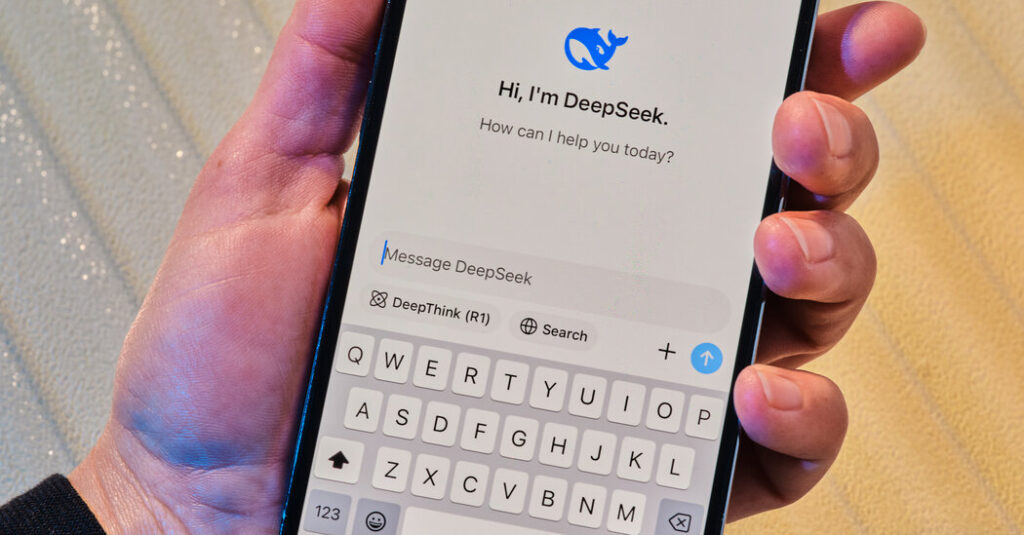
Remember the “DeepSeek moment?” The Chinese start-up announced in early 2025 that it had created an artificial intelligence model that could rival ChatGPT. Not only that, it had created it at a fraction of the cost of its American competitors.
If China had been considered behind the United States on A.I., DeepSeek changed that. Almost instantly, its model became the most downloaded free app in the U.S. Some in Silicon Valley started calling it “A.I.’s Sputnik moment.”
DeepSeek released its latest model last week. Today, my colleague Meaghan Tobin, who covers technology in Asia, writes about how DeepSeek’s models have not just put China and the U.S. neck and neck in the A.I. race — but revolutionized the nature of the race itself.
What DeepSeek really changed about the global A.I. race
By Meaghan Tobin
Early last year, the Chinese start-up Deep Seek sent tech stocks around the globe plummeting when it announced it had spent far less on computer chips when building its new artificial intelligence models than American rivals like Anthropic and OpenAI. The DeepSeek moment, analysts thought at the time, heralded a major shift in the global tech landscape.
A little more than a year later — and in the aftermath of the release of DeepSeek’s highly anticipated newest model late last month — it’s clear that DeepSeek has indeed transformed the global tech landscape. It just hasn’t been in the way analysts anticipated.
Instead of pushing A.I. companies to be more efficient with their computer chips, DeepSeek has revealed the benefits of making the details of this technology widely available to the public.
Until DeepSeek, the details of the world’s top performing A.I. systems were, for the most part, closely held company secrets. DeepSeek, by contrast, published the details of its systems for anyone to use and build upon — a practice called open source.
In the months since, its models have become some of the most widely used open-source A.I. systems in the world. And the DeepSeek moment kicked off a surprising shift. While American companies have kept their best models closed, A.I. has become one area where China — a country known for its strict government controls on technology and information — has embraced openness.
The Big Mac of A.I.
Open source is an idea as old as the internet itself.
The top American A.I. companies say only a few people should be able to have access to the full details of a technology that has the potential to be extraordinarily powerful, even dangerous. But many proponents of open source argue that technology both improves more quickly, and is actually safer, when it is shared and transparent.
At first, many Chinese companies turned to open source because it was easier to build something on top of a foundation laid by others. But the competition to build the best A.I. quickly became a geopolitical struggle. And Chinese officials began to see the open-source nature of their country’s models as a potential soft-power win.
For developers and app builders around the globe, these models have made A.I. cheaper and more accessible. People working on building A.I. apps in Nigeria, Malaysia and Brazil — as well as the U.S. — have found that using Chinese models can be more than 90 percent cheaper than paying to build with, for example, OpenAI’s technology.
China has put billions toward the goal of becoming an A.I. superpower. Being known as the birthplace of a popular, widely available A.I. system could help cement that image for people using the technology all over the world. One tech investor I spoke to likened the soft power of open-source A.I. to the impact of Hollywood movies and Big Macs.
In the months after the initial DeepSeek release, Chinese tech companies released dozens of other open-source models. By the end of last year, about a third of all global A.I. usage involved Chinese open-source models.
Not everyone is on board with using Chinese A.I. Government agencies in South Korea, Taiwan and Australia have told their employees not to use DeepSeek’s models over concerns about the company’s approach to security and data protection.
Silicon Valley leaders at Anthropic and OpenAI have accused DeepSeek of unfairly using their technology to build its own, and have framed the competition between American and Chinese A.I. companies as an ideological one. Sam Altman, the chief executive of OpenAI, said he wanted to “make sure democratic A.I. wins over authoritarian A.I.”
But what might matter more to most users is affordable A.I.
Move fast, but obey the rules
China’s embrace of open source isn’t as contradictory as it might seem. The technology might be open to everyone to develop, but it still has to abide by Chinese rules. If anything, it’s China’s full-throated embrace of A.I. itself that contains contradictions.
The Chinese government wants cutting-edge A.I. But A.I. is also inherently unpredictable. It will be used in ways that people haven’t even thought of yet. And China’s leadership doesn’t want new technology to disrupt the stability of Chinese society and the Communist Party’s hold over it.
The government is pushing Chinese companies to do two things at once — move fast so China can outpace international rivals, while complying with an increasingly complex set of regulations. We’ll find out if that eventually starts to hinder China in the global A.I. race.
While DeepSeek’s latest model hasn’t made as big of a splash as its earlier ones, it still performs well. It lags behind only the top models from OpenAI and Anthropic at writing computer code. And if the popularity of Chinese open-source models over the past year is any indication, maybe coders around the world don’t feel as though they need the best. They just need good enough — and cheap enough.
MORE TOP NEWS
Trump’s Iran predictions appear to be crumbling
Talks between Iran and the U.S. were still at an impasse yesterday. President Trump said Saturday on social media that he was likely to reject Tehran’s latest proposal. Iran’s foreign ministry spokesman said yesterday that the U.S. gave its response to Iran’s 14-point plan to the Pakistani mediators and that the Iranian side was reviewing it, but there were no signs that things were moving forward. Here’s what we know.
Trump suggested to reporters over the weekend that military strikes could resume. Officials in Tehran said that a renewed military confrontation was possible, according to an Iranian news agency.
The Strait of Hormuz remains effectively shut, and energy markets are in turmoil. Trump wanted a short-term conflict. What he got was a complicated, expensive and unpopular war that doesn’t have a clear endgame.
OTHER NEWS
-
India begins counting votes today in a crucial round of state elections that will test Prime Minister Narendra Modi’s party.
-
A Times analysis of video from the attack on the White House correspondents’ dinner appears to show that the assailant shot at a Secret Service officer, who then returned fire.
-
OPEC Plus agreed to step up oil production, but the higher output will have little effect on global supplies.
-
Three people died on a cruise ship in the Atlantic Ocean after a suspected outbreak of the hantavirus, the W.HO. said.
-
The U.S. Army is searching for two soldiers who went missing during a joint military exercise in Morocco.
-
The U.S. indictment of a Mexican governor on cartel corruption charges has set off a political firestorm.
TOP OF THE WORLD
The most clicked link in your newsletter on Friday was about the suicide note purportedly written by Jeffrey Epstein.
SPORTS
Football: Manchester United beat Liverpool 3-2, qualifying for next season’s Champions League.
World Cup: FIFA introduced new rules to issue red cards to players who cover their mouths when confronting an opponent at this summer’s tournament.
Formula 1: Kimi Antonelli won the Miami Grand Prix, extending his championship lead.
SPECTACLE OF THE DAY
The hats of the Kentucky Derby
At America’s most famous horse race, the victory by Golden Tempo was definitely the highlight of the day, but the hats were a close second. Fascinators, fedoras, bowlers, boaters, flowers and feathers (so many feathers) created a kaleidoscope in the stands.
MORNING READ
Balochistan, the poorest of Pakistan’s four provinces, is home to the Reko Diq mine, which has one of the world’s largest untapped reserves of gold and copper. The Trump administration has promised to invest $2 billion in the project.
But the U.S. plan in Pakistan could be derailed by attacks from one of South Asia’s most lethal separatist groups: the Baloch Liberation Army, or B.L.A. The group is drawing support from young, educated Baloch who feel alienated by corruption and what they see as a lack of resources allocated to their region. Read more.
AROUND THE WORLD
Iceland’s secret. For now.
The English gather in pubs, the Finns in saunas. For Icelanders, the social hub where people decompress is the pool or the hot tub. The country has roughly 150 pools, usually heated by geothermal energy, mostly outdoors and open all year long. And mostly out of sight of tourists. Until now.
Ever since UNESCO honored Icelandic pool culture as “intangible cultural heritage” late last year, some Icelanders worry that hordes of visitors are coming for their peace and quiet. Dive into the full story.
RECOMMENDATIONS
Watch: “The Devil Wears Prada 2” is out in theaters. The sequel has great fashion, our film critic Alissa Wilkinson says, but the story has also mutated to be about journalism.
Sweat: If you love strength training, do you really need cardio, too? We asked an expert.
Read: Novels by ’Pemi Aguda and Ilona Bannister are among these 26 new books coming out in May.
Glow: What do you really need to have healthy skin? Take our quiz to find out.
RECIPE
Comforting and spicy in just the right way, Rasta pasta is popular in Jamaican communities across New York and beyond. This version gets its spice from jerk seasoning and a single Scotch bonnet. The dish gets better with fridge time, so save the leftovers.
WHERE IS THIS?
Where are these boats?
TIME TO PLAY
Here are today’s Spelling Bee, Mini Crossword, Wordle and Sudoku. Find all our games here.
That’s it for today. See you tomorrow! — Katrin
Meaghan Tobin was our guest writer today.
We welcome your feedback. Send us your suggestions at [email protected].
Katrin Bennhold is the host of The World, the flagship global newsletter of The New York Times.
The post DeepSeek’s Sequel appeared first on New York Times.