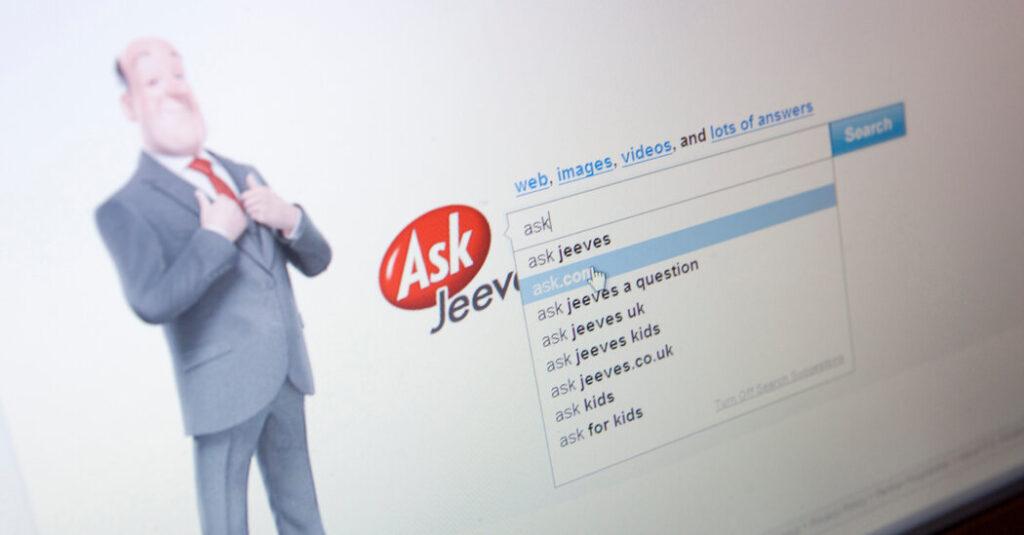
In the digital wilds of Y2K, we came to him with our most probing questions.
He told us about Britney Spears, tamagotchis, former President George W. Bush and Beanie Babies. We asked, and he answered: Jeeves, the digital butler of information, the online valet who led us into the depths of cyberspace.
Now, like so many other relics of yesterday’s internet, Jeeves — and his home, Ask.com — are no more. After almost 30 years, the question-and-answer service and former search engine shuttered on Friday.
“To you — the millions of users who turned to us for answers in a rapidly changing world — thank you for your endless curiosity, your loyalty, and your trust,” the company said in a notice posted on its now-defunct website.
The death of Ask.com is, perhaps, a Rorschach test for our current digital crossroads: proof of the internet’s unyielding change-or-die law, or the decay of a simpler digital time.
Before Claude Code, Grok and Gemini, Jeeves was there in a modest, everyman suit. We conversed with him in full sentences and asked him whole questions. We knew him. We believed him.
Created in Berkeley, Calif., in the days of the dot-com gold rush, Ask Jeeves first appeared on computer screens in 1996.
The pioneering, quirky question-and-answer search engine was the brainchild of founders David Warthen and Garrett Gruener. Their mascot, Jeeves, was modeled on the clever English butler character from the famed P.G. Wodehouse comics. Its search function was simple — type in a question, get an answer.
But the quality of its responses was uneven, and the website was quickly eclipsed by Google and Yahoo as the world’s go-to search engines.
The site was bought by InterActive Corp. for more than $1 billion in 2005, and was given an injection of cash to help it compete as a search engine.
It rebranded as Ask.com and as part of the reimagining, the site also ditched the character of Jeeves in 2006. Scrappy but inventive, the site was one of the first to introduce hyperlocal map overlays to its searches and incorporate thumbnails of webpages.
“They are doing a lot of clever and interesting things,” a Google executive noted of Ask.com at the time.
Still, Ask.com struggled to compete and returned in 2010 to its bread and butter: question-and-answer style prompts.
Even then, it faltered against newer, crowdsourced iterations like Quora and Google’s unyielding march to the internet fore — the platform now dominates search traffic, and the world’s general experience of the internet.
“As IAC continues to sharpen its focus, we have made the decision to discontinue our search business, which includes Ask.com,” said the statement from InterActive Corp. on Ask.com’s website.
Still, Jeeves and his more polite, genteel brand of cyberspace survives, if only in the Gen Z-fueled nostalgia for simpler digital times.
In the pantheon of millennial touchstones, he resides somewhere between AOL Instant Messenger and Limewire, gone from our screens but forever in our Wayback machines. (By Sunday, many of Ask.com’s archived webpages were no longer available.)
Ali Watkins covers international news for The Times and is based in Belfast.
The post So Long Jeeves and Ask.com, Relics of Yesterday’s Internet appeared first on New York Times.