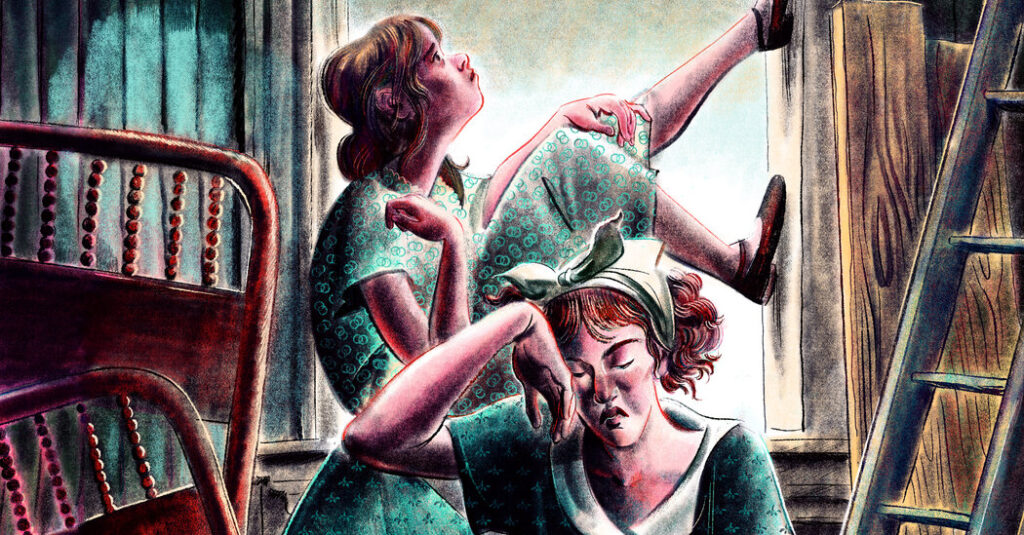
THE CALAMITY CLUB, by Kathryn Stockett
It all starts with a moldy ceiling in the Lafayette County Orphan Asylum for Girls. It’s the height of the Depression in Oxford, Miss., and the dilapidated house — known around town simply as the Orphan — is filled to the brim with children and babies, waiting to be adopted. Among them is 11-year-old Meg Lefleur, who is banished from the schoolroom by the Orphan’s demonic chairlady and forced to spend most of her waking hours alone in a dank, airless office, wondering why her mother left for the store one day and never came back. Meg was 9.
Enter Birdie Calhoun, the 24-year-old spinster sister of the Orphan’s most butt-kissing socialite-cum-volunteer, Frances Tartt, who married up and out of their Delta hometown and is using her sister’s bookkeeping skills to suck up to the chairlady, Garnett Pittman. (Birdie owes her: Frances has agreed to ask the Tartts for money to pay off the Calhouns’ debts — little realizing that the Tartts will soon fall on their own hard times.)
Balancing the Orphan’s dubious receipts in the suffocating, “verdant” office, Birdie is appalled by the conditions Meg and the other older girls are kept in, becoming fixated on the stench, on the boarded-up window, on the brown mold creeping its way up the wall and across the ceiling. Soon she and Meg are clandestinely scrubbing with rags and mops and bleach, and painting the whole room an optimistic, unapproved robin’s egg blue. Birdie rips off the wooden slats covering the broken window, letting fresh air flow in.
“Do you miss your mama, Meg?” Birdie is the first to ask her, and the floodgates open. While they work, Meg confides about her mother’s habits of dancing and cleaning and reading; about the male stranger who found Meg alone in her house and brought her to the orphanage; how before he showed up she’d been so cold and so hungry she’d tried to eat her mother’s copy of “You Liss Sees.” (“Boringest book I ever ate.”)
Meg and Birdie, the alternating narrators of Kathryn Stockett’s prodigious second novel, “The Calamity Club” — published 17 years after her wildly successful debut, “The Help” — soon part ways for good, and Garnett boards the window right back up. But the week and a half in which their paths overlap changes both young women irrevocably, setting in motion a rollicking and wrenching story of economic hardship and injustice, of the particular cruelty that masquerades as charity, of the primal longings of motherless children and childless women.
This is a 638-page book whose action takes place over just a couple of months, and with very little exposition to speak of. So it is remarkable that, with the conspicuous exception of about 100 sagging, repetitive pages toward the middle — when Birdie and her “slapped-together band of misfits” are busy turning the Tartts’ disgraced home into the titular “dance club that was also a boardinghouse that was actually a speakeasy that was truly a brothel” — it flies. There are forced sterilizations and troubled, tragicomic scions; alcoholics, adulterers, child laborers, plagiarists, gossips.
This is not a so-called novel of ideas, or at least not of new ones. It is not the least bit experimental or formally inventive. It’s all about plot, baby, and that plot, for the most part, delivers. Stockett is a master of the set piece, from the club’s painfully awkward grand opening — “Not even the prostitutes looked like they wanted to go upstairs and do it anymore” — to a late passage in which the simmering tension between Meg’s adoptive parents builds to a torturous sequence of confrontation, disappointment, despair.
And all this action is carried relentlessly forward on the surf of Stockett’s full-hearted, down-to-earth prose, her dialogue and inner monologues so well crafted that each sentence gives the impression of being not crafted at all, but inevitable. When one prostitute talks about the son she hasn’t seen in years, “the ache in her voice had muscle, sinew.” When Meg’s adoptive father, Tom, laughs, “it is the kind that is all on the inside,” she observes. “His body shakes and he keeps his lips shut, but he is still laughing. I wonder did somebody tell him he should not do that out loud.”
Where “The Help” spoke from the perspectives of Black maids in white homes in 1960s Jackson — drawing appropriate criticism not for the fact of the white author’s ventriloquism, but for the inauthentic and at times insulting portrayal of the Black women Stockett sought to speak for — “The Calamity Club” is concerned with, and narrated exclusively by, white women: not employers themselves, but moneyless outsiders who arrive in the once-gilded rooms of two grand palaces of the old-money South after they’ve both seen better days.
As narrators, Meg and Birdie are sympathetic and utterly hilarious, drawn fully enough that their individual senses of humor feel distinct from the beginning. Meg has the fierce intelligence, “odd personality” and definitional naïveté of a Charles Portis or Miriam Toews heroine; Birdie is sarcastic and keenly observational, a Jim Crow-era Jerry Seinfeld.
When Frances and her mother-in-law return from shopping to find that Frances’ husband, Rory, has ransacked the house for everything of value and absconded to God knows where — the man has been keeping a lot of secrets — the shallow, clueless Frances seems most concerned with her public image. “If people ever find out about this, I swear I’ll shoot myself,” she threatens, a 1930s Alexis Rose blubbering around Schitt’s Creek. “Well, good luck,” pragmatic Birdie replies, quick as a bullet. “Rory took all the guns.”
One night at the Orphan, before Meg is adopted, she prays to God to “give me something better than five months alone in that room.” Then she repeats the same prayer a couple more times for good measure. “I figure if it is already in the till, it can’t hurt to say it again. Plus Mama always said men are slow learners, so you got to repeat it until it sticks.”
The men in this novel are indeed almost universally pathetic, comically impotent in more ways than one. They squander fortunes and abandon their mistresses and flunk out of Yale, they flock to brothels from the Ole Miss dormitories in busloads, they cower pitifully in the presence of their strong-willed wives. It is the women who are the novel’s driving force, for better and for worse. Recent fiction has seen few villains quite so hateable as Garnett Pittman.
Stockett’s portraits of good and evil, of rich and poor, of women with class and those who can’t afford it, can be uncomplicated to the point of cartoonish, but the point here isn’t so much moral complexity as it is pure, hell-raising entertainment.
It’s the least complicated thing in the world, after all, the yearning between mother and child. Some 400 pages after Birdie asks her about missing her mama, Meg finally answers, in a moment of desperation when she’s experienced one abandonment too many. “Maybe I will let myself say it,” she thinks. “I curl in a ball and say it soft as a poem. Just this once, so only I can hear it: I want my mommy.”
THE CALAMITY CLUB | By Kathryn Stockett | Spiegel & Grau | 638 pp. | $35
The post A Raucous Tale of Found Family by the Author of ‘The Help’ appeared first on New York Times.