TRUE CRIME: A Memoir, by Patricia Cornwell
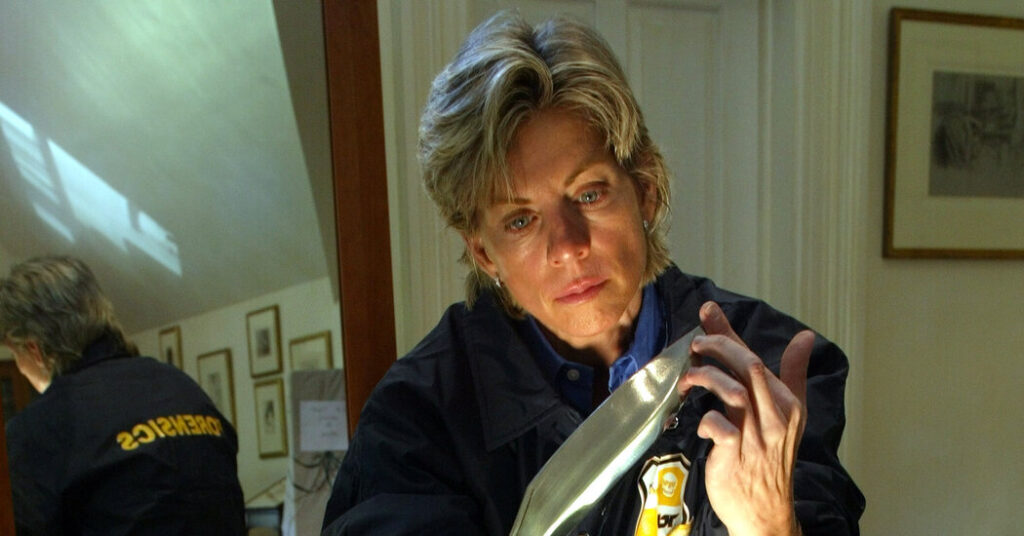
Patricia Cornwell is meticulous about researching the plots of her best-selling forensic thrillers — leaving a quarter under one corpse’s buttocks for a month, for example, to test whether it oxidized on the skin in a telltale pattern — but mystical in her outlook.
In her plainly written but effective new memoir, “True Crime,” Cornwell recounts how, long before her supersonic career took off, she had a dream where Agatha Christie appeared in a big black hat, looked her in the eye and proclaimed grandly: “You will take my place.”
Once success does swoop in, “True Crime” gets bogged down by famous names. Flirty friendships with George H.W. Bush and Orrin Hatch; script discussions with Demi Moore and Susan Sarandon; candidates to play Cornwell’s famous heroine, the forensic pathologist Kay Scarpetta (Nicole Kidman eventually got the role).
There were unwelcome advances from Larry King, and the previously untold, underwhelming anecdote of Bill Clinton theorizing why O.J. Simpson did it.
But a mesmerizing Southern Gothic horror hovers over the author’s formative years, with “perfume pie” made from Cool Whip and Jell-O powder; a neighbor’s child requesting she put heated steel screws up his rectum; a Grandma Gussie, a.k.a. G.G., who made hats with ostrich feathers; and a beloved teacher giving lessons in poisonous botany.
The Scarpetta books (almost 30 of them) originated from Cornwell’s own gruesome experiences working at the medical examiner’s office in Richmond, Va., and have extended to groundwork with NASA. (“Blood doesn’t drip” in outer space, F.Y.I. “It floats and spatters everywhere as fans blow constantly.”) A survivor of multiple serious accidents, she boldly flies helicopters and drives Ferraris but is nonetheless constantly scanning the world for danger.
“An escalator can cut you to ribbons if you’re not paying attention,” she writes. “The scaffolding you foolishly walked under could collapse. The backhoe gouging the earth on the roadside is way too close to cars going past. The person loitering suspiciously might be a serial killer.”
Little Patricia was known as Patsy after her mother, a former flight attendant and part-time model who resembled Vivien Leigh and was inexplicably nicknamed Pat, though she was actually Marilyn Frances.
These tragic actress associations were apt: After Pat’s husband, Sam Daniels, an appellate lawyer, left her for his secretary, she had psychotic depressive episodes that included, on one occasion, feeding the possessions of their three children, whom she called “schnickelfritzes,” into a living-room fire.
Sam was obviously not the picture of mental health either. Yes, he took the schnickelfritzes for fast-food feasts and magical sounding boat trips under the Big Dipper. But he also enjoyed popping up in the window with a nylon stocking over his head when Pat was washing the dishes, and whispering “you’re not fit to live” as she slept.
Pat found solace as a born-again Baptist, and after the breakup relocated with Patsy and two sons to the small town of Montreat, N.C., because her favored televangelist, Billy Graham, lived there. His wife, Ruth, helped route her to a psychiatric hospital, where she got electroconvulsive therapy, and the Daniels brood into foster care with a missionary couple, which was its own kind of shock treatment: intercom spying system, Maltese puppy tied to a pole and left alone in a basement, etc.
The strict mealtime rules there probably contributed to Patsy’s eventual eating disorder and own institutionalization, under the questionable care of a sinister “Dr. Bill” who had also treated her mother. The sense of control that came with working at the morgue, vile odors and crunch of hardened arteries being sectioned notwithstanding, was probably the cure.
The “Cornwell” came from Patricia’s late ex-husband, Charles, who had been one of her English professors at Davidson College, where she was admitted as a tennis player so good she played on men’s teams, despite a subpar academic record.
Their marriage foundered after she was drugged and raped by a law-enforcement official, a source when she was on the police beat at The Charlotte Observer. (Bisexual, Cornwell has been partnered with Staci Gruber, the neuroscientist nicknamed Harvard’s Pot Doc on CNN, for over 20 years.)
The author’s first published book, “A Time for Remembering” (later repackaged as “Ruth: A Portrait”), was a poorly received hagiography of Ruth Graham, a fairy godmother descending from her mountaintop manse in a silver automobile, playing Pachelbel’s Canon for young Patsy and supporting her early writing efforts.
This ragtag protégée wrote four novels and was rejected by multiple imprints, all currently rending their garments, before Scribner bought “Postmortem” for $6,000, publishing it in 1990.
Though best known for Scarpetta, and a few other fictional series, she is also devoted to the mysteries of history.
She questions the conclusion that her maternal grandfather’s plunge off the 17th floor of the Conway Building in Chicago — resulting in fatal “evisceration of the liver and intestines” — was a suicide.
Meanwhile, somewhere back on the paternal side is Harriet Beecher Stowe, the abolitionist author of “Uncle Tom’s Cabin.”
Cornwell feels a certain kinship for Stowe’s investigation of John Wilkes Booth’s death and defends her against Charles Dickens’s charge of sentimentality. “The ugly truth is that many authors don’t like each other even if they won’t admit it,” she writes.
One sore thumb on Cornwell’s enormous body of work is the 2002 book “Portrait of a Killer,” which concludes that Jack the Ripper was the painter Walter Sickert. In The New York Times, Caleb Carr, a fellow abuse survivor turned literary criminologist and animal advocate, called it “sloppy,” “insulting” and an “exercise in calumny.”
Cornwell does not address his criticisms in the memoir. “To this day I rarely read anything written about me,” she writes, “most of all book reviews.”
TRUE CRIME: A Memoir | By Patricia Cornwell | Grand Central | 464 pp. | $32.50
Alexandra Jacobs is a Times book critic and occasional features writer. She joined The Times in 2010.
The post Patricia Cornwell Takes a Scalpel to Her Own Life Story appeared first on New York Times.