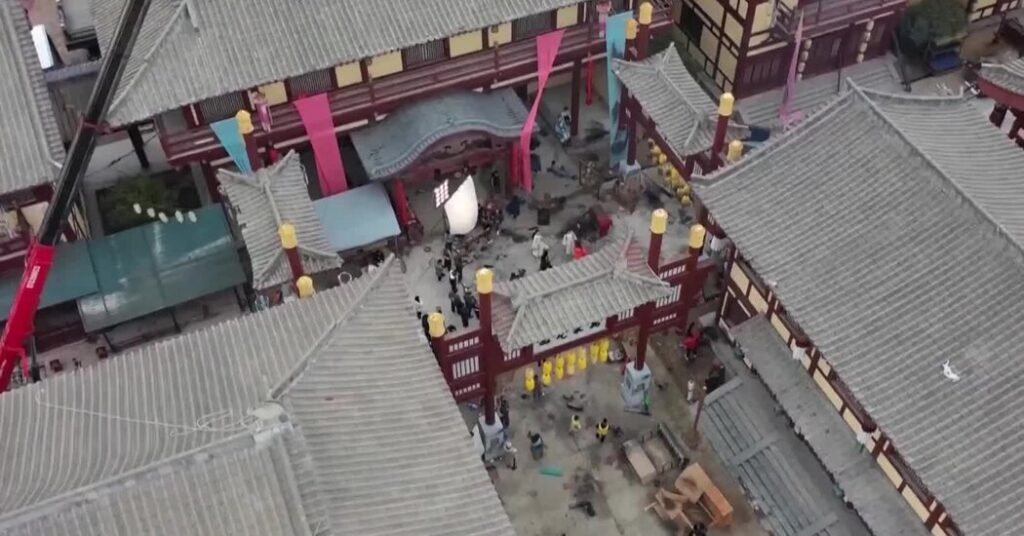
Until recently, making a hit microdrama — the soapy, short-form, made-for-mobile shows that have become wildly popular in China — meant hiring actors, renting sets and spending weeks filming and editing.
Now, some Chinese companies are churning them out for $30 a minute, with no cameras, no crew and no human performers.
That’s thanks to artificial intelligence.
Dramas generated by the technology have suddenly become ubiquitous in China: In March alone, nearly 50,000 new A.I.-generated microdramas were uploaded to Douyin, China’s version of TikTok, according to DataEye, a Chinese consulting firm. That single month’s uploads nearly matched the platform’s total uploads for all of 2025.
The boom is being fueled by the widespread availability and increasing prowess of A.I. video tools, including Seedance 2.0, which was released in February by the Chinese parent company of TikTok. Production companies have been testing what these models can do, creating experimental clips of Chinese warriors in combat, an apocalypse or an idyllic countryside river. The microdrama episodes themselves are usually one or two minutes long and serialized.
Most A.I.-generated microdramas, which under Chinese law are required to be labeled as such, attract little attention. But some clips have racked up hundreds of millions of views, in a country where people are generally more optimistic about A.I. than in the West. The Chinese market for A.I. microdramas is expected to be worth more than $3 billion this year, according to Chinese state media, out of a more than $14 billion market for microdramas in general.
But recently, the surge has also set off an outcry in China. Actors say their work opportunities have dried up. Celebrities and ordinary people alike have threatened legal action after discovering their likenesses in A.I.-generated microdramas. (ByteDance has since introduced restrictions on using real people’s faces in Seedance.)
We spoke to several people in China’s entertainment industry to hear how A.I. has changed their lives.
The Actor
Li Jiao’e, 32
When Li Jiao’e moved to Hengdian, a major filming hub in eastern China, in 2024, he had only bit parts in microdramas. Still, he was thrilled. After years of bouncing between unrelated jobs, he was finally chasing his dream of being an actor.
As time passed, he started getting a few speaking lines, often in comedic roles. Sometimes, people recognized him in public.
But in recent months, roles evaporated, he said. Group chats where people shared opportunities went silent.
“There’s nothing,” he said. “It’s like it was raining, and then suddenly the rain stopped.”
He said the drop was partly because a major streaming platform raised its standards for what it was buying. was trying to weed out lower-quality shows. But he thought the hype around A.I. was another reason.
Fears of actors being replaced by A.I. gathered steam recently after a major streaming site announced that it had created a database of more than 100 actors whose likenesses could be available for future A.I. productions. While the platform described the move as a way to ease actors’ workloads, many commenters online said it would only accelerate job losses.
A different microdrama platform also announced that it had removed a popular show after two social media users discovered that their likenesses had been used, without their permission, to create villains in the show. The platform, which is owned by ByteDance, said it would strengthen its review mechanisms to prevent similar cases in the future.
Chinese regulators last month introduced rules requiring people’s consent before they can be used as digital avatars.
Mr. Li said he did not oppose the use of A.I. in entertainment but thought the industry was applying it in the wrong way.
“They’re still just imitating humans or trying to make things more humanlike,” he said. “They should be trying to unleash more imagination, taking a more unconventional route.”
He continued: “After all, our fundamental value as humans is in our ability to imagine.”
The Director
Wang Yushun, 37
Wang Yushun knew the importance of budgets in filmmaking. Before becoming a microdrama director, he had made television dramas and independent films, and he had seen projects that he had worked on for months or even years derailed by a skittish investor. Part of the reason he had turned to the shorter format was for the quick returns.
Still, when A.I. tools first became popular several years ago, he was skeptical of their quality, even as he saw how they could help him save money. He used them mostly to create mood boards, he said.
But last summer, he changed his mind. When he asked an A.I. tool to generate a scene of a horse charging into a trench to rescue a general, the result was far more detailed than he had expected or even asked for, including the horse crashing into an enemy soldier, the soldier falling and the general galloping away.
“I thought to myself, ‘Wow, this technology may really be able to replace some of the more difficult or expensive scenes,’” he recalled.
Since then, he has adopted A.I. extensively for visual effects, and started a company that makes A.I. microdramas in addition to ones using actors.
Still, Mr. Wang also has concerns about the industry’s rapid pivot to A.I. He has had to lay off employees who worked on live-action productions because demand for such content has fallen so precipitously. Turning to A.I. has been more a necessity than a choice, he said.
He hopes to make projects that combine A.I. with live action. He is working on a project that he said is similar to “Stuart Little,” the film that featured an animated mouse alongside real actors.
“If we could feel the warmth of a real performance, and also see the power of A.I. technology, I think that would be great,” he said.
The Production Company Founder
Hou Xiaohu, 40
When Hou Xiaohu started a company that used A.I. to make videos two years ago, the technology was only good enough for corporate promotional videos. But last year, as A.I. video tools improved, and demand for microdramas was exploding, he shifted focus.
Mr. Hou now has about a dozen employees, divided between creative work, similar to traditional screenwriting and directing, and the technical work of generating A.I. footage. His company focuses on stories involving traditional narratives, such as the story of a folk sea goddess or a superhero monk.
Some of Mr. Hou’s creative employees have backgrounds in filmmaking, but others are simply people “who are obsessed with A.I.,” he said.
“This work isn’t exactly traditional screenwriting. Part of it requires translating into a language that A.I. can understand,” he said. “People who don’t have a traditional directing or screenwriting background might actually be better at it.”
Producing a 100-minute animated series takes about one month and three employees. Realistic ones take around five people, because it is more labor-intensive to create images that are good enough.
Industry competition has become fiercer in recent months. But Mr. Hou predicted that many of the cheapest productions would fizzle out, as audiences demanded higher quality.
He also said he was not worried about the public backlash toward A.I.-generated microdramas. As government oversight increased, he said, improper uses of people’s likenesses would decrease.
And people would gradually find ways to adapt to the employment pains, too, he said. He himself had previously worked for big tech companies in Beijing before he was forced out by cutbacks and pivoted to A.I. filmmaking.
“The impact on employment — there definitely will be an impact,” Mr. Hou said. “But for individuals, what can you do? You can only embrace this new era and think about how to adapt.”
Siyi Zhao contributed research.
Vivian Wang is a China correspondent based in Beijing, where she writes about how the country’s global rise and ambitions are shaping the daily lives of its people.
The post How A.I. Is Transforming China’s Entertainment Industry appeared first on New York Times.