A federal appeals court issued a ruling on Friday temporarily halting the ability of abortion providers to prescribe pills using telemedicine and send them to patients by mail, blocking what has become a major avenue for women seeking abortions in recent years.
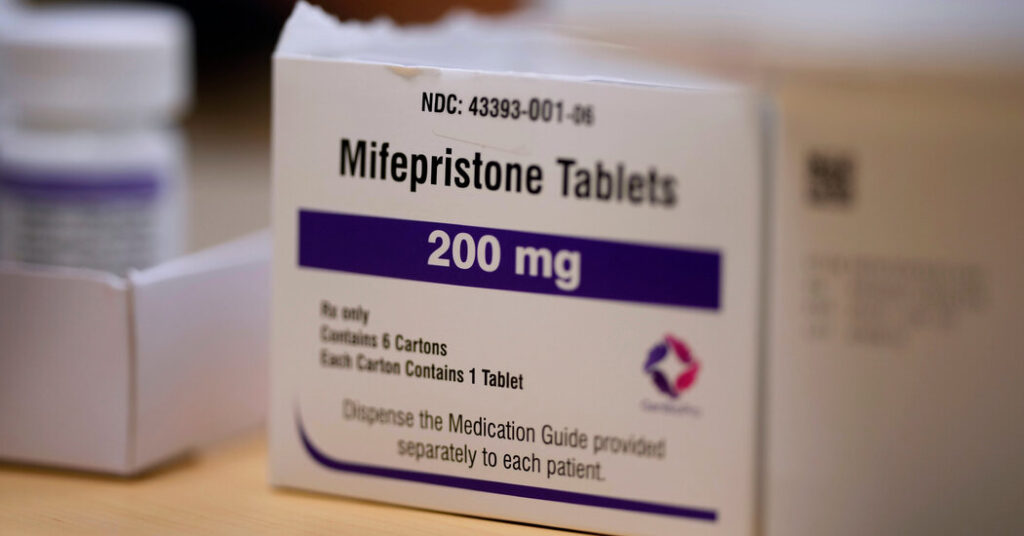
The order comes in a case in which the state of Louisiana is suing the Food and Drug Administration, seeking to sharply curtail access to the abortion pill mifepristone. In the order, a panel of the U.S. Court of Appeals for the Fifth Circuit granted Louisiana’s request for a temporary stay of the F.D.A.’s decision several years ago to remove a requirement that patients see a medical provider in person before the pills could be prescribed.
The court order, citing Louisiana’s claims that making pills available by mail has allowed patients there to access the medication despite the state’s near-total abortion ban, said that “Louisiana has shown that it is irreparably harmed without a stay.”
In April, a Federal District Court in Louisiana had declined to pause the availability of pills by mail, instead saying that the proceedings should be delayed until the F.D.A. completes a safety review of mifepristone that is underway and is expected to take until late this year.
On Friday night, Danco Laboratories, a mifepristone manufacturer and defendant in the lawsuit, filed a motion asking the Fifth Circuit to stay its ruling for a week for time “to seek relief in the United States Supreme Court.” The motion asked the court to rule on that request by 9 p.m. Central time “because the panel’s order threatens Danco with immediate harm.” If a weeklong stay is not issued, the company said it will file an emergency appeal with the Supreme Court.
It was unclear Friday night whether the Trump administration would seek a similar stay or appeal the ruling to the Supreme Court. Administration officials did not immediately respond to requests for comment.
In court filings, the Trump administration had argued that the F.D.A. was already conducting a review of mifepristone that would determine whether any regulatory changes were needed.
After the Supreme Court overturned Roe v. Wade in 2022, a wave of politically conservative states, including Louisiana, implemented abortion bans. In response, a number of states that support abortion rights passed shield laws to protect the ability of abortion providers to prescribe pills by telemedicine and ship them to patients in states with abortion bans.
Under shield laws, more than 100,000 patients per year in states with abortion bans have been receiving abortion pills through the mail. A few shield-law providers have been targets of criminal charges or civil actions from Louisiana and Texas, in cases that legal experts believe are setting up a constitutional showdown over whether states must honor one another’s abortion laws.
Mary Ziegler, a law professor and abortion expert at the University of California Davis, said the current landscape of abortion access would be upended if the new court ruling is upheld. “If this holds up in the Supreme Court, it will gut shield laws and radically change how, and how easily, abortion is available,” she said.
Legal experts have said that the case puts the Trump administration in a politically difficult spot, especially ahead of midterm elections. While the administration does not want to be seen as supportive of abortion rights, it also does not want to take a high-profile anti-abortion action at a time when it might antagonize some voters who support abortion rights.
“This ruling will put abortion back on the map as an election issue,” said Ms. Ziegler.
In addition, legal experts say that a court ruling that dictates decisions for a federal agency sets a precedent that could open the door for many other states to challenge federal agencies if they disagree with their policies and regulation.
Another mifepristone manufacturer that is a defendant in the lawsuit, GenBioPro, said in a statement that the court’s order has implications nationwide, not just in Louisiana.
“If this ruling is allowed to stand, everyone in America will lose access to mifepristone by mail or from a pharmacy,” GenBioPro said. “Women nationwide will be forced to navigate unnecessary barriers in order to pick up the medication in person at a hospital, clinic, or medical office — including in states where abortion remains legal.”
Anti-abortion groups hailed the ruling. Tony Perkins, president of the Family Research Council and a former Louisiana state representative, posted on X: “Great news for the unborn in Louisiana!” He added: “The stay was granted because Louisiana has a good chance of winning its case against the FDA. This should be before the U.S. Supreme Court soon.”
Abortion rights supporters reacted with anger and alarm.
“Today’s decision disrupting access to mifepristone via telehealth access goes against what we’ve known to be true for years: medication abortion is safe, it’s effective, and its safety does not change whether dispensed in person or via telehealth care,” Dr. Jamila Perritt, an obstetrician-gynecologist and the president and chief executive of Physicians for Reproductive Health, said in a statement.
Medication is now the method used in nearly two-thirds of abortions in the United States, and is typically delivered in the form of a two-drug regimen through the first 12 weeks of pregnancy. The first of those drugs is mifepristone, which was approved in 2000. The F.D.A. regulates the medication under a strict framework that applies to only about 70 other drugs. Over the years, after careful review of evolving medical data, the F.D.A. has eased some restrictions around the drug.
In 2016, for example, the F.D.A. found that evidence supported allowing additional types of health providers, not just doctors, to become certified to prescribe mifepristone. It also eliminated the requirement that the second medication in the two-drug regimen, misoprostol, be taken in the presence of a doctor.
Misoprostol, which is also used for other conditions, including ulcers and to induce labor, has never been as tightly regulated, and is widely available by prescription. The court’s ruling does not affect misoprostol.
In 2021, at the height of the coronavirus pandemic, the F.D.A. lifted its requirement that patients visit a medical provider in person to obtain mifepristone. That decision, which was officially made permanent in 2023, spurred the formation of numerous telemedicine abortion services.
A report from a reproductive rights research group found that in the first six months of 2025, more than one-fourth of abortions were provided via telemedicine.
Louisiana has argued in its court filings that the F.D.A.’s decision to remove the in-person dispensing requirement was based on inadequate or flawed data. Medical organizations and reproductive rights groups strongly dispute that argument, noting that more than 100 studies have consistently found that mifepristone is safe and that serious complications from taking it are rare.
If access to mifepristone were limited, many abortion providers are prepared to prescribe only misoprostol, which can be used on its own for abortions, but is considered somewhat less effective and more likely to have side effects.
One telemedicine abortion provider, Dr. Angel Foster, co-founder of the The Massachusetts Medication Abortion Access Project, said in a statement that her organization was consulting legal experts about the ruling’s implications and that the group would “do everything in our power to continue providing care to people in all 50 states.”
In 2022, anti-abortion doctors and groups filed another lawsuit against the F.D.A., initially seeking to have mifepristone’s approval revoked. In 2024, the Supreme Court threw out the case, saying the plaintiffs did not have standing to sue. The case was revived later that year with several conservative states as plaintiffs, and is pending before a federal court in Missouri. Another similar case was filed against the F.D.A. last year by Texas and Florida.
Pam Belluck is a health and science reporter for The Times, covering a range of subjects, including reproductive health, long Covid, brain science, neurological disorders, mental health and genetics.
The post Federal Appeals Court Temporarily Halts Abortion Pill Access by Mail appeared first on New York Times.