The future is truly upon us — because the next time your check-in luggage gets battered, you could be blaming a robot.
Starting in May, Japan Airlines, in partnership with GMO AI & Robotics, will start trialing humanoid robots to help baggage handlers at Tokyo’s Haneda airport, it announced Monday, in the hopes that they could one day alleviate a labor shortage.
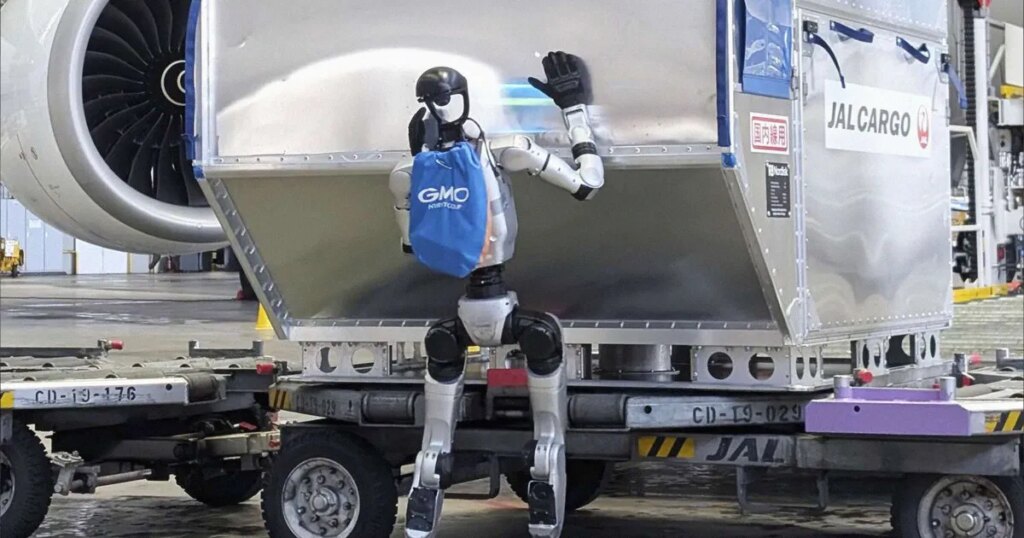
In a demonstration held in front of the media, one of the mechanical helpers built by the Chinese Robotics company Unitree gently pushes — or should we say barely touches — a metal container stacked with suitcases towards a passenger jet. Its contribution is entirely perfunctory, though, since the container is actually being moved by a conveyor belt; the robot didn’t “help” with anything at all.
Not that the robot’s aware. Oblivious, the Unitree machine proudly waves to his human colleague controlling the belt, who kindly returns a thumbs-up.
The stunt is clearly not a serious demonstration of the robots’ capabilities — if it does have meaningful capabilities at all — but Japan Airlines certainly sounds serious about the experiment, since it’s planning for it to run until 2028.
It will be a trial by fire for the androids. Serving more than 60 million passengers per year, Haneda is easily one of the busiest air travel hubs in the world. Slip-ups could lead to luggage being lost or damaged, or costly delays.
They’ll also face steep competition. We’re not trying to launder Japan’s PR any more than it already gets, but its baggage handlers are pretty lauded for being thorough and gentle, and going above and beyond. That’s kind of remarkable, since the only other time baggage handlers make the news is for piling together your fragile belongings like sandbags.
How capable the bots prove remains to be seen. It could go horribly wrong, given the number of robot flameouts we’ve witnessed. But in theory they’ll help Japan’s baggage handlers deal with the influx of tourists, seven million of whom visited in the first two months of this year alone.
“While airports appear highly automated and standardised, their back-end operations still rely heavily on human labour and face serious labour shortages,” GMO AI & Robotics’ president Tomohiro Uchida told reporters, per the BBC.
More on robots: New AI-Powered Robot Can Destroy Human Champions at Ping Pong
The post Japanese Airport Trialing Humanoid Robots as Baggage Handlers appeared first on Futurism.