Federal disaster declarations, which unlock millions of dollars in aid for communities hit by catastrophes, have been delayed significantly in President Trump’s second term, and money is flowing especially slowly to states that Mr. Trump lost in the 2024 election, according to a New York Times analysis.
The review of Federal Emergency Management Agency data found that the Trump administration is moving more slowly than its predecessors to approve or deny requests for emergency aid after natural disasters, sometimes leaving communities stretched to pay big expenses until they hear whether the federal government will help.
In past decades, more than a few weeks rarely passed before presidents approved or denied state requests for disaster declarations, designations that make communities eligible for federal aid.
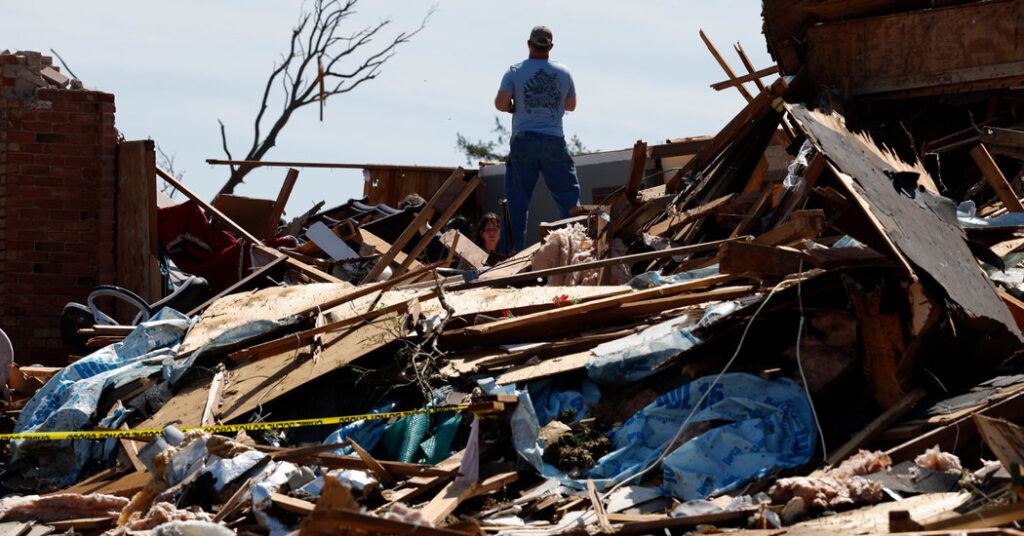
But that gap has been growing, a change that has accelerated under this administration. For instance, when destructive storms swept across Kansas in July, triggering widespread flash flooding that required rescues in areas still recovering from earlier storms and tornadoes, it took six months for Mr. Trump to grant the state’s request.
In Edwards County, Kan., population 2,800, that meant local officials had to cover costs up front.
“That comes out of our budget,” said Richard Neilson, the county’s emergency manager. “Sometimes it’s a lot of money.”
FEMA officials said the agency’s approach to disaster declarations had not changed, apart from adjustments to damage thresholds for inflation. The administration received 75 disaster declaration requests last year, down from 100 or more per year in the two previous years, reflecting a relative lull in disaster activity, not changes in policy, they said.
“Any suggestion that disaster decisions are politically motivated does not reflect how this process works or how FEMA carries out its mission,” Daniel Llargués, an agency spokesman, wrote in an email. “FEMA continues to process federal declaration requests and deliver assistance promptly, supporting state and local governments to invest in their own resilience before disaster strikes.”
The Times analysis includes 70 disaster declaration decisions made since Mr. Trump’s second inauguration for Republican-controlled red states and 20 for blue states governed by Democrats.
Since 2000, there have been 86 disaster declaration requests per year, on average, excluding those related to the coronavirus pandemic.
Federal disaster declarations are typically issued when hurricanes, tornadoes, earthquakes or even pandemics overwhelm a state or tribal government’s ability to respond. Officials calculate the need based on damage estimates, which are weighed against population figures to determine the overall impact.
But while such analyses are intended to inform a president’s decision-making on disaster aid requests, they are only advisory. The final call is up to the president.
In his second term, Mr. Trump has made clear he doesn’t think federal intervention is always the best solution after disasters. He has been pushing for FEMA to be drastically reshaped, if not abolished, saying last year that governors should be able to handle most disasters without requesting federal declarations.
“If they can’t handle it, they shouldn’t be governor,” he said in June.
Mr. Trump has yet to formally nominate a FEMA administrator in his second term and has largely left the agency in limbo, shrinking its work force by thousands and weighing significant changes to the way it operates. He is said to be considering nominating Cameron Hamilton, who briefly led the agency on an acting basis last year but was fired days after he testified to Congress that FEMA should not be abolished.
Slower moves to declare disasters could reflect the president’s desire for state and local governments to manage more disaster events without federal disaster declarations, said Pete Gaynor, who served as FEMA administrator during Mr. Trump’s first term.
Trump Administration: Live Updates
Updated
- The authorities release new video of the suspect in the White House correspondents’ dinner attack.
- Trump threatens higher tariffs on European cars.
- The administration is pushing forward with tariffs based on forced labor laws.
“If you’re committed to FEMA reform and shifting responsibility to states and locals, one way to do that is, don’t approve them all,” Mr. Gaynor said.
Some delays in the flow of disaster aid may also have been the result of a policy implemented by the former homeland security secretary, Kristi Noem, that required all expenditures of more than $100,000 to go to her office for review. But it isn’t entirely clear why declarations are taking longer, former FEMA leaders said.
More frequent disasters could be slowing the FEMA and federal budget review process that typically follows a declaration request. That scrutiny can be lengthy and involve significant back-and-forth with community officials, especially in cases when damage costs are close to the thresholds designed to guide approvals, said Deanne Criswell, who led FEMA under President Joseph R. Biden Jr.
At the same time, though, as climate change increases the damage that some types of extreme weather cause, determining that an event was severe enough to merit federal intervention could be easier, Ms. Criswell said.
“It’s hard to say if there’s a trend because disasters are different,” she said. “Every disaster is different.”
Mr. Trump has highlighted the role politics plays in his disaster declaration decisions, often stressing on social media that he is eager to approve requests from states that voted for him.
“I just informed Governor Mike Dunleavy that, based on his request, I am approving $25 Million Dollars to help Alaska recover from the major typhoon they experienced earlier this month,” he wrote in a Truth Social post in October. “It is my Honor to deliver for the Great State of Alaska, which I won BIG in 2016, 2020, and 2024 — ALASKA, I WILL NEVER LET YOU DOWN!”
States that voted for Mr. Trump in 2024 have seen declaration approval rates on par with past administrations, but states that backed Vice President Kamala Harris have had their requests rejected at more than twice the usual rate, the Times analysis shows.
In Vermont, for example, a system of slow-moving thunderstorms created the latest in a series of flooding emergencies in July in a state that sees frequent disaster declarations despite its small size. But it wasn’t until February that Vermont (which Ms. Harris won by a 32-point margin in 2024) got word from FEMA: Its request had been denied, even though flood damage exceeded thresholds that Eric Forand, director of Vermont Emergency Management, said would normally lead him to expect approval.
“In the past, that was a pretty good indicator of whether you were going to get your money,” Mr. Forand said. “Now, that is not a good indicator.”
Uncertainty over shifts in FEMA policy have Mr. Forand questioning what, if anything, he can do to change his state’s approach. In blue and red states alike, emergency managers are waiting to learn how the Trump administration might revise disaster aid criteria or the ways aid is delivered.
In Kansas, which voted for Mr. Trump by a 16-point margin in 2024, the president’s December approval of its declaration request, which was made in July, marked just the beginning of another process by which Mr. Neilson and counterparts in a dozen other counties could seek reimbursement from FEMA for expenses they incurred months earlier to save lives and help communities recover. States are typically eligible for federal dollars covering 75 percent of approved disaster costs, and up to 100 percent after the most severe disasters. It could be months more before rural counties like Mr. Neilson’s recoup all their costs.
Scrutiny of FEMA spending has caused that reimbursement process to slow dramatically under the Trump administration, too, creating significant backlogs of disaster aid.
“It’s a long time,” Mr. Neilson said of the lengthening gap between a disaster event, a presidential declaration, and the payout of any federal disaster aid.
The newly confirmed homeland security secretary, Markwayne Mullin, has signaled a desire to keep partisanship out of disaster aid and other aspects of the work of his department, which includes FEMA. He quickly followed through on a pledge to roll back Noem’s $100,000 review policy.
“I don’t care what color your state is,” Mr. Mullin said at a Senate confirmation hearing in March. “I don’t care if you’re red or you’re blue.” He added that his job would be “to protect everybody.”
Disaster policy experts will be watching closely to see if Mr. Mullin can deliver on that call for bipartisanship. Sarah Labowitz, a senior fellow at the Carnegie Endowment for International Peace who studies disaster spending, said she was eager to see whether FEMA could combat the rising trend in the number of days disaster-struck communities must wait for federal aid to flow, whether in blue or red states.
“The question going forward,” Ms. Labowitz said, “is can they bring that number down for everybody?”
Scott Dance is a Times reporter who covers how climate change and extreme weather are transforming society.
The post It’s Harder Than Ever to Get Federal Disaster Aid. Even in Red States. appeared first on New York Times.