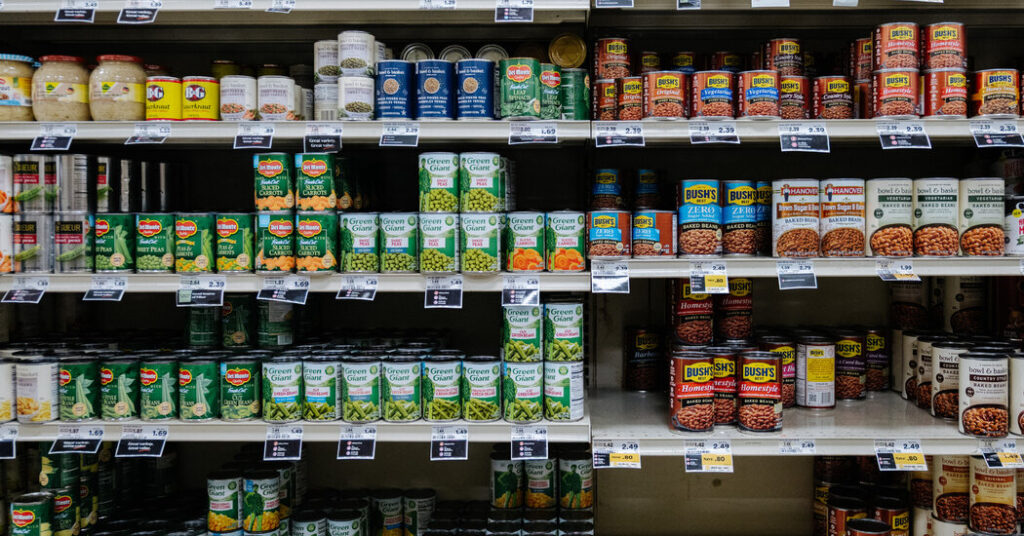
Maryland this week became the first state in America to ban grocery stores and third-party delivery services like DoorDash from using customers’ personal data to set higher prices.
The practice — supported by artificial intelligence and known as dynamic pricing or surveillance pricing — can lead to two consumers paying different amounts for the same item from the same retailer, at roughly the same time. If a store knows, for example, that one of those customers lives in a wealthier neighborhood, it can charge that person a higher price.
The bill enforcing the ban, the Protection From Predatory Pricing Act, goes into effect on Oct. 1. Merchants face fines of $10,000 for running afoul of the law, and penalties of $25,000 for repeat offenses.
“At a time when technology can predict what we need, when we need it, when we’ll pay for it and also when we’ll pay more for it,” Gov. Wes Moore of Maryland, a Democrat, said at a signing ceremony for the bill on Tuesday. “And at a time when we are watching how big companies are then using those analytics against us to make record profits, Maryland is not just pushing back. Maryland is pushing forward.”
The bill comes amid increasing resistance to dynamic pricing from states across the country, according to privacy advocates. Tom McBrien, counsel at the Electronic Privacy Information Center, a nonprofit group, estimated that 33 states had introduced bills seeking to either ban some form of dynamic pricing or force companies to disclose their use of the practice.
Last November, New York enacted a disclosure bill, making it the first state in the country to target dynamic pricing, and lawmakers have introduced legislation to ban the practice outright. California, Colorado, Illinois and New Jersey are among the other states considering dynamic pricing laws.
The Maryland Retailers Alliance, a trade association representing thousands of merchants in the state, released a statement on Thursday criticizing the bill.
The practice of charging two customers different prices for the same item based on personal data was already prohibited in the state under the Maryland Consumer Protection Act, the alliance said, and “the notion that widespread, individualized price gouging could occur in such a market is inconsistent with the economic realities of the industry.”
The alliance added that the state attorney general’s office had received no “substantiated complaints” pointing to a pattern of predatory price hikes at grocery stores.
Some consumer advocates and rights groups, however, said the bill did not go nearly far enough.
“We appreciate Gov. Wes Moore and the Maryland legislature for making the issue of surveillance pricing a top priority during this legislative session,” Grace Gedye, a policy analyst at Consumer Reports, said in a statement. “Unfortunately, this law has too many industry-friendly loopholes and weak enforcement provisions.”
Among those problematic carve-outs, according to Consumer Reports and other privacy advocates, is the fact that the bill does not apply to customer loyalty programs, which are popular with consumers and harvest significant amounts of their data.
“Data has become the currency of retail strategy, and loyalty programs are really among the most powerful vehicles for collecting it,” said Stephanie Nguyen, a senior fellow at the Center for Law and the Economy at Columbia Law School.
Loyalty programs can pry out potent insights about consumer behavior, including how often people shop and how much they are willing to pay for a pair of sneakers or a six-pack of toilet paper, said Ms. Nguyen, who has studied such programs and worked as a chief technologist at the Federal Trade Commission under the Biden administration.
Consumer Reports and Mr. McBrien took issue with the way the Maryland law prohibits only price increases, not decreases. Mr. McBrien described a scenario in which a retailer might raise prices across the board while using dynamic pricing to lower prices for a few targeted consumers, thus increasing costs for most customers.
Mr. McBrien and Ms. Nguyen also criticized the law for giving enforcement power to Maryland’s attorney general and prohibiting individual consumers from suing violators.
In response to criticisms of the bill, a spokeswoman for Mr. Moore, Rhyan Lake, said that the law “represents an important step toward transparency, and will help protect Marylanders’ pockets at the supermarket as the governor continues fighting to make life a bit easier for hard-working people.”
The reality, Mr. McBrien said, is that many retailers are using algorithms to make inferences about human behavior, and they tend to be about how much someone is willing to spend.
“Businesses are no longer competing on price,” he said.
The post Maryland Is First to Ban A.I.-Driven Price Increases in Grocery Stores appeared first on New York Times.