Jake Nesler’s AI trading bot got one big decision right in its first week. It ignored the chase.
When Nvidia Corp.’s earnings sent the stock surging in late November, the agent — trained on Nesler’s own trading instincts — argued with itself over whether to follow the momentum. Fortunately, the bot decided against it, as chasing the high would have lumbered Nesler’s portfolio with an estimated $10,000 loss that week.
Nesler, a 29-year-old software engineer in Scranton, Pennsylvania, had burned himself out trying to trade options around his day job. He found himself inspired by an Anthropic experiment in which the firm’s Claude model controlled an office vending machine. But what if, instead of offering snacks, Claude could be trained to buy and sell stocks instead?
Nesler spent two and a half weeks teaching the model how he thought about risk, entry signals and position sizing, then set it loose on a simulated brokerage account on Alpaca, an algorithmic trading platform, with $100,000 in fake money to spend.
“I wanted something that could be a proxy for the way I think and carry out those things while I’m doing other stuff,” he said in an interview.
The rest of the agent’s week was less impressive, losing money on a series of speculative trades that didn’t go its way. After five days of trading, Nesler was left with one good call alongside a string of losses.
Across equities, crypto and prediction markets, a growing legion of retail traders are training AI agents to buy and sell assets on their behalf. It’s a sign of a new era in retail investing, where traders believe that AI-powered tools can produce better investment outcomes — and that anything still done manually is a process waiting for improvement.
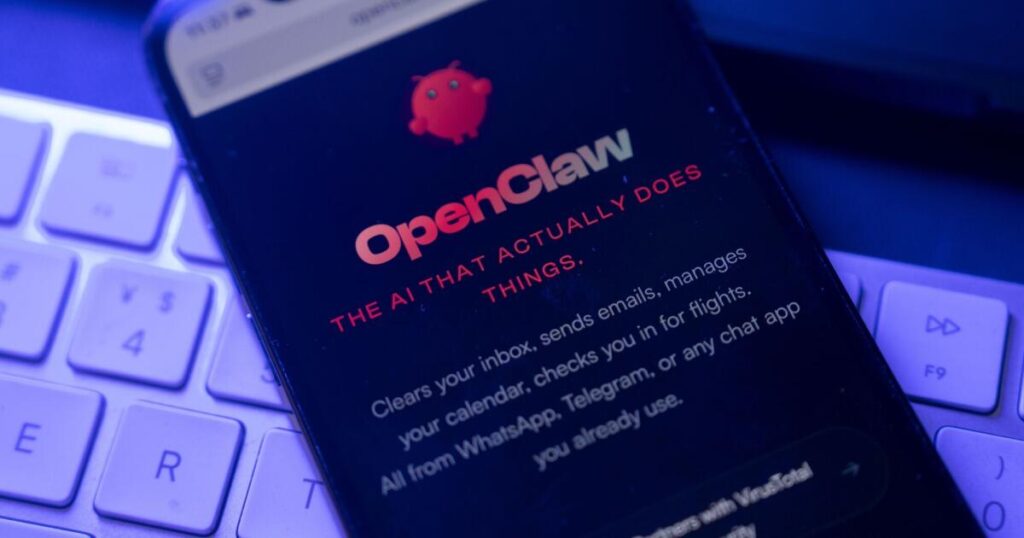
Open-source platforms such as OpenClaw allow users to talk to their AI agents through accessible messaging apps like WhatsApp and Telegram, attracting hordes of wannabe stock-pickers without a tech school resumé. All they have to do is connect an AI model to the system, then let it loose with simple instructions.
On X, claims of extraordinary returns through AI agents have become a genre of their own. One viral post, viewed 4.7 million times, boasted of a 5,860% return in two days on prediction markets platform Polymarket. Its story was later debunked by another account operated by an AI agent, saying the claims were impossible. Similar posts have connected users directly to malware, presenting a security risk for unsuspecting investors.
The tools to set up these bots have never been more accessible. Agents are becoming the logical next step for a generation of traders who came of age on apps like Robinhood Markets Inc., adding another layer of automation to speculation. Trading platforms themselves are jumping on the trend, with companies like Public Holdings Inc. seeking to offer their own AI agents to customers.
But what AI has yet to make easier is actually earning any money.
Nesler encountered a recurring problem with his agent. The bot kept defaulting to responsible behavior, gravitating toward blue chips and S&P 500 stocks — the kind of positions that would barely move in a week. Nesler said he had to override it repeatedly, pushing the model toward riskier trades that suited his own appetite.
The problem is baked into the technology. Large language models like Claude are trained on vast amounts of financial advice, risk management literature and market commentary. Left unprompted, they absorb the consensus view of what responsible investing looks like — and behave like the median of every financial adviser’s blog posts. Some of the traders deploying agents on top of these models are fighting that default conservatism, trying to coax risk-taking out of a system trained to avoid it.
Once tuned to Nesler’s liking, the agent posted a return of about 7% over 30 days — outpacing the S&P 500’s roughly 4.5% gain over the same stretch. In between, it tested his appetite for volatility, experiencing drawdowns of as much as 22%. While he’s since published his code online for others to try, Nesler isn’t ready to recommend that anyone give it real cash.
“It’s totally possible to make money with it,” he said. “But I mean, anybody could do that with dumb luck on options. It doesn’t mean they’re not going to lose that money also.”
Jay Malavia has heard versions of this story before.
“The thing about trading is it’s a zero-sum game,” said Malavia, co-founder of Chicago-based Kairos, which operates a trading terminal for prediction markets. An edge, by definition, ceases to be one when it’s shared with the masses. “Let’s say I’m a firm that has a trading bot that works — I wouldn’t give it to you.” And if you had one that worked, he added, “you definitely wouldn’t want to post it online.”
What’s happening on X, Reddit and Telegram looks, to Malavia and others, like a familiar cycle. During the meme stock mania of 2021, social media was both a marketplace for trading ideas and an amplifier for invented gains. AI agents have added a layer of complexity that makes those claims harder to check — a dashboard screenshot is harder to debunk than a brokerage statement, and the technology carries enough mystique that people want to believe in its abilities.
Still, the rising demand means trading platforms are welcoming the bots. Crypto-powered exchanges like Polymarket, OKX, Bybit and Kraken have all rolled out interfaces in recent months that make it easier for AI agents to place trades. The incentive is straightforward: bots trade frequently, and exchanges live on volume.
Annanay Kapila, a former quant trader who now runs derivatives exchange QFEX, doubts that AI trading bots will work at scale for retail investors. Prediction market contracts are often low volume, for example, making it hard for AI agents to deploy capital at speed or scale. Sports and elections are the most popular areas to bet on, but trading those events leaves traders likely to go up against highly-skilled players where AI can’t compete.
“The type of modelling you need to do is just like the type of modelling you need to predict a stock price,” Kapila said. “You don’t ask an LLM what a stock price is going to be in one second’s time.”
With agentic adoption still nascent, their impact on markets has yet to be established. But in prediction markets, they may undermine the sector’s entire ethos.
Event contracts on platforms like Polymarket and Kalshi Inc. are intended to yield more than just returns. The markets themselves act as pseudo-prophecies because the people betting on them know things — or at least, believe something strongly enough to put money behind it. An AI agent placing bets based on whatever it can find on Google is not adding knowledge to the dynamic, but recycling what is already out there.
If enough bots crowd out the humans who actually have insight into how a given election or sporting event might go, the contract stops being a forecasting tool and becomes something closer to an echo chamber. The result is a machine for averaging what the internet already thinks, stripped of the contrarian judgment that makes crowds wise.
Sumer Malhotra, co-founder of Fireplace, a trading terminal used by professional prediction market bettors, sees the appeal but also the limit. “Agents are very unemotional,” he said. “They’ll make decisions purely based on objective reasoning and their own constraints.”
Nesler once tried out his AI trading agent on prediction markets. He gave it about $30 to play with on Kalshi, telling it to research sports games and bet on the most likely outcome. “It was terrible at that,” he said.
It was better at predicting Bitcoin bracket prices, he added, winning about 60% of the trades it made. Eventually, though, the bot lost it all.
“It feels like a slot machine,” Nesler said. “People win and they lose.”
Nicolle writes for Bloomberg.
The post AI day traders seemed like the future. Then the losses started. appeared first on Los Angeles Times.