It was two days before King Charles III was to visit New York City, and Mayor Zohran Mamdani had nonroyal subjects on his mind.
The World Cup was a few short months away. As he held a news conference on Monday to announce free fan events, he seemed giddy, putting on an accent to shout: “Bafana Bafana, goal for South Africa, goal for all Africa.”
When the subject of the royal visit came up, he refused to say what, if given the chance, he would say to the king privately, and he said brusquely that his attendance at a Sept. 11 memorial event would “be the extent of my meeting with the king.”
Yet on Wednesday, when asked again what he would say to King Charles, Mr. Mamdani came prepared with an answer.
“If I was to speak to the king,” Mr. Mamdani said, “I would probably encourage him to return the Koh-i-Noor diamond.”
The response was not something his communications team cooked up; it was the mayor’s idea, according to a city official familiar with the mayor’s decision.
In America, views about the British monarchy can be something of a Rorschach test on how people feel about colonial power, or inherited wealth and authority. Kings and queens are the stuff of fairy tales and poker tables in the United States, so when real monarchs come to town they tend to stir emotions.
Mayor Mamdani grew up closer to the subject of the monarchy than most people. He was born in Uganda, part of the former British Empire; his parents were born in India, another former colony. His father, Mahmood Mamdani, is one of the leading scholars of post colonialism.
“Dispossession, expulsion, being treated as non-indigenous, being treated as alien — that was the colonial construct from the beginning,” said Hisham Aidi, a political scientist at Columbia University whose supervisor was Professor Mamdani. “That is Mahmood’s life’s work, and Zohran grew up with that.”
The Koh-i-Noor diamond was acquired and given to Queen Victoria in 1849, after the British had the 10-year-old Maharajah Duleep Singh sign over his possession.
The diamond is just over 21 grams — about the size of eight pennies, a large strawberry, a hummingbird or a mid-sized packet of jelly beans. It is 105.6 carats, or five times the amount of one of Kim Kardashian’s (sizable) engagement rings. It is currently sitting in the Tower of London, nestled in a display case. India, Pakistan, Iran and Afghanistan have all claimed it ought to be returned to them.
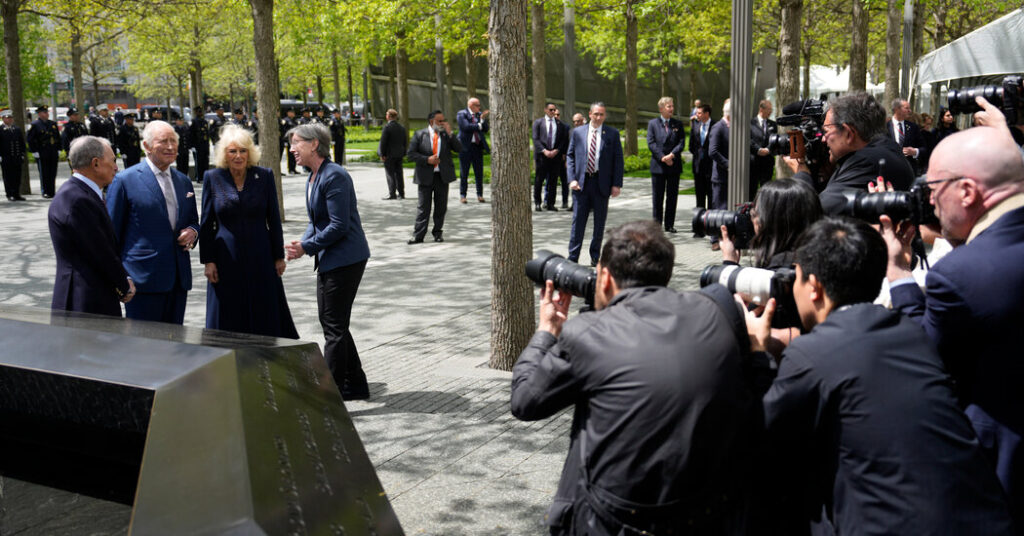
Mr. Mamdani had the chance to ask the king about the diamond when they met at the memorial for the Sept. 11 terror attacks. He did not.
Instead, the mayor smiled and shook hands with King Charles. They exchanged pleasantries, but didn’t talk about anything of substance, according to a person familiar with the interaction.
The mayor, a maestro of the vertical video, also made no mention nor posted any pictures of him appearing with the king. And it was left to a former mayor, Michael R. Bloomberg, to do the honor of escorting the royals at the memorial.
Mr. Mamdani’s call to return the jewel didn’t sit well with some observers.
“After all the King’s deft pyrotechnics navigating the minefield of Trump, I thought it was the wrong time and place for Zoh to bring up the Koh-i-Noor diamond, though I share his opinion it should be returned,” Tina Brown, author of “The Palace Papers,” wrote in an email. “Give his Maj a break!”
Mr. Mamdani’s apparent unease with the royal visit stood in contrast with the scene in Washington, D.C., where the list of heavyweights who attended a dinner for the visiting British monarchs included the president, supreme court justices and at least 10 billionaires.
Mr. Aidi, the Columbia political scientist, recalled Professor Mamdani assigning his students readings about “colonial plunder,” wealth seized by Britain. And his earliest memory of the mayor was being with the Mamdani family at a book launch for the professor’s 2001 book, “When Victims Become Killers.” The scholar took questions from around the packed room, giving the final one to a rambunctious child in the front, his son.
Less steeped in the post-colonialism vernacular at the time, the young Mr. Mamdani wanted to know: “Was this book hard to write?”
Emma Goldberg is a Times reporter who writes about New York City and the Mamdani administration.
The post Why Mayor Mamdani Didn’t Roll Out the Red Carpet for the Royals appeared first on New York Times.