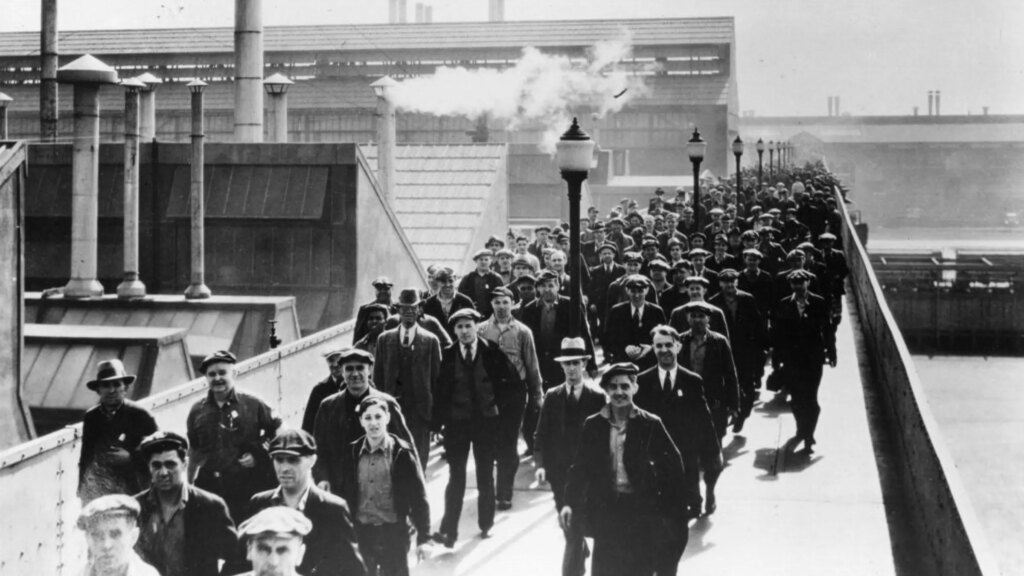
May 1, 2026, marks the 100th anniversary of Henry Ford’s adoption of the five-day workweek.
This standard workweek is now so ingrained in our society that it almost feels timeless. But the five-day rotation doesn’t claim roots in any historic text or religious practice. It wasn’t developed by the ancient Romans, Greeks, or Egyptians. Nobody sat down to conduct an objective analysis for the optimal number of days for humanity to rest and work and determined that our current schedule was ideal, or fair, or necessary.
Our conventional workweek was instead forged by the Industrial Revolution, a period of rapid economic and technological change. As we enter another period of disruption driven by AI, we are once again in a unique position to reimagine how we work in ways that better suit the needs of our modern economy.
As with the last time there was a systemic shift in our working hours, new technologies have catalyzed a reimagining of our professional schedules. Though it’s still early days, AI is already changing not just how we work, but the kinds of skills that deliver value. We believe the next phase in this evolution is a four-day work week.
By reducing the workweek to four days, organizations can foster the well-being and work-life balance that drives innovative thinking—and give workers a reason to embrace, rather than resist, new AI tools.
The history of the work week
To understand how the work week is impacted by technology, look to the history books.
It is estimated that for 95% of human history, we worked an average of 15 hours a week. As work moved from the field to the factory during the first industrial revolution—which began in 1760—working hours skyrocketed. By the late 1800s, it wasn’t uncommon for workers to put in 100-hour weeks.
Throughout that period, workers lobbied for better working conditions, convincing some organizations to experiment with shorter working hours and fewer working days. In the early 19th century, a group of Christian Sabbatarians convinced the federal government to close the post office on Sundays so workers could attend church, and other employers gradually followed.
Some Jewish workers, meanwhile, were given Saturdays off to observe the Sabbath. It is believed that a New England mill was the first to offer both days off to accommodate the holy days of both major religions in 1908.
The first major industrial employer to adopt that schedule was Henry Ford, who announced his intention to implement a five-day, 40-hour workweek at his Detroit auto plant in 1922, a move considered very controversial at the time. A 1922 New York Herald editorial, for example, argued that “the Ford plan is joyous news to all who like to think of bringing work down to the irreducible minimum.”
It wasn’t until 1926—100 years ago—that Ford made the five-day workweek permanent. “It is high time to rid ourselves of the notion that leisure for workmen is either ‘lost time’ or a class privilege,” wrote Ford at the time.
Since then, work has changed in countless ways, yet that structure has remained—not for good reason, but because it’s “the way it’s always been.”
When Ford standardized the five-day workweek a century ago, the paid workforce was about 20% female, an hour of labor was directly correlated with a specific output, and workers couldn’t be reached after they clocked out.
Today, 57% of American women are employed—as are 67% of men—and many households rely on a dual income to make ends meet. That means that even if standard operating hours haven’t changed in the last 100 years, the number of working hours in those dual-income households has nearly doubled.
Thanks to mobile technology, however, work is rarely contained from nine to five. On paper, we work the same eight-hour days as Ford’s factory workers, but in practice, many workers are expected to put in additional time on evenings and weekends.
On an assembly line, an hour of activity is closely correlated with a specific output, but in a knowledge economy, there are countless ways to fill an hour at work—not all of which contribute equally to the bottom line.
According to Asana’s Anatomy of Work Index, the average knowledge worker spends 103 hours in unnecessary meetings, 209 on duplicative work, and 352 just talking about work each year. As a result of these unnecessary and time-consuming tasks, 88% say they’re falling behind on time-sensitive projects and major initiatives. In a knowledge economy, the number of hours worked is far less relevant than the quality of those hours.
At the same time, wages aren’t keeping up. According to the Economic Policy Institute, from 1948 to 1973, a technology-fueled 97% jump in individual productivity was coupled with an inflation-adjusted 91.3% increase in average wages. Between 1973 and 2013, however, individual productivity increased by another 74% while average hourly compensation increased by just 9% once adjusted for inflation.
When Ford made the five-day, 40-hour workweek permanent, he didn’t reduce worker compensation, which was nearly double the industry average. But Ford didn’t reduce working hours and increase employee compensation for altruistic reasons, or as a concession to his workforce. He saw it as a competitive advantage.
At the time, automobiles were a luxury good, and the Ford Motor Company had already sold a car to just about anyone with enough money to afford one. By increasing wages and reducing working hours, Ford expanded the market for his product from the upper classes to the masses.
“The industrial value of leisure as a promoter of the consumption of goods, and thus as a stimulant to business, have been proved,” Ford wrote in 1926. “We find that the men come back after a two-day holiday so fresh and keen that they are able to put their minds as well as their hands to work.”
Ford knew that reducing working hours would spur economic activity, boost recruitment and retention, and improve worker morale and wellbeing, all of which positively contributed to the company’s bottom line.
That brings us to today. As with the last major adjustment to working hours, some are skeptical that our economy can support giving workers an extra day off, but there’s good reason to believe history won’t be on their side. As was the case in the lead-up to Ford’s dramatic decision, hundreds of organizations have experimented with shorter workweeks and report positive results.
Today, many workers are avoiding AI adoption, and their anxiety and hesitancy is understandable. But when the prize for embracing new tools is time off from work, without any change in salary, workers are incentivized to stop resisting and start experimenting.
Many employers are already waking up to that reality.That is in part why OpenAI recently included the four-day workweek in its list of policy recommendations for the intelligence age.
As we undergo another seismic shift in how work is accomplished, history tells us that we have another once-in-a-century opportunity to set a new standard that reflects the needs of today—and those of the 100 years to come.
The post As the 5-Day Workweek Turns 100, It’s Time for an AI Era Upgrade appeared first on TIME.