“We may stop by Cuba after we’re finished with this,” President Donald Trump mused earlier this month during remarks about the war in Iran, one of a number of times in recent weeks that he has implied Cuba will be “next” on the administration’s regime change agenda.
The administration amped up its “maximum pressure” campaign against Cuba in January, shortly after the capture of Venezuelan president and key Cuban ally Nicolas Maduro, severely restricting oil imports to the island as it was already suffering from repeated nationwide blackouts. Now the Pentagon is preparing a range of military options for taking action on the island. Senate Democrats are alarmed enough by the saber-rattling that they’ve sponsored legislation to block military action against the nation.
Amid the threats, talks are ongoing as well. A US State Department delegation visited Havana earlier this month, the first time a US government aircraft had touched down in Cuba since the short-lived rapprochement under the Obama administration. The American delegation brought a list of demands including economic reforms, the release of political prisoners, compensation for US residents and corporations whose properties were seized in the Cuban revolution, and allowing Starlink internet connectivity on the island.
Ever since Fidel Castro took power in 1959, every US president has struggled with the question of what to do about the regime Castro founded 90 miles off the US coast. Fresh off decapitation operations in Venezuela and Iran, Trump seems confident that he’s the one who can solve the problem.
“All my life I’ve been hearing about the United States and Cuba: When will the United States do it? I do believe I’ll be the honor, having the honor of taking Cuba.” he has said.
But what does “taking” Cuba actually mean? The dream for opponents of the regime in both Cuba and the United States is the removal of the communist regime followed by the lifting of the US embargo. But it’s probably more likely to be something short of that.
This administration seems to have a capacious understanding of the concept of “regime change” that does not appear to imply regime removal. The US has left Maduro’s former Vice President Delcy Rodriguez in power in Venezuela under implied threat of further military action if she steps out of line. After the killing of Supreme Leader Ayatollah Ali Khamenei and scores of other top officials in Iran, Trump has said the country’s new government is “less radical and much more reasonable,” though unlike Rodriguez, they seem far less amenable to his demands.
So how might Trump actually “change” the Cuban government, and what would that mean for the Cuban people?
Will the Venezuela model work in Cuba?
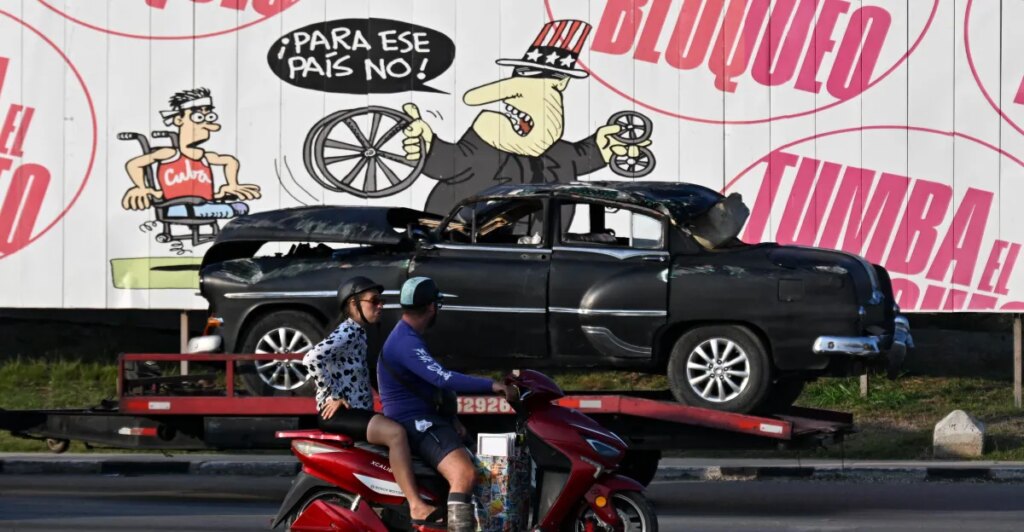
Cuba has been under a US embargo since the early 1960s, but in Trump’s second term, the pressure campaign against the island has significantly escalated. In early January, after Maduro’s ouster, the US cut off supplies of oil to Cuba from Venezuela, which had previously been its main supplier. Later that month, Trump threatened tariffs against any country supplying oil to the island, prompting countries like Mexico to halt shipments. This is the closest thing to an outright “blockade” of the island since the 1962 missile crisis — exacerbating the nation’s already dire economic situation. Food prices have been rising, trash has been piling up on the streets, and even Cuba’s once vaunted health system is on the verge of collapse, with hospitals canceling surgeries and struggling to keep ventilators running because of power cuts.
“This is a different level of desperation,” said Chris Sabatini, senior fellow for Latin America at Chatham House. But the Cuban regime has weathered economic crises before, notably the “special period” in the early 1990s after the collapse of the Soviet Union, its longtime patron. Despite Trump’s suggestions that the Cuban regime might simply collapse on its own, there’s little evidence that economic pressure alone would cause that to happen.
“What’s not different is the Cuban regime’s almost genetic need to survive and defend itself, and its resistance to anything that could potentially weaken its all-consuming power,” Sabatini added. “They’ve always been willing to just let their people suffer as long as they remain in power.”
There are in fact some signs that the Trump administration is easing up on the oil restrictions. The US allowed a Russian tanker carrying 100,000 tons of crude to reach Cuba at the end of March. Mexican President Claudia Sheinbaum has also indicated her country may restart shipments.
If Cuba’s current leaders won’t accede to Trump’s demands, no matter how much economic pressure is applied, could they be replaced by new ones? Trump may be hoping for a repeat of the Venezuela scenario in which an anti-American leader was replaced by a more pliant one, but that may not be an option in this case. Even if current President Miguel Díaz-Canel, who became communist Cuba’s first non-Castro president in 2021, could be forced into exile, it’s not clear if there’s a more cooperative alternative waiting in the wings.
“The Venezuelan government was a very different beast,” said Michael Bustamante, a professor of Cuban-American studies at the University of Miami. Whereas the Venezuelan government was splintered into fiefdoms and camps, some of which had long pushed for better relations with the US, the Cuban leadership is much more ideological and unified. “There’s no one who has a consistent track record of having stood for economic liberalization, even in a modest way.”
The State Department has reportedly been negotiating with former Cuban leader Raul Castro’s 41-year-old grandson, also named Raul. “El Cangrejo,” or “the crab,” is seen as relatively business-friendly as well as a conduit to his 94-year-old grandfather, who is officially retired but still widely seen as influential. But “Raulito” is generally seen by experts as a useful go-between rather than a potential new leader.
In any event, cutting a deal with Cuba that leaves a member of the Castro family in power would violate the spirit if not the letter of the 1996 Helms-Burton Act, which prohibits the lifting of the embargo on Cuba as long as a government that includes either Fidel or Raul is still in place.
Do Cubans want American intervention?
Even as the administration’s plans for Cuba have remained somewhat unclear, Trump’s attention to the island has raised hopes among opponents of the Castro regime. Graffitied messages reading “Viva Trump” and “Make Cuba Great Again” have been appearing more often, Boris González Arenas, a prominent journalist and human rights activist in Havana, told Vox.
González Arenas cautioned against trying to analyze Cuban politics on a traditional right-left spectrum. The support for Trump, he said, is because “people perceive that pressure from the president of the United States could change the government in Cuba, and they know that the government is the cause of their situation — of the famine, the lack of medicine. They don’t have access to elections.”
He believes the talks would produce change in the Cuban regime only if they are accompanied by the credible threat of military force. “If Castroist leaders don’t feel that their fate, properties, and even lives, are in real danger, they are going to engage in negotiations without any compromises and real transformations.”
González Arenas said he would support military intervention “only to give sovereignty back to the Cuban people” rather than simply to replace a Castroist dictatorship with a pro-American one. “Cuba is not a country incapable of self-governance; Cuba is a nation kidnapped by a criminal group,” he added.
In Marco we trust?
In some ways, Cuba seems like a strange target for Trump. Unlike Venezuela, it does not sit atop the world’s largest oil reserves. Unlike Iran, it does not have a nuclear weapons program. While it has long supported other left-wing governments and paramilitary groups in Latin America, it’s hard to argue that it poses an imminent national security threat to the US today. And democracy promotion has never been a major priority for this administration, even in the countries where it has sought to topple regimes.
Trump may be enticed by the notion of solving a problem that has bedeviled his 12 predecessors in office, but if there’s a driving force behind the current US pressure campaign, it’s Secretary of State Marco Rubio. Though Rubio has played a conspicuously low-profile role in managing the crisis in Iran, the secretary of state — whose parents were born in Cuba — has long prioritized US efforts to topple the Cuban government, was a leading critic of Obama’s efforts to normalize relations with the Castro regime, and has been the face of this administration’s more assertive posture toward Latin America.
“The only person in office today, in the whole political landscape in the United States, who would care enough to make Cuba a priority for the United States is Marco Rubio,” said Ricardo Herrero, executive director of the US-based Cuba Study Group. “This makes him both the chief threat, but also the chief opportunity that Cuba is facing.”
He’s an “opportunity” for Cuban leaders because he may be the only person in the United States capable of getting the more than 60-year-old embargo lifted. Rubio has left open the possibility of lifting the embargo in a situation where there were “new people in charge” and major economic reform. But he’s also said Cuba “doesn’t have to change all at once…everyone is mature and realistic here,” suggesting that something short of a complete toppling of the communist government would be acceptable in the near term.
Depending on what it means in practice, that would be a tough pill to swallow for opponents of the regime on the island, Cuban American exiles, and members of Congress who would have to lift the embargo. It might also be tough to square with the Helms-Burton Act, which sets the holding of free elections and the dismantlement of Cuba’s state security department as conditions for lifting the embargo.
But in a “Nixon-to-China”-like situation, Rubio’s Cuba hawk bona fides may give him unique credibility for selling a deal both on Capitol Hill and in Miami.
“It would be a hard sell, but I also think the Cuban American community doesn’t really have any other options,” said the University of Miami’s Bustamante. “‘In Marco we trust’ is sort of the vibe.”
But there won’t be any deal for Rubio to sell if the Cuban government is unwilling to make major compromises. And as the Iran crisis drags on without a resolution in sight, it’s also not clear how much Rubio’s boss will actually prioritize yet another regime change project.
The post Trump says Cuba is “next.” What does that mean? appeared first on Vox.