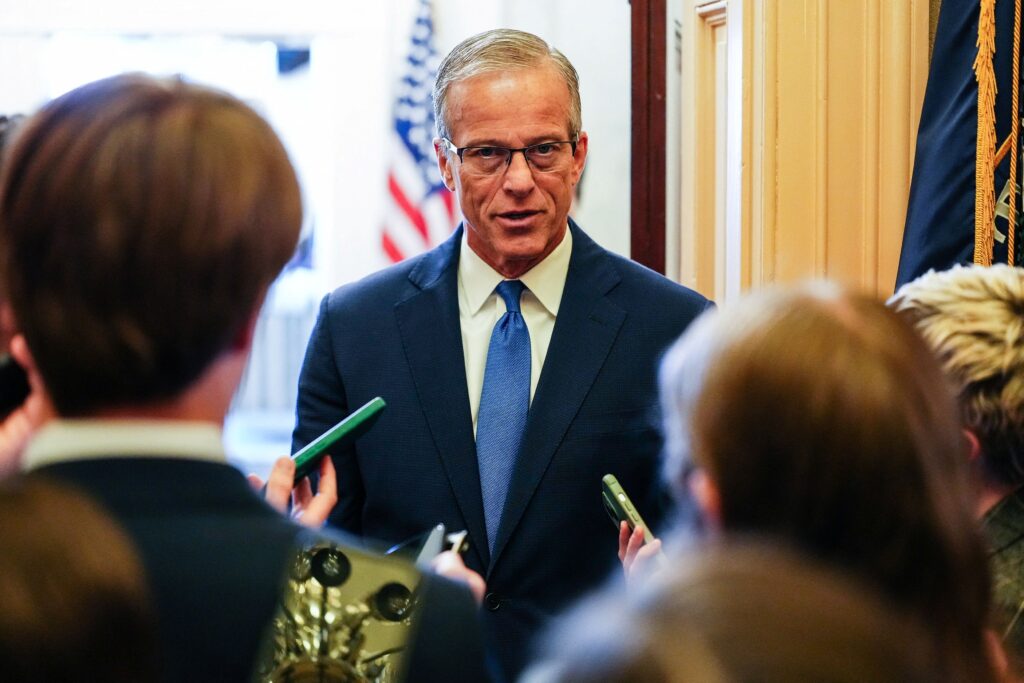
For months, Senate Majority Leader John Thune (R-South Dakota) has resisted pressure from President Donald Trump to get rid of the filibuster, the long-standing rule that requires 60 votes to advance most legislation through the chamber.
But GOP senators’ support for the rule is beginning to fracture, and even some Republicans who once supported the filibuster now want to end it.
Sen. Mike Lee (R-Utah) warned in 2021 that scrapping the filibuster “would be bad for the Senate and bad for the country.” But he endorsed the idea last month after a Republican voting bill that he has championed, the Save America Act, stalled in the Senate after narrowly passing the House. Sen. John Cornyn (R-Texas), who once defended the filibuster, now also supports getting rid of it.
The filibuster gives Democrats the power to block much of Trump’s agenda, creating a strong incentive for them to defend the rule while they’re in the minority. But many Democrats want to scrap it if they regain control of Congress and the White House.
A Senate vote last week to take a first step to circumvent the filibuster to fund two federal agencies — Immigration and Customs Enforcement and Border Patrol — without Democratic votes only added to Democrats’ frustrations with the 60-vote threshold.
“The Senate has reached the point that the 60-vote requirement has really shut down most of our legislative activity,” said Sen. Dick Durbin (D-Illinois), who is retiring next year after three decades in the chamber. “I can’t see how we can continue to respect the 60-vote requirement unless we can find better ways to work together.”
Republicans are seeking to bypass the 60-vote threshold to fund ICE and Border Patrol by using reconciliation, a special process that allows the Senate to evade the filibuster as long as legislation conforms with complicated budget rules. Sen. Chris Murphy (D-Connecticut) said the move could help lead to the filibuster’s eventual demise.
“It feels like Republicans are just putting us on a path to 50 votes,” Murphy said.
Republicans have shown no willingness to scrap the filibuster in the short term. Thune has pledged that he will preserve it as long as he is majority leader. Doing away with it would require a majority vote in the Senate — including all but a handful of Republicans, many of whom have said they want to preserve it.
Changing Senate rules without the consent of the minority party is considered so cataclysmal that it is known as the “nuclear option,” although both parties have done it. Democrats scrapped the filibuster for confirming most presidential nominees in 2013; Republicans did the same for nominees to the Supreme Court four years later, allowing Trump to put three justices on the court even though none of them won 60 votes.
The consequences of doing away with the filibuster entirely would be enormous.
If they controlled the Senate, Democrats could take up bills to ban gerrymandering of congressional districts and restore aspects of the Voting Rights Act of 1965 struck down by the Supreme Court. Democrats tried and failed to weaken the filibuster in 2022 to pass such legislation; many Democrats renewed calls to pass it this week after the Supreme Court further limited the Voting Rights Act.
Senate Minority Leader Charles E. Schumer (D-New York) suggested in 2024 that Democrats could also weaken the filibuster to restore Roe v. Wade, the landmark abortion rights ruling the Supreme Court struck down in 2022. Republicans, meanwhile, could pass their voting bill — which Trump bragged would “guarantee the midterms” for his party — if the filibuster disappeared.
Trump has argued that Democrats will get rid of the filibuster the next time they control Congress and the White House, so Republicans should beat them to the punch.
Sen. Ron Johnson (R-Wisconsin), who agrees with Trump, said some Republican senators are holding out hope that Democrats won’t dismantle the filibuster if they retake the chamber. Some Republicans who support the filibuster just don’t want to be responsible for “destroying the Senate,” he said.
“My point is, I don’t know it could be much more broken,” Johnson said.
While Thune has resisted pressure to get rid of the filibuster, he has made other moves that Democrats argue have weakened the 60-vote threshold, including last week’s maneuver to fund ICE and Border Patrol with only Republican votes.
“What’s happening right now just shows how stupid the supermajority requirement for the filibuster is,” Sen. Chris Van Hollen (D-Maryland) said.
Even some Republicans expressed qualms. Sen. Shelley Moore Capito (R-West Virginia) said she supported the move but was concerned that it would undercut the bipartisan appropriations process in the future.
“It just further feeds a dysfunctioning system and I think erodes what’s been successful [for] 250 years,” Capito said.
Democrats could use the same strategy to bypass the appropriations process to fund their priorities if they recapture the Senate majority. Sen. Brian Schatz (D-Hawaii), a member of the Senate Appropriations Committee, said he hoped it won’t come to that, but other Democrats acknowledged it could happen.
“I think there’s a good chance that Democrats would wrestle with that idea,” said Sen. Jeff Merkley (Oregon), the top Democrat on the Senate Budget Committee.
Thune has said Democrats gave Republicans no choice but to fund ICE and Border Patrol without their votes. Democrats demanded new restrictions on federal immigration agents in exchange for funding the agencies, but the two sides failed to reach a deal after weeks of negotiations.
“This is not ground I want to be on,” Thune told reporters. “We tried to avoid this. We did everything we could to avoid this.”
Schumer has blamed Republicans for walking away from negotiations. “Republicans have proven they can’t govern and won’t compromise,” he said in a statement.
Democrats argue that Thune has eroded the 60-vote threshold in other ways, too.
Republicans have used the Congressional Review Act — which lets Congress overturn some actions by federal agencies without threat of a filibuster — in more aggressive ways. The Senate voted 50-49 along party lines last month to overturn an order by President Joe Biden’s administration banning mining on federal lands in Minnesota despite Democratic complaints that the law cannot be used to override such orders.
Sen. Thom Tillis (North Carolina), one of two Republicans who voted no, said his party should expect Democrats to use the law in the same way in the future.
“Don’t be surprised if you are shocked and angry someday because you’ve made it easy to reverse something that you happen to like by enabling this mechanism,” Tillis said.
Not every Democrat is on board with torpedoing the filibuster entirely. Some want to weaken the filibuster by requiring senators to speak on the floor to block legislation, sometimes known as a “talking filibuster.” The change would make it harder — but not impossible — for the minority party to block legislation.
Senate Democrats tried to change the rules adopt a talking filibuster in 2022 to pass their voting bill but came up two votes short when then-Sens. Kyrsten Sinema (D-Arizona) and Joe Manchin III (D-West Virginia) joined with Republicans to block them.
One potential obstacle to any future effort by Democrats to move to a talking filibuster: Sen. Angus King (Maine), an independent who caucuses with Democrats. King supported Democrats’ push to change the rules in 2022, but he said recently that he had changed his mind, and praised Sinema and Manchin.
“They were right, and I was wrong,” King said in an interview in his office.
Republicans’ unsuccessful recent push to use a talking filibuster to pass their voting bill, the Save America Act, demonstrated the perils of changing the rules, King said.
The Republican bill would require Americans to prove their citizenship with a birth certificate or a passport when they register to vote, and to show photo identification when voting. Republicans say the bill would prevent undocumented immigrants from voting, while Democrats have warned it would make it harder for Americans to vote.
“If we didn’t have the 60-vote requirement, we’d have the Save Act or something worse,” King said. “We’d have a national abortion ban. We’d have a lot of things that my progressive friends who always talk about how they hate the filibuster … would certainly not like.”
“The filibuster, as frustrating as it can be in many cases, is worth preserving,” he added.
The post A key Senate rule is slowly losing its grip, and both parties know it appeared first on Washington Post.