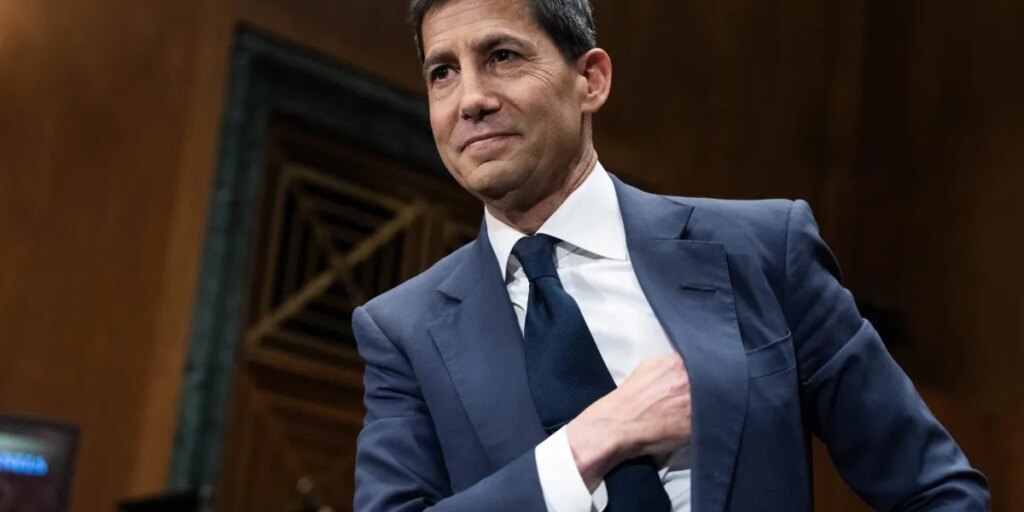
The Senate Banking Committee voted 13-11 along party lines Wednesday to advance Kevin Warsh’s nomination as the next chair of the Federal Reserve, the first fully partisan committee vote on a Fed chair in the panel’s history, according to Sen. Elizabeth Warren. Hours later, current Fed Chair Jerome Powell will deliver what is very likely to be his last interest-rate decision before his term expires May 15, holding rates steady at around 3.6%.
To Claudia Sahm, the former Federal Reserve economist known for founding the eponymous recession indicator, the vote is just the start of the idiosyncrasy. “This is not normal is going to be a theme,” Sahm told Fortune. “Frankly, it could be a theme for Warsh’s tenure as Fed chair.”
Sahm’s remarks come in a climate of widespread concern about the nature of his appointment after an unprecedented assault on central bank neutrality by President Trump. Most economists and politicians, even some Republicans, lay the blame more squarely on Trump than on Warsh himself. Sen. Thom Tillis (R-N.C.), who had blocked Warsh’s nomination over the recently withdrawn DOJ investigation into Powell, told Warsh at his hearing that he was an “outstanding nominee” — making clear the holdup was about Trump, not the candidate.
Sahm, who worked at the Fed during Warsh’s tenure as a governor from 2006 to 2011, but doesn’t know him personally, said his confirmation hearing last week broke with a tradition of deference Fed leaders have historically shown to Congress. She pointed specifically to Warsh’s exchanges with Sens. Elizabeth Warren and Raphael Warnock, in which he made jokes deflecting pointed questions about the 2020 election and President Trump’s grade for the economy.
“His jokey replies to Warren and Warnock at the hearing were a disrespect I have never seen a Fed Chair show in testimony,” Sahm said. “I’ve watched a lot of hearings and testimony that Fed chairs have given—ones where they’re getting some very tough lines of questioning. They show a lot of respect.”
Skanda Amarnath, executive director of Employ America, sees both forces at work. But he argued Warsh had ample opportunity to dispel doubts about his independence and didn’t take it. “He could have made a name for himself as someone who was going to be able to work with the whole committee,” Amarnath told Fortune, noting that Sens. Chris Van Hollen, Raphael Warnock, and Catherine Cortez Masto had all asked “pretty calm, sober” questions Warsh could have engaged with substantively, rather than “smugly.”
“Ultimately, the Fed is a creature of Congress. So it would seem like it was a good time for him to win over some new friends. He chose to not take that path.”
The takeaway, Amarnath said, is that Warsh enters the role under a partisan cloud that will shape how the Fed is perceived going forward. “And if that’s the case, it probably makes things more challenging for the Fed to be effective in a crisis, for the Fed’s legitimacy long term.”
“Regime change”
But Sahm’s concerns about Warsh extend beyond the independence question. After re-reading years of Warsh’s speeches and op-eds, Sahm said his actual monetary framework remains opaque even to specialists. “He always talks at like a 30,000-foot view,” she said. “He says stuff that sounds smart, but if you know the institution, or you know the details of monetary policy, it’s like word salad. Like he makes my head hurt.”
During his time as Fed governor, Warsh was known for delivering vivid, literary speeches—particularly during the 2008 financial crisis, when he declared early on that “the Panic began before the recession and will assuredly end before it,” a deliberate historical reframing that placed the modern crisis alongside the panics of 1837 and beyond, rather than treating it as an ordinary downturn.
But after leaving the Fed in 2011, Warsh built a second reputation as one of the institution’s loudest external critics. In a March 2016 speech to the National Association for Business Economics titled “Challenging the Groupthink of the Guild,” he argued that the Fed’s reliance on consensus forecasts and economic models had calcified into intellectual conformity. “The clustering of economic forecasts reveals conformity of views inside the Fed,” he said, noting that FOMC members’ estimates “closely match the outputs of the staff forecast.”
He also called the Fed’s “mantra of data-dependence” a cause of “erratic policy lurches in response to noisy data,” and compared the central bank’s attachment to its models to centuries of misplaced faith in Ptolemaic astronomy.
At his confirmation hearing last week, Warsh pledged a “regime change” at the Fed: ending forward guidance, retiring the dot plot, and refusing to commit to continuing Powell’s practice of holding press conferences after every meeting.
It is precisely the gap between the diagnosis, which he has spent a decade refining, and the vagueness of his actual prescriptions that troubles Sahm. If Warsh doesn’t want to use data, what does he want to use? The deeper problem, she argued, is bad-faith framing of an institution Warsh helped run.”It’s almost like—I saw you. I know you were in the building. I know that you know better than what you’re saying,” she said.
She is also skeptical of Warsh’s signature policy idea—that the Fed should cut rates preemptively in anticipation of AI-driven disinflation. “I think it’s completely off the table,” Sahm said.
With inflation at 3.3%—its highest in two years amid an energy shock from the Iran war—and ongoing tariff pass-through still not quite working through goods prices, an early cut would require seven FOMC votes Warsh does not have. He is replacing Stephen Miran, the committee’s most vocal dovish voice, meaning the rate-cut coalition shrinks rather than grows. “He doesn’t have the chops to make that argument persuasively on day one, and nobody would, because the data aren’t there yet,” Sahm said.
The pressure on Warsh, she warned, will not subside once he takes the chair. Trump has continued to call for interest rates as low as 1%, while a DOJ criminal investigation of Powell—recently dropped to clear Warsh’s path—set a new precedent for executive-branch confrontation with the central bank.
“This pressure campaign from the White House on the Fed—I cannot believe it ends with Warsh becoming Fed chair,” Sahm said. “Trump wants to see interest rates lower.”
Asked how Warsh will communicate to a public still reeling from five years of above-target inflation, Sahm offered two paths. He could follow Powell’s data-driven approach. Or, she said, “he could step up to the mic and tell us about how we’ve entered a golden age.”
The post Former Fed economist raises alarm on Warsh after historically partisan vote: ‘this is not normal is going to be a theme’ appeared first on Fortune.