With the Supreme Court’s decision striking down Louisiana’s congressional map on Wednesday, a new era of gerrymandering may be about to begin.
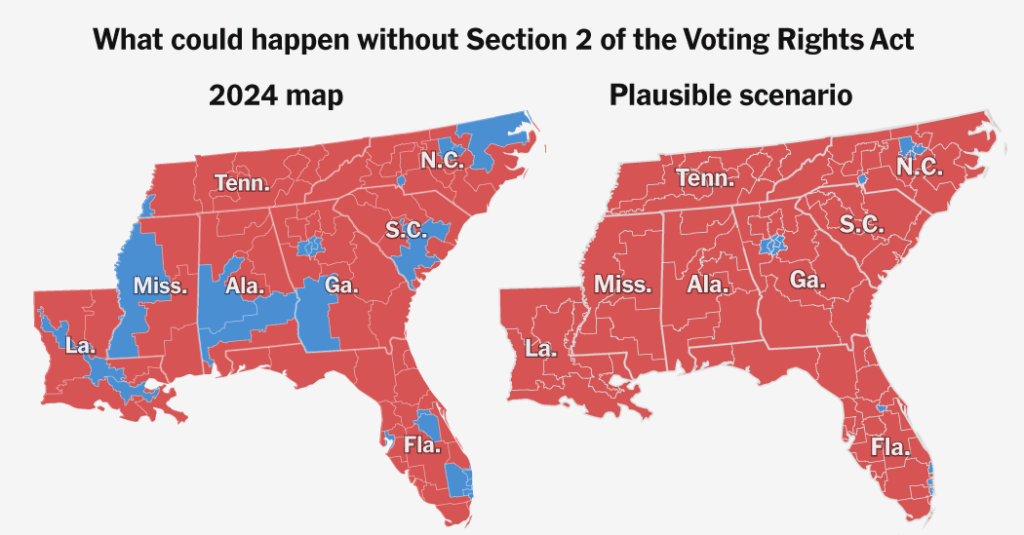
Across much of the country, Section 2 of the Voting Rights Act was the only legal limitation on partisan gerrymandering. As previously interpreted, it prevented states from dismantling House districts where a specific minority group was a majority of the voting population, limiting how far each party could go toward redrawing maps in its favor.
That limitation is gone. The court held that Section 2 “does not intrude on states’ prerogative to draw districts based on nonracial factors, including to achieve partisan advantage.” Put simply: Republicans and Democrats are now allowed to eliminate majority-minority districts if it helps their party, and so they will.
Between now and the next presidential election, more states will enact more gerrymanders — and those gerrymanders could go much further than ever before.
Adding to the redraws they’ve already made since 2024, Republican-led states could eliminate most Democratic districts across the South. Here is one way they could do it:
Democrats have promised to retaliate, and they have every incentive to do so. If they do not, Republicans will obtain a meaningful structural advantage in the House of Representatives, which could allow the party to win the chamber in 2028 or 2030 even while losing the combined national House popular vote by a wide margin. And if Democrats redraw maps in blue states, Republicans could attempt to regain an advantage by going further in their own states, setting off a tit-for-tat cycle of retaliation.
With the incentives pointing toward escalation, it’s easy to imagine extreme gerrymanders that would have seemed laughable a year ago. By the end of the decade, nearly every solidly red or blue state could adopt a vigorous gerrymander, leaving only a handful of competitive districts in a handful of competitive states across the country.
What it means for November …
The big question for 2026 is whether it’s too late for Southern states to redraw their maps to be more favorable to Republicans ahead of the midterms. Filing deadlines have passed, and primaries have been held in many states; in other states, early voting is underway. States could try to redraw maps after the voting, but these are significant obstacles.
Only a few Southern states — including Louisiana, South Carolina and Tennessee — have a clear path to redistrict before primary voting and without materially endangering Republican incumbents. Those states could yield up to four Republican seats in this year’s midterms.
These potential seats come on top of gains Republicans have already made in the South, including a new map passed by Florida’s Legislature this week. While Republicans could have targeted many of these seats even before the court’s ruling, these new maps were often drawn with a weakened Voting Rights Act in mind.
Together, these additional seats should give the Republicans a modest structural advantage in the contest for control of the House. In a different year, this advantage could be pivotal. But so far, the 2026 midterm election is not shaping up to be close enough for a handful of districts to prove decisive.
In an environment where President Trump is at sub-40-percent job approval, Democrats would be expected to win by more than a mere handful of seats. As I wrote last week, Democrats have enough wind at their backs that they even have a shot at winning the Senate, despite having to win some solidly red states to prevail. To win the House, Democrats won’t have to flip such Republican-leaning areas.
… and beyond
The stakes will be very different when 2027 rolls around and the incentives point toward escalation. With a close election much likelier in 2028, neither side will be able to presume it will win by a wide enough margin to overcome a modest structural disadvantage. Democrats will have every incentive to retaliate if the remaining Southern states redistrict as expected.
In some states, Democratic retaliation may look much like recent redistricting efforts in California and Virginia. New York and Colorado, for instance, could mostly cancel out Republican gains by following that gerrymandering formula. But if Republicans attempt to reclaim their advantage with gerrymanders in Texas or elsewhere beyond the Deep South, tit-for-tat retaliation in the absence of any legal limitation could soon lead both parties to consider more extreme gerrymanders than ever before.
On Wednesday, one Democratic House member posited a 52-0 Democratic map in California and a 17-0 map in Illinois. In theory, these extreme gerrymanders would give Democrats a path to canceling out Republican efforts, even beyond the South. They could even allow Democrats to win the redistricting wars, as they control — or could control — more Republican-held districts in solid blue states where they could plausibly draw unanimous congressional delegations.
There are important reasons Democrats would not want to draw unanimously Democratic maps in states like California or Illinois. To do so, they would have to draw multiple pinwheel-like districts that stretch from Democratic cities out into the countryside. Southern California, for example, might need to look like this:
These districts would offend many moderate voters and deprive congressional incumbents of their traditional bases of support. It would also require the party to split up majority-minority districts, which would provoke significant opposition from Black voters and lawmakers under any circumstances, but especially in the wake of the Supreme Court decision, which will substantially reduce Black representation in Washington.
Democrats also face an important legal obstacle: Many blue states have state constitutional limitations on gerrymandering. To redraw their maps, they’ll need to amend those constitutions or win the approval of voters, following the path of Virginia and California this cycle. It may not be so easy. Colorado, for instance, requires 55 percent voter support for amending the state constitution, not the 50 percent necessary in Virginia.
Nearly every large state has at least some opportunity to redraw its maps, and there are simply too many legal, political and electoral question marks to game out exactly what might happen by 2028 or beyond.
It’s possible that when all is said and done, each side’s gerrymanders will roughly cancel out, as they do today. If so, there might be a narrow opportunity for both parties to agree to limit or end gerrymandering before the 2032 election. Absent some kind of compromise, we might end up with only a handful of competitive districts, mostly concentrated in purple states with nonpartisan redistricting processes and where neither party has the numbers necessary to amend state constitutions, like Arizona, Michigan and Pennsylvania.
While all these gerrymanders may ultimately cancel out, they also might not. And with so few competitive seats, one side might not need to “win” the redistricting wars by much to build a formidable advantage in the House.
Graphics by Francesca Paris, Jonah Smith and Eve Washington.
Nate Cohn is The Times’s chief political analyst. He covers elections, public opinion, demographics and polling.
The post What Peak Gerrymandering Could Look Like Now appeared first on New York Times.