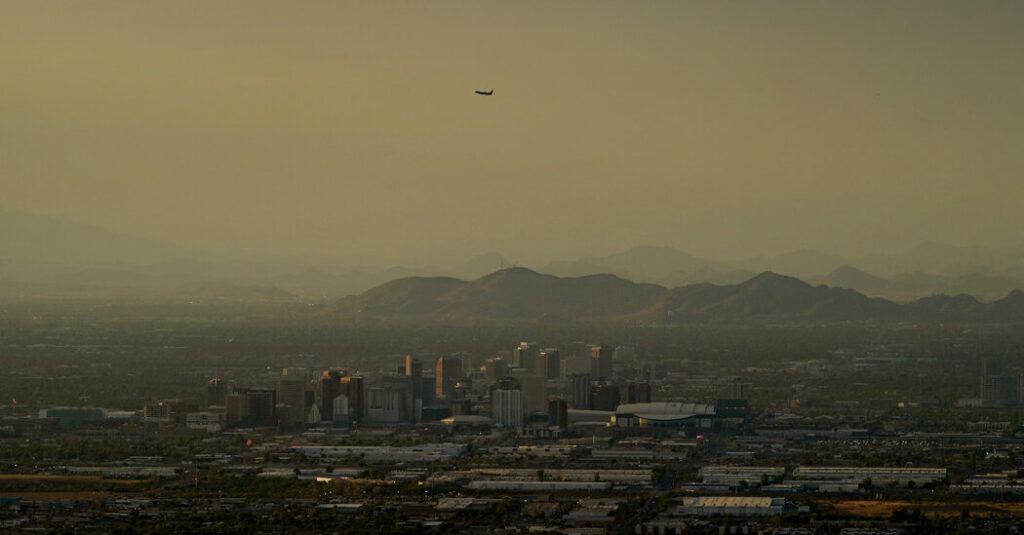
For decades, Phoenix has struggled with smog that gets trapped in its bowl-like topography and is detrimental to human health. In 2024, when the city failed to meet a federal air pollution standard, it risked being hit with stricter rules designed to force more aggressive pollution limits.
Then, President Trump returned to the White House. And now the Phoenix-Mesa region has gotten off the hook for an unusual reason: The Trump administration is blaming foreign countries for the pollution.
Without contaminants blowing in from Mexico and Asia, the reasoning goes, Phoenix would have been in compliance with federal pollution limits.
Other regions are now taking up that strategy. Last week, the Environmental Protection Agency accepted similar reasoning to propose that the area around Salt Lake City in Utah get a reprieve from stricter emissions rules governing vehicles, factories and power plants.
These places should not be penalized “due to foreign sources of emissions,” Lee Zeldin, the E.P.A. administrator, said on X. “Federal ozone air quality standards would have been met had it not been for emissions transported into the region from outside the U.S.”
Senator John Curtis, Republican of Utah, hailed the move. “For too long, Utah has faced the prospect of being penalized for air pollution we did not create and cannot control.
”The Utah Petroleum Association also lauded the E.P.A.’s moves. The oil and gas industry has been on the forefront of the move to shift the blame for smog away from local polluters and onto foreign countries.
Some environmental groups and experts say that argument is preposterous.
The Clean Air Act does allow regions to take account of cross-border emissions to avoid penalties for failing to meet federal air quality standards. But it was not meant for pollution from thousands of miles away, they say.
Moreover, accounting for emissions from elsewhere does not excuse local authorities from tackling local sources of pollution, said Abi Vijayan, a former E.P.A. lawyer who is now with the Natural Resources Defense Council, an environmental group.
“You can’t point to some pollution blowing in from thousands of miles away, when there’s a lot more to do to cut local pollution,” Ms. Vijayan said. “This is going to mean more heart attacks, more lung disease, more asthma for the residents of Phoenix.”
The idea that pollution crosses international boundaries isn’t scientifically controversial. Ozone, the main ingredient in smog, is produced when nitrogen oxide combines with volatile organic compounds and is heated by sunlight. It can indeed travel thousands of miles, for example, carried by westerly winds across the Pacific Ocean, or across the border from Mexico.
Phoenix and Utah officials say that explains why, over the last two decades, ozone levels have risen despite local efforts to reduce the pollutants that form the thick haze. Both Phoenix and Salt Lake City have long received “F” grades from the American Lung Association for high levels of ozone.
“We’d done a great job in reducing those local emissions, almost cut them in half, but ozone concentrations were starting to increase again,” said Matthew Poppen, director of environmental planning at the Maricopa Association of Governments, which put together the analysis for the Phoenix metropolitan area. “That got us asking, ‘Hey, what’s going on?’”
Local officials commissioned an analysis that found that pollution from overseas, carried in particular by atmospheric currents in the case of Asia and by summer winds from Mexico, contributed an average of about 15 parts per billion of ozone. That bumped up the area’s average above the 70 parts per billion federal limit. Wildfires, as well as pollution from other states, also had an effect, they said.
Trump Administration: Live Updates
Updated
- Trump may pull troops from Germany. That isn’t as scary as it once was.
- Trump and Putin talk, and Ukraine shrugs.
- House adopts budget to unlock $70 billion for immigration enforcement.
The Northern Wasatch Front region in Utah, which includes Salt Lake City, reached a similar conclusion.
“It’s allowed us to understand what we can control locally, what can be done to improve things, but also that we shouldn’t over‑regulate,” said Bryce Bird, air quality chief at the Utah Department of Environmental Quality.
“Other areas in the West are seeing the same thing that we are: added local reductions aren’t resulting in a reduction in ozone,” Mr. Bird said. “There’s something else that’s driving that.”
Some experts doubted the significance of the findings.
“We’ve always known some pollution comes from abroad,” said Daniel Cohan, an expert in atmospheric modeling at Rice University. Still, “the levels that they’re claiming are contributed internationally are not particularly high,” he said.
“There’s nothing really unusual in seeing that level of ozone getting attributed to emissions from other countries,” he said. “These standards are based on air quality levels needed to protect human health. If everyone can point to international sources as a reason why their air doesn’t need to be clean enough, then we’ve undermined the entire meaning of the standards.”
Normally, a failure to meet federal ozone standards would trigger a downgrade in what’s known as the area’s nonattainment status, bringing a wave of tougher environmental regulations, including stricter federal permitting rules and a mandate to conduct more aggressive vehicle emissions testing.
Local industry groups have rallied in support of the effort by Arizona and Utah, highlighting the region’s data center construction boom.
“Arizona is now a global hub for advanced manufacturing and is a highly desirable location for artificial intelligence and computing related industries,” Danny Seiden, president of the Arizona Chamber of Commerce and Industry, said in comments submitted to the E.P.A. in December.
Tougher pollution controls were “not just a regulatory burden for local industries, but also an economic and strategic threat,” he said.
The stakes were high for health too, said Dr. Brian Moench, president of Utah Physicians for a Healthy Environment, a nonprofit organization.
Ozone is a colorless, odorless gas that can harm the lungs, especially in children and older people, and can trigger a host of respiratory and cardiovascular diseases. “Ozone is so potent, it doesn’t take much at all to have a profound impact on people’s health,” Dr. Moench said.
He pointed to a large study that found that being exposed to an increase of just 3 parts per billion of ozone for a duration of 10 years caused a loss of lung function and lung tissue equivalent to what would typically occur from smoking a pack of cigarettes a day for 29 years.
“It doesn’t matter if the ozone came from China,” Dr. Moench said. “If you’re breathing it, it’s doing the same harm as if it came from Salt Lake City.”
Over the past two decades, several other regions had made similar arguments against stricter regulations, including Imperial County, Calif., and El Paso, Texas.
But previous administrations had largely been skeptical. The Biden administration set a high bar for considering such arguments, including proof that the area was already doing everything it reasonably could to reduce pollution domestically. The arguments also tended to come from regions closer to the border.
In March, Senator Mark Kelly, Democrat of Arizona, hosted Mr. Zeldin at an air quality round table of local officials and industry representatives. “A key topic of discussion was the need to modernize E.P.A. guidance and cut red tape for local governments and businesses,” Mr. Kelly later said in a news release.
The following month, during a trip to Utah, Mr. Zeldin announced that he would repeal the Biden administration’s strict guidance, saying he was removing “cumbersome red tape.”
Some researchers pointed out the irony of the United States, currently the second-biggest polluter on the planet, pointing its finger at other countries.
In fact, dirty air from the United States can and does travel abroad, just as the United States receives pollution from across the globe, said Yuhang Wang, a professor in atmospheric science at Georgia Tech.
“What’s blowing in,” he said, is also blowing out.”
Hiroko Tabuchi covers pollution and the environment for The Times. She has been a journalist for more than 20 years in Tokyo and New York.
The post Smog in Phoenix and Salt Lake City? The E.P.A. Is Blaming Asia. appeared first on New York Times.