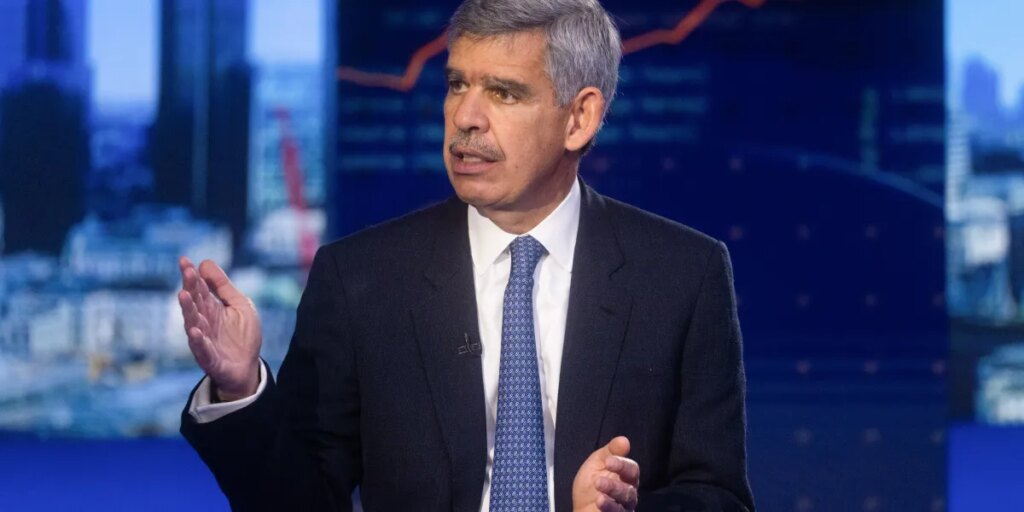
The countdown is on: The global economy has four weeks, eight at most, if it is to avoid plunging into a recession. That’s the warning from Mohamed El-Erian, the former CEO of PIMCO, who served as chair of President Obama’s Global Development Council. This week, El-Erian said the globe will “avoid a recession, provided—and here’s the important thing—provided the Straits are reopened in the next four to eight weeks. If they’re not reopened in the next four to eight weeks, it will look very different.” El-Erian’s focus on the Strait is the same as the rest of the world’s: Wondering when the global oil supply will return to normal, easing prices as a result. But El-Erian is one of the few who has stepped further, by placing a timeframe on when the discomfort may dip into a full economic contraction.
On the question of when the Strait might reopen, there’s little evidence of a swift resolution. It’s worth remembering that when the conflict between Iran, the U.S. and Israel broke out, Wall Street was widely of the opinion that it would be resolved in a matter of weeks. Instead, the standoff has rumbled into a third month, with Iran (which borders the Strait of Hormuz) threatening ships which pass through the waterway, suffocating oil supply out of the vital Middle East region.
“Investors are pricing in a more protracted conflict,” observed Deutsche Bank’s Jim Reid this morning, referencing that longer-dated futures have moved up to their highest levels of the conflict so far.
Consumers are feeling the sharp end of the conflict, El-Erian said, particularly in Europe and Asia. As well as strategic stockpiling of oil reserves, consumers are also beginning to panic buy—in Japan, for example, shoppers have returned to the Covid-era habit of toilet paper hoarding.
“If the war goes on, [the UK] will become and Europe will become as vulnerable as Asia is right now,” El-Erian said to LBC. “If you go to Asia right now, they’re not just worried about the price of fertilizers, the price of energy. They’re worried about physical availability. They’re worried about running out. There was a warning last week that Europe only has six weeks of aviation fuel left in terms of storage decisions.
“The irony in all this is that the U.S., which started the war, does better in relative terms than anybody else because of its energy supplies. It’s totally energy independent, and it has a very agile economy.”
The U.S. isn’t invincible
Whether a recession in Europe and Asia would be enough to tip the U.S. into a similar contraction is a hypothetical question, but economists on home turf are already concerned about the fundamentals for American growth.
Even though the U.S. is relatively shielded from oil inflation (it became a net energy exporter in 2019), last year it still imported 17% of its domestic energy supply, per the U.S. Energy Information Administration. That comes on top of an already diverging picture on the domestic consumer: The emergence of a “K” shaped economy where the gap between those on the higher and lower end of the income spectrum is growing.
Moody’s chief economist, Mark Zandi, has been warning about the effects of such a split. In a note this week, he wrote that U.S. growth is “fragile,” explaining: “Growth, yes, but less than the economy’s potential growth rate, and not sufficient to support any meaningful job growth. Unemployment is still low, but it is steadily drifting higher, and the labor force participation rate is falling. Of course, this is not sustainable.”
The outlook at the start of the year had looked rosier, he added, courtesy of stimulus from the One Big Beautiful Bill Act (OBBBA), and bets on Fed rate cuts to stimulate economic activity. The latter is looking all the more unlikely.
Stimulus from the OBBBA is also likely to be cancelled out because of the Middle East conflict. Research from Goldman Sachs and Morgan Stanley both found that the Iran war’s knock-on effect on oil prices has almost entirely canceled out the biggest consumer tax windfall in years, and for lower-income Americans, the ledger may be in the red.
“Even if the Iran War winds down and oil prices recede quickly, the fallout will ensure there is no GDP pickup or job growth this year. Unemployment will rise further, and already considerable recession risks will worsen,” Zandi added.
The post The global economy has a month—eight weeks at most—to avoid a recession, warns top economist appeared first on Fortune.