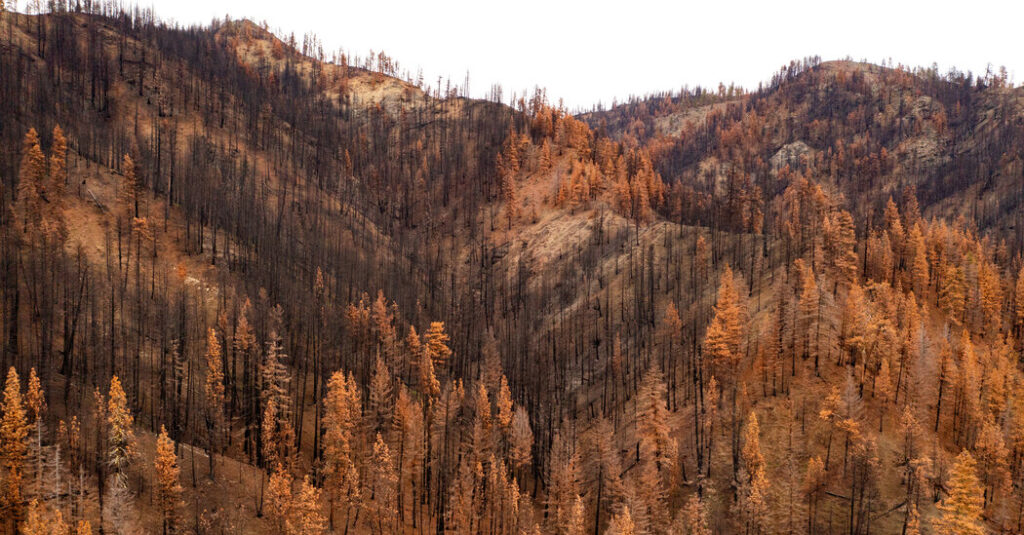
Inside a low-slung building on the outskirts of this town in north-central Washington State, federal scientists are examining how tree seedlings are responding to a drier, hotter climate, collecting important data as officials brace for what is expected to be an intense wildfire season.
But this federal research station and 56 others in 31 states are slated to close in the next few months, part of a shake-up of the U.S. Forest Service by the Trump administration.
“The future is uncertain, and that uncertainty is deeply shaking,” said Paul Hessburg, an affiliate professor of forestry at the University of Washington who spent 42 years at the Wenatchee lab until his retirement in 2024.
At the same time the administration is reorganizing the Forest Service, President Trump is proposing to eliminate its entire $309 million research and development budget and to cut all of the agency’s 1,215 scientific positions. The White House budget plan would reduce the overall number of Forest Service employees to 12,000 from 30,000.
In an interview, the Forest Service chief, Tom Schultz, said that despite the closure of the research facilities and the president’s plan to eliminate funding for research, science would be preserved. He said universities, state governments and private groups would fill the gaps left by the service.
The reorganization would reduce maintenance costs and streamline operations and is separate from the White House budget cuts, according to Mr. Schultz. “They’re two different things,” he said.
“There’s a strong commitment to research and to science in the reorganization,” he said. “We’ve tried to design a structure that is within our means, that retains researchers and research over buildings and facility managers that we can no longer afford.”
Mr. Schultz, a former timber industry executive, is scheduled to appear on Capitol Hill on Thursday to defend both the reorganization and the White House budget proposal before a Senate committee.
Critics say the plans would decimate science-based decision-making at a time when the West is suffering from the tinderbox conditions because of record-low snowpack and drought.
“President Trump’s efforts to shutter these labs will leave the state of Washington less equipped to handle future wildfires and the dangers they pose our communities,” Senator Maria Cantwell, Democrat of Washington, said. Thirty-five other Democratic senators wrote to the Forest Service this month to protest the reorganization and closures.
A group of more than 70 outdoor recreation companies, including Patagonia and REI, are calling for a stop to the remaking of the Forest Service.
Mr. Schultz said he expected 300 of the service’s 30,000 employees to voluntarily leave the agency as a result of the closures, which would merge research and development functions from nine regional offices to a single location in Fort Collins, Colo. The sites of the shuttered research laboratories would be sold. The service is also moving its headquarters to Salt Lake City from Washington, D.C., along with 260 of the 350 jobs in the national capital area.
“This is not a serious effort at reorganization, it’s an attack on America’s public lands,” said Senator Patty Murray, Democrat of Washington. “The thousands of Forest Service employees whose offices are being abruptly shut down, those in Washington State, are not going to be able to uproot their entire lives on a whim.”
On April 3, Agriculture Secretary Brooke Rollins issued a “national forest emergency” order that removes environmental protections and expedites logging in 113 million acres of forests that were deemed at risk of insect infestation, disease or wildfire. In January, Ms. Rollins, whose department oversees the Forest Service, relaxed rules for oil and gas drilling and mining on Forest Service lands.
At an April 16 hearing on Capitol Hill, Representative Chellie Pingree, a Maine Democrat, told Mr. Schultz that the 2026 budget prohibits forestry officials relocating offices or employees without congressional approval.
Trump Administration: Live Updates
Updated
- House adopts budget to unlock $70 billion for immigration enforcement.
- Trump administration announces moves to sharply curtail gun rules.
- Trump threatens to pull troops from Germany as he lashes out at Merz.
In the coming months, the Wenatchee lab’s six scientists, two support staff members and about 20 seasonal employees will pack up and move scientific equipment, tree samples, decades of archives of wood and water samples, and high-speed computers to a location that has yet to be announced. A lab in Seattle, which studies the wetter forests of Western Washington State, is also scheduled to close. That leaves a single research facility in Olympia, Wash., about three hours drive from Wenatchee.
Nationwide, the Forest Service lost 16 percent of its staff during the first half of 2025 after layoffs instituted by the so-called Department of Government Efficiency, combined with an early retirement program. In Washington State alone, 520 people, or 18 percent of its staff, left during the first six months of 2025, according to a December 2025 report by the Agriculture Department inspector general.
Dr. Hessburg said the scientific work done at the Wenatchee lab helps managers make better decisions about when and where to thin trees to prevent wildfire, set prescribed burns to improve forest health, and select the best places to harvest timber without polluting streams critical to spawning fish and downstream drinking water supplies.
The closure of the Wenatchee lab will make it harder to understand ecological shifts underway in a region the size of Connecticut on the eastern slope of the Cascade Mountains.
“The bottom line is, that reduces the care of peoples’ lands,” Dr. Hessburg said about the looming closure. “You have to spend a lot of time in the woods to know the forest conditions, landscapes and how they change with wildfire and climatic changes.”
The Forest Service was created in 1905 and, eight years later, officials added a research division to help manage forests based on science. They built labs to study the variety of trees, soils and wildlife from Florida to Alaska. Today, the agency manages 193 million acres of forests and grasslands, including 39 percent of all land in Idaho, 29 percent of Washington, and 25 percent of Oregon.
Unlike academic studies that are short-lived because of grant funding cycles, Forest Service studies often last decades as researchers collect data on changes in the snowpack on mountaintops or how water quality in streams changes after logging or wildfires.
“Smokey the bear is under attack,” said Anthea Lavallee, executive director of the Hubbard Brook Research Foundation, a nonprofit group that supports science projects at the Forest Service’s Hubbard Brook Experimental Forest in New Hampshire.
The Hubbard forest was established in 1955 and is best known as the facility where federal researchers first documented the effects of acid rain in 1963. Since then, scientists have been monitoring the 7,750-acre forest for signs of the changing climate and how it affects Northeastern forests, streams, and wildlife.
The fate of the Hubbard site is unclear, Ms. Lavallee said. “This just is not the time to pull the plug on science in New Hampshire or across the country,” she said.
The proposed cuts to forestry research follow cuts to scientific research at the National Oceanic and Atmospheric Administration, the National Aeronautics and Space Administration, the National Institutes of Health, and the National Science Foundation.
Susan Prichard, a research scientist at the University of Washington, has been collaborating with scientists at the Wenatchee lab since 2006 to find the best ways to reduce the risk of large intense wildfires. Dr. Prichard collaborated with Dr. Hessburg to produce an important study that showed how landscapes become healthier if they are allowed to burn more than once.
Dr. Hessburg and his team used old aerial photos and imaging equipment at the Wenatchee lab to reconstruct patterns of vegetation from the early 20th century in an area that burned in 2006 during the Tripod fire, which was the largest in Washington at the time.
The scientists developed a model that simulated how the same area would have evolved if the Forest Service had allowed more than 300 fires to burn between 1940 and 2006 instead of putting them out. The model found that allowing multiple fires on the same landscape would have created a more stable ecosystem that would support wildlife like the Canada lynx.
Since that research was published in 2023, policymakers in the Pacific Northwest and Canada have used the model to decide whether it is better to put out new fires right away, or in some cases, let smaller ones burn over time in hopes they will result in healthier forests in the future.
Closing the Wenatchee lab could lead to shortsighted decisions as the planet continues to warm, Dr. Pritchard said.
“Our forests are changing at an unprecedented rate,” she said. “The only thing we have is smart science that guides adaptive management.”
It’s not only academics who are worried about the cuts to forestry science. Tyler Broecker, a fire scientist at Vibrant Planet, a Montana-based wildfire analytics and technology company, uses data collected by and fire simulation models developed by Forest Service scientists to create software programs that help insurance companies, local governments and utilities prepare for wildfire outbreaks.
In addition to the laboratories in Washington State, the reorganization calls for the closure of five locations in Mississippi that study pests that attack southern pine forests; five research facilities in California that were developing disease-resistant seeds for ponderosa pine and Douglas fir, and all four stations in Michigan, including those studying the destructive emerald ash borer and the effects of wildfire smoke.
The post As Wildfire Risks Rise, Forest Service Shutters Labs That Study Them appeared first on New York Times.