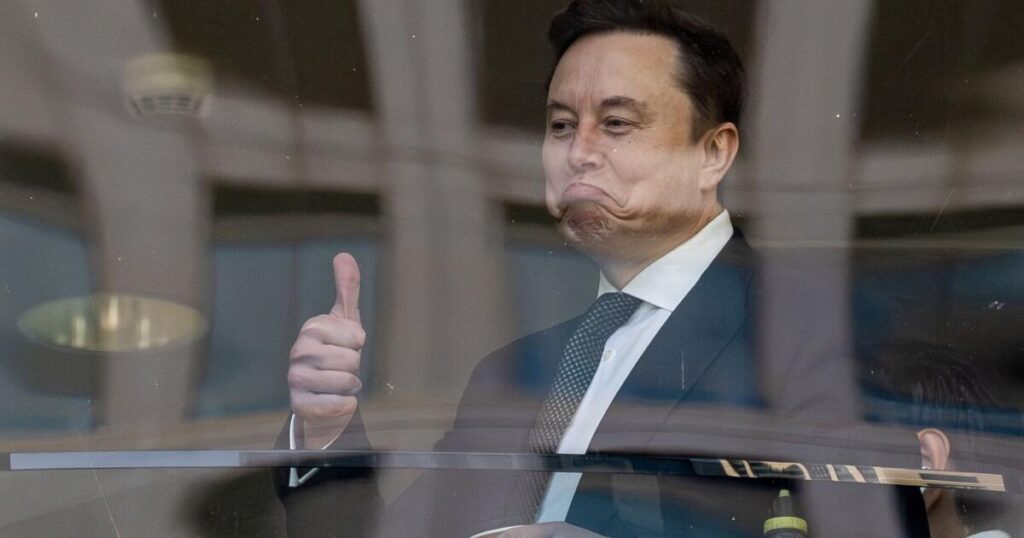
Elon Musk became visibly irritated on the witness stand Wednesday as an attorney for OpenAI questioned whether the billionaire backed off his financial commitment to the startup in its early years.
In his second day testifying at a closely watched trial over his claims that OpenAI betrayed its altruistic mission in pursuit of profit, the world’s richest person was put on the defensive about how much he supported the startup since its founding.
He had several heated exchanges with William Savitt, who represents OpenAI, about the clarity of the lawyer’s questions, calling them “unfair” and “misleading” at various points.
Savitt repeatedly posed what he described as “simple” yes or no questions to Musk, to which Musk would reply that they could not be answered so easily.
‘Trick Me’
“Your questions are not simple,” Musk said at one point. “They are designed to trick me, essentially.”
In the lawsuit he filed in 2024, Musk alleged that Sam Altman, OpenAI’s chief executive officer, and Greg Brockman, its president, have enriched themselves by converting the company to a for-profit business with billions of dollars in support from Microsoft Corp.
OpenAI and Altman have accused Musk of harassment and say the real goal of the lawsuit is to undercut competition with his own startup that he co-founded in 2023, xAI.
Savitt pressed Musk on how much money he had actually contributed to OpenAI in its early years. Musk had been making quarterly donations and paid the rent on an office building for OpenAI, before he said he “lost confidence” in its leadership.
During that time, Musk and OpenAI made different representations about the scope of his financial support for the nonprofit that he co-founded with Altman, Brockman and Ilya Sutskever.
When announcing its launch in 2015, the nonprofit said Musk committed to eventually donating as much as $1 billion to its mission to develop artificial intelligence for the “benefit of humanity.” In a post on X in 2023, Musk wrote that he had donated $100 million.
‘Did You?’
“At the end of it, you didn’t contribute a billion dollars to OpenAI, did you?” Savitt asked Musk.
Musk replied that he had been growing concerned with the direction of OpenAI around 2017, and started losing trust in the team. Savitt interjected.
“My question to you was simple,” he said, repeating it.
Musk sidestepped again, and said he contributed his reputation, his ideas and other assets that had non-monetary value: “Without me, it would not exist.”
U.S. District Judge Yvonne Gonzalez Rogers intervened and told Musk to answer Savitt’s question, which Musk asked to be repeated.
“My question was: You didn’t contribute anywhere near $1 billion to OpenAI, yes or no?” Savitt said.
$38 Million
“In strict monetary terms, I contributed $38 million,” Musk said.
The two have been courtroom rivals before. Savitt, one of the country’s leading corporate litigators, represented Twitter Inc. in its lawsuit to force Musk to follow through on his bid to buy the social media company for $44 billion when he tried to back of the deal in 2022. Musk ultimately conceded before that case reached a trial.
The stakes in the Oakland trial are high — maybe even existential — for OpenAI because of what Musk is seeking: As much as $134 billion in damages and removal of Altman and Brockman from their leadership roles, as well as the unwinding of OpenAI’s for-profit conversion that was completed in October.
Much of Musk’s testimony so far has been about his falling out with OpenAI’s leaders as they explored strategies to line up sufficient funding to compete with Alphabet Inc.’s Google and other pioneers in the AI space that were operating as for-profits.
In 2017, he and the other OpenAI co-founders were considering creating a for-profit subsidiary to support research. They contemplated giving Musk a majority interest in the subsidiary, and virtually unequivocal control over its operations.
He would have had the power to appoint four seats to a 12-member board, while Altman, Brockman and Sutskever would have each received one seat. Musk told jurors the intention was for his majority interest to quickly dilute over time, as more investors were recruited.
‘Final Straw’
But Musk said the “final straw” in his rift with the co-founders came when they seemed to turn on him and voice concerns about the proposal, which never came to fruition.
“They had gone back on what they had agreed on previously,” Musk said. “I felt this was somewhat disingenuous and what they really wanted to do was create a for-profit where they had as much shareholder ownership as possible.”
Savitt showed jurors a 2017 email exchange between Musk, Sutskever, Brockman and a few others at OpenAI about these discussions. In the email, Musk expressed a need to “change course” to keep up with business demands.
In that same message thread, Musk offered to give free Teslas to Sutskever and others at OpenAI.
‘Full Price’
“To be fair, I paid full price for the Teslas,” the longtime chief executive officer of the electric car maker said to laughter in the courtroom. “I don’t get a discount or anything.”
Five years after he left OpenAI’s board in 2018, Musk founded xAI as a for-profit company. It was recently acquired by SpaceX as Musk’s rocket maker moves toward an initial public offering.
OpenAI is also poised for an IPO as its valuation approaches $1 trillion.
Musk told jurors that OpenAI was established as a nonprofit because he was concerned about the safety of AI and ensuring that the future of the technology would not be controlled solely by companies like Google.
‘Some Safety Risk’
Savitt asked Musk on Wednesday whether he considered it to be a safety risk for an AI company to operate as a for-profit. Musk said he believes it “creates some safety risk.”
“So xAI suffers from that safety risk?” Savitt asked.
“Yes,” Musk replied.
Musk repeated throughout his testimony that he was not against the idea of a for-profit AI company, but stated his objection to turning a nonprofit into a for-profit enterprise.
“That’s having your cake and eating it too,” he said.
Savitt posed a number of questions about Musk’s competing loyalties as both an OpenAI board member and his roles at Tesla and Neuralink, both of which are heavily invested in AI.
The lawyer suggested during questioning that despite Musk’s fiduciary duties to OpenAI, in 2017 he was actually attempting to hire top researchers away from the nonprofit to his other companies.
Recruited Scientist
Savitt pointed out that Musk helped recruit OpenAI scientist Andrej Karpathy to Tesla, and showed the jury an email Musk sent to a Neuralink executive saying he had “no problem if you pitch people at OpenAI to work at Neuralink.”
“I believe it’s a free world,” Musk said in response. “People should have the right to work where they want to work.”
Mekelburg and Poritz write for Bloomberg.
The post Visibly irritated on stand, Musk defends his financial commitment to OpenAI appeared first on Los Angeles Times.